
The Future of Affiliate Marketing in 2026: Powerful New Trends
Affiliate marketing used to be the quiet cousin of digital marketing. Not anymore. Businesses now earn $6.50 on average for every $1 they invest in affiliate programs, a return that outperforms most channels in performance marketing (FirstPromoter, 2026). But the real story with the future of affiliate marketing isn’t the ROI number. It’s how affiliates find audiences now, how platforms track conversions differently, and how much AI has quietly worked its way into the funnel.
I teach this as part of agency-based digital marketing training, and here’s something I’ve noticed firsthand: students who lean on AI tools to speed up their content still get noticeably better engagement the moment they add their own product testing on top — a screenshot, a real result, an honest “this part didn’t work as well as I expected.” That’s not a stat from a report. It’s just what shows up, again and again, in live student projects, and it’s probably the clearest early signal of where the future of affiliate marketing is actually headed. Here’s what’s genuinely changing, and what it means if you’re building an affiliate strategy in India or anywhere else in 2026.
What is Affiliate Marketing today?
At its core, nothing complicated: a business pays a commission to an affiliate — a blogger, an influencer, a content creator — once that traffic turns into a sale through a tracking link. Sometimes called performance marketing or commission marketing, it’s stayed cheap compared to most channels for a simple reason: you only pay when it works. Worth noting, because the future of affiliate marketing doesn’t replace this model, it just changes how the traffic gets earned, tracked, and attributed.
Why The Future of Affiliate Marketing is changing
Three things are pulling the industry in a new direction at once: cookies are dying out, AI is taking over chunks of the content and targeting workflow, and platforms would rather build checkout into their own apps than send anyone away. US affiliate spend is expected to cross $12 billion in 2026, heading toward $16 billion by 2028 (brandID, 2026), happening at the exact moment the tracking infrastructure underneath the affiliate network ecosystem gets rebuilt — precisely why the future of affiliate marketing matters now, not “eventually.” Brands moving early on these affiliate marketing trends are already pulling ahead on conversion tracking accuracy.
AI and Automation in Affiliate Marketing

AI is, hands down, the biggest force behind the future of affiliate marketing right now. Roughly 79% of affiliates already use AI tools to churn out content and personalise recommendations faster than they could manually(Post Affiliate Pro). Where’s this showing up? Content and localisation are adapted per region faster than any human team could turn around; fraud detection catches bot traffic and cookie stuffing before it eats into payouts; and conversion tracking, where AI-assisted models are helping affiliate networks piece together the customer journey now that third-party cookies are unreliable.
My honest take: the affiliates who win from here use AI for speed but still bring something it can’t fake — real hands-on experience. That’s the whole idea behind EEAT (Experience, Expertise, Authoritativeness, Trustworthiness), and it matters more, not less, as AI content tools improve. AI-assisted wins. AI-only doesn’t.
AI tools for affiliate marketers worth knowing
A few categories worth knowing:
1. AI writing assistants
(ChatGPT, Claude, Jasper) for drafts and localisation
2. SEO research tools
(Semrush, Ahrefs, SurferSEO) with built-in AI content scoring
3. Analytics platforms
Modelling cross-device attribution now that cookies are fading. Getting comfortable with these is a practical way to prepare for the future of affiliate marketing.
The Rise of Influencer-Affiliate Hybrid Models
Influencer marketing and affiliate marketing used to be two separate things. Not so much anymore, and this blending might be the clearest signal of where the future of affiliate marketing is going. Brands are increasingly turning influencer deals into commission-based affiliate arrangements instead of flat sponsorship fees, because the math works better that way. A lot of that shift comes down to micro-influencers — 10K to 100K followers.
Their engagement rate sits around 3.86%, compared to roughly 1.21% for macro accounts (DigitalApplied, 2026), and 73% of brands now say they favour micro and mid-tier creators over celebrity partnerships because of this (AutoFaceless, 2026). Smaller audiences tend to trust the person more, so influencer affiliate programs are getting spread across many more creators instead of a handful of celebrities — part of the broader creator economy shift toward performance-based deals. For a deeper comparison, see our related post on influencer marketing vs affiliate marketing.
Platform-Native Shopping and Social Commerce
Social commerce is shrinking the gap between “I saw this” and “I bought this,” reshaping the future of affiliate marketing at the platform level. Forget the old bio-link workaround; Instagram, YouTube, and TikTok now build checkout straight into the app, changing where the click and the commission actually land. For affiliates in India, the go-to entry points are still Amazon Associates India, Flipkart Affiliate, and aggregators like EarnKaro or Cuelinks. Regional-language content is also quietly reshaping affiliate marketing in India, reaching people English-only blogs never really got to. One more thing worth flagging: 62% of affiliate traffic is mobile now (FirstPromoter, 2026). If your strategy isn’t mobile-first, it’s already behind.
Best affiliate networks to know if you're based in India
Most Indian affiliates start with a mix: Amazon Associates India (broad catalogue, low barrier), Flipkart Affiliate (electronics and fashion), and aggregators like EarnKaro and Cuelinks, which bundle merchant programs into one dashboard. That diversification is part of preparing for the future of affiliate marketing rather than betting on one platform’s rules.
Types of Affiliate Marketing in 2026
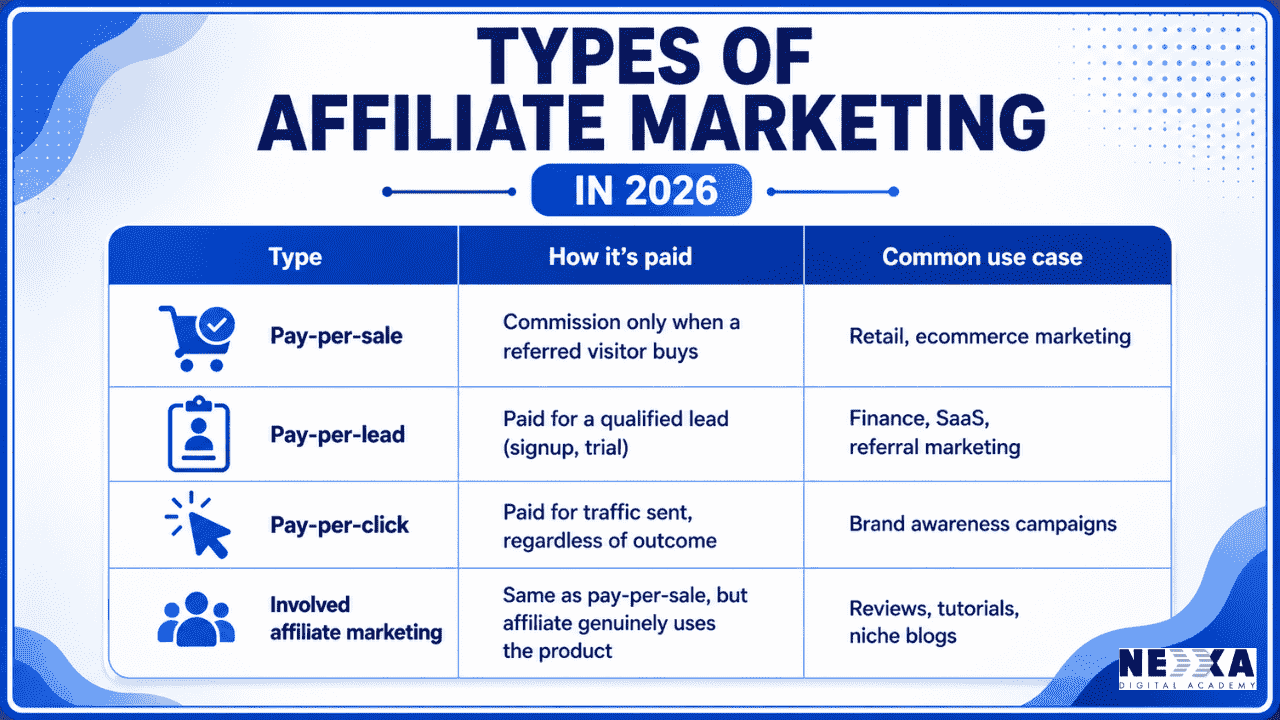
The basic types of affiliate marketing haven’t changed much — they’ve just gotten more sophisticated in how they’re tracked and paid.
- Pay-per-sale: still the most common. You earn only when the referred visitor actually buys.
- Pay-per-lead: being paid for a qualified lead — a signup, a trial start — is common in finance and SaaS.
- Pay-per-click: less common these days, but still around, paying for traffic sent regardless of what happens after.
- Involved affiliate marketing: the affiliate genuinely uses the product and writes from real experience, which both readers and algorithms increasingly favor over “unattached” content from someone who’s never touched the thing they’re promoting.
Most affiliate marketing strategies that actually hold up combine two or three of these rather than betting everything on one. And knowing these types of affiliate marketing cold is really the starting point for figuring out where the future of affiliate marketing goes next.
The Privacy and Compliance Shift
Cookies are on their way out, so affiliate tracking is moving toward hybrid setups — server-side tracking plus first-party data. Better attribution, but it means some rebuilding on the tech side too. Compliance is becoming a bigger piece of the future of the affiliate marketing conversation. The EU’s Digital Services Act now requires advertising-transparency disclosures and bans manipulative “dark pattern” tactics for affiliate content on major platforms.
In the US, the FTC’s endorsement guidelines extend disclosure rules to live streams and short-form video, and California has tightened privacy protections under the CCPA/CPRA, enforced by the California Privacy Protection Agency. None of this makes affiliate marketing harder. If anything, affiliates who disclose clearly and track transparently come out ahead as enforcement ramps up.
What This Means For Affiliate marketers in India
India’s affiliate scene is riding the same global wave, with a local push behind it: UPI payments have made it far easier for smaller creators to get paid, opening affiliate and referral marketing up to people who’d have had no way to monetise five years ago. The skills that matter most here are SEO fundamentals, AI-assisted content workflows, and real working knowledge of tools like Amazon Associates and Flipkart Affiliate. As affiliate marketing in India matures, marketers pairing solid technical SEO with genuine niche knowledge will keep beating out generic, templated content true to the future of affiliate marketing everywhere, not just here.
Common Affiliate Marketing Mistakes To Avoid in 2026
A few patterns that keep showing up as the future of affiliate marketing takes shape:
- Relying on a single traffic source. Collapses the moment an algorithm shifts.
- Promoting products you’ve never used. The fastest way to lose trust and get penalised is for generic reviews.
- Skipping disclosure. Beyond legal risk, upfront disclosure builds trust rather than eroding it.
- Ignoring mobile. With 62% of traffic mobile, a desktop-first site loses conversions daily.
- Chasing commission rate over relevance. A high-commission product nobody wants converts worse than one your audience trusts.
Emerging Verticals to Watch
A few niches outside the usual retail crowd are worth keeping half an eye on if you’re thinking about affiliate marketing trends and the future of affiliate marketing heading into 2027. Sustainability and ESG-focused brands are one. They’re actively looking for affiliates who can actually speak to that audience with some credibility, not just anyone chasing a commission check. B2B SaaS is another, and honestly a bigger one — software companies are quietly pulling budget out of paid ads and putting it into affiliate deals instead, because for an expensive, considered purchase, a recommendation from someone the buyer trusts just converts better than an ad ever will.
Health and wellness is growing too, though it stays tightly regulated for good reason, and it rewards affiliates who combine genuine product use with proper disclosure rather than skating by on either alone. Fintech and personal finance round it out — a natural fit for pay-per-lead types of affiliate marketing, since so much of that space runs on signups rather than one-time sales. Neither of the first two has retail’s scale yet, and maybe they never will. But that’s the point.
Getting into a niche before it’s crowded tends to matter more than chasing whatever’s already saturated. It’s the same passive income pull that’s brought so many creators toward the future of affiliate marketing in the first place — just aimed at corners of the future of affiliate marketing nobody’s picked over yet.
Where Affiliate Marketing Might be by 2030
Worth saying clearly: this is a reasonable extrapolation, not a verified forecast.
- AI shopping agents are doing more browsing — attribution may shift from “which post drove the click” to “which content trained the AI’s recommendation.”
- Regulation stabilising — DSA, FTC, and CCPA/CPRA rules likely settle into a baseline, the way GDPR did for cookies.
- Voice and conversational commerce are maturing — conversational, question-answering content will have an edge.
- Creator economy consolidation — fewer, larger creator-affiliate networks as the aggregator model spreads globally.
How to Prepare For The Future of Affiliate Marketing
A few things the affiliate marketing strategies actually holding up through 2026 have in common:
- Diversify beyond flat commissions. Revenue-sharing and lifetime-value-based payouts are quietly becoming the norm.
- Build mobile first. Not optional — 62% of traffic is already there.
- Use AI without losing the human part. Let it handle scale; keep your own testing and firsthand experience in the content.
- Get disclosure right. A clear, upfront disclosure is a trust signal that helps conversion, not just a legal box to tick.
- Watch emerging verticals. Sustainability, ESG, and B2B SaaS affiliate networks are worth exploring before they saturate.
Treat this as a working checklist, not a trend list, and you’ll be in decent shape as the future of affiliate marketing keeps unfolding through 2026 and beyond.
Conclusion
How does this affect you? Affiliate marketing itself hasn’t changed at its heart — you’re still getting paid to point people toward something worth buying. What’s different is everything wrapped around that. AI doing the heavy lifting on content. Platforms tracking clicks in new ways. Readers and regulators caring a lot more about whether you’ve actually used the thing you’re recommending.
I’ll be honest, none of this is complicated once you see it. Use AI to move faster, not to skip trying the product yourself. That’s the whole game. Do that consistently and you’ll be fine no matter which direction the future of affiliate marketing bends next. Everything else — the tools, the platforms, the algorithms — is just noise around that one habit.
FAQ
1. Is affiliate marketing still profitable in 2026?
Yes. Businesses pull in $6.50 for every $1 spent, beating most other channels in digital marketing. If you’re on the fence about the future of affiliate marketing as a career, that ROI should settle it.
2. What skills do I need for affiliate marketing?
SEO, content creation, basic analytics, plus growing comfort with AI-assisted tools. Platform knowledge matters too — knowing how Amazon Associates or Flipkart Affiliate works day-to-day counts as much as general marketing skills.
3. Is affiliate marketing part of a digital marketing course?
Most of the time, yes — usually a core module in an agency-based digital marketing course, alongside SEO, social media, and paid ads.
4. Will AI replace affiliate marketers?
I don’t think so. AI can churn through the grunt work, but it can’t fake having actually used a product — that’s what builds trust. The affiliates doing well are using AI for speed while leaning into the human parts it can’t touch
5. How do I get started with affiliate marketing in 2026?
Start with a niche you genuinely know, join a fitting program (Amazon Associates, Flipkart Affiliate, or EarnKaro if you’re in India), and write from real experience instead of copying competitors. It’s slow at first — most people quit before it pays off, which is exactly why the ones who stick around are still building toward the future of affiliate marketing a year later.