
Impact of Social Media on Students in India 2026: Positive and Negative Effects Explained
In any classroom in Kerala today, you’ll be surprised by something new. Nearly every child over 13 has an iPhone, a social media account, and an opinion on both. The impact of social media on students is now one of the most debated subjects among teachers, parents, and policymakers from across India.
Platforms such as Instagram, YouTube, and WhatsApp are no longer just optional additional features. They’re integrated into how youths learn to connect and perceive themselves. This article examines the positive and negative effects of social media on students, with an emphasis on India in general and Kerala in particular. Instead of defining social media as “good” or “bad,” we’ll explore the real advantages of social media for students, the actual dangers, and what families can do to mitigate the risks.
The Growing Influence of Social Media on Students in India
India is now home to one of the largest numbers of Internet users under the age of 18 worldwide. A large portion of this growth comes from small towns and semi-urban districts and includes many areas of Kerala.
Affordable data plans with low-cost smartphones accelerated an already-in-progress trend. Students spend a lot of time every day on social media and often before they reach college age of college.
The impact of social media on students is evident daily. Group projects are coordinated through WhatsApp. Tips for exam preparation and scholarships are found on Instagram as well as YouTube. However, the same platforms affect the way that students view themselves in comparison to other students. Knowing that this dual impact is the beginning of any discussion about the effects of social media on students.
What the Data Shows
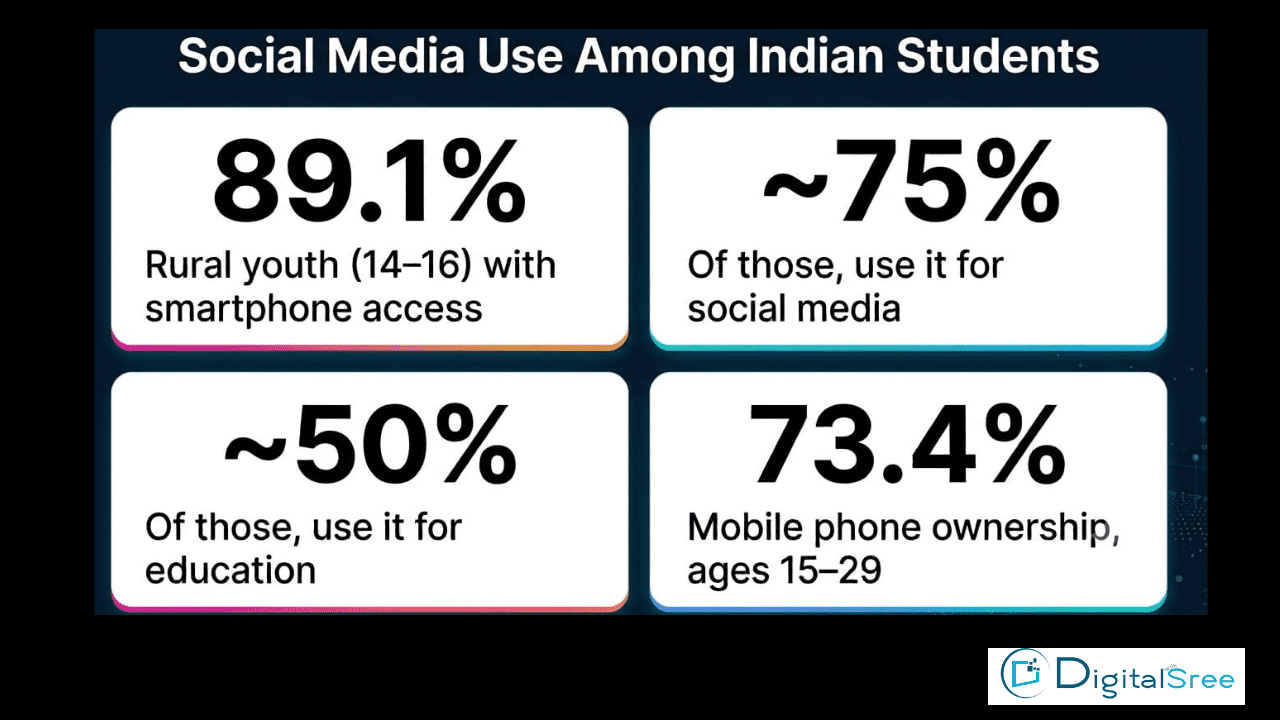
The data confirms the perception that many Kerala teachers are already feeling in their classrooms. In India’s Economic Survey 2025-26, citing ASER 2024 data, that 89.1 per cent of rural youngsters aged 14-16 have mobile access at home. Only about half of them make use of it for educational purposes. Around 75% of users use it for social networking.
A separate government survey for 2025 (NSS Comprehensive Modular Survey Telecom) discovered that 73.4 per cent of the population aged between 15 and 29 across India have a mobile phone, which is a majority of this age bracket. These figures point to a clear access-versus-purpose gap. Indian students have never had greater device access, yet a large portion of it is devoted to social media, not learning. A pattern that shapes the positive and negative effects of social media on students is explored throughout this article.
Sources: Economic Survey 2025-26 via BusinessToday; NSS Comprehensive Modular Survey: Telecom, 2025 — PIB, Government of India)
Positive vs Negative Effects of Social Media on Students: Quick Comparison
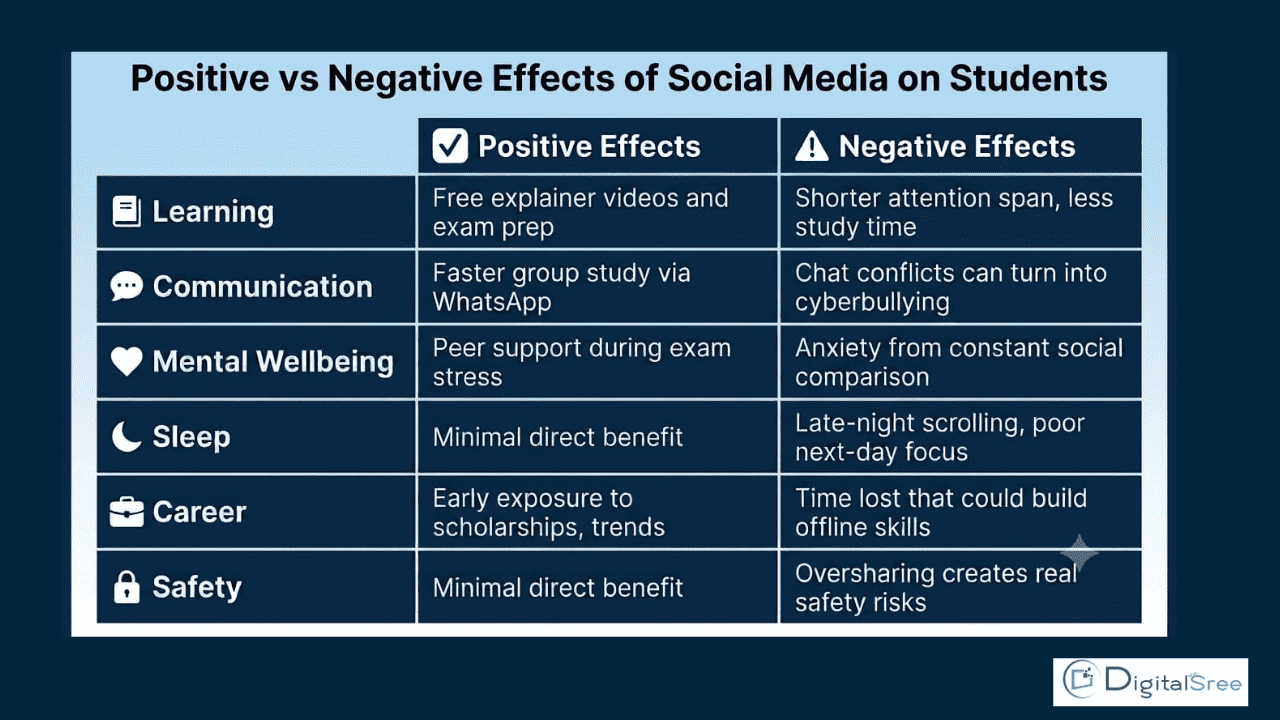
Two rows are designated “minimal direct benefit” rather than being forced into a false equilibrium. Privacy and sleep genuinely are skewed towards risk in the study, and claiming otherwise could undermine any credibility that is built on the remainder tables.
At a glance, it is clear that the pattern is similar; the benefits centre around learning, communication, and the possibility of a better life, while the risks are centered around health, sleep, safety, and well-being. The same pattern of division is seen in the more detailed sections below.
Benefits of Social Media for Students
It’s easy to concentrate only on the potential risks. But recognising the genuine benefits of social media for students can inspire educators and policymakers to support its positive use. This is particularly the case in the Indian education environment, where access to high-quality coaching isn’t evenly distributed, underscoring the need to promote equitable opportunities for all students.
1. Access to Free Learning Resources
The YouTube channel and Instagram pages run by teachers now offer an alternative to expensive tuition fees for students studying in Tier-2 and Tier-3 Kerala towns. Students preparing for board exams can access explanation videos and problem-solving sessions for free, opening new avenues for learning.
2. Better Communication and Collaboration
3. Exposure to Career and Higher-Education Opportunities
Many students first find out about scholarships and niche careers via LinkedIn as well as Instagram. Most of the time, this happens before they are informed by their school’s career counselling department, which, in some Kerala schools, is not yet formal.
4. Development of Digital and Creative Skills
Editing reels or managing a student club’s Instagram page is a way to teach practical digital literacy. It includes the creation of content as well as communication skills that are increasingly crucial in employment.
5. A Platform for Voice and Awareness
Student-led initiatives, from campaigning for the environment to health initiatives within Kerala universities, have received an enormous amount of support through social media. Ten years ago, it would have been much harder offline.
The benefits of social media for students highlight the need for responsible management; providing examples of best practices can help educators and policymakers develop effective strategies.
Negative Effects of Social Media on Students
The well-documented negative impact of social media on students underscores the need for awareness and action, as these issues are often grouped around a few common concerns.
1. Distraction and Falling Study Time
Students who plan to spend an hour studying often end up scrolling for 3 hours. Highlighting how notifications are designed to keep attention can help educators and parents feel empowered to support better focus and sleep habits.
2. Sleep Disruption
Scrolling late at night delays the time to bed. Students who are on their phones just before bed get less sleep, and this shows the following day with poor concentration.
3. Mental Health and Social Comparison
The constant exposure to curated, filtered versions of other people’s lives can cause depression and anxiety. Addressing this can help policymakers and educators feel responsible and motivated to implement supportive measures for teens struggling with identity and peer pressure.
4. Cyberbullying and Online Conflict
Discussion forums and group chats could quickly turn into a hostile environment. Cyberbullying is becoming a major issue for Kerala schools, and many schools are still implementing formal rules.
5. Academic Performance Decline
The use of alcohol during the day is linked to lower grades and unfinished assignments. This can also be seen in shorter attention spans in classes.
6. Exposure to Misinformation
Students often encounter untrue ‘facts’ and circulating exam rumours through WhatsApp forwards. Recognising how quickly misinformation spreads can motivate educators and policymakers to develop strategies to combat online harm and misinformation.
7. Privacy and Safety Risks
A lot of students share personal information but don’t fully understand who has access to it. This presents real risks to safety, which schools in general haven’t yet dealt with
Signs a Student May Be Struggling With Social Media Use
Not every student experiences the impact of social media on students the same way. There are a few warning signs to look out for.
- A noticeable rise in screen time and a fall in grades
- Anxiety or irritability when their access to the phone is restricted
- Tiredness at school after staying up late scrolling
- Rejecting offline friends
- Negative comparisons with peers or influential people
All of them together do not confirm a problem. A direct and non-judgmental discussion is worth having if you have several of these.
The Role of Parents and Teachers in Guiding Healthy Use
For Parents:
An open conversation is better than a ban, which can often drive usage underground. It is helpful to agree on screen-free hours for study.
For schools and teachers:
Kerala schools are increasingly introducing digital literacy classes that cover misinformation and privacy settings. It is better to treat this subject as part of life skills rather than just a single talk.
Practical Tips for Students to Balance Social Media and Studies
It is often a matter of establishing a few habits that help balance the positive and negative impacts of social media on students, such as recognizing which accounts or activities support your learning and well-being.
- Use a timer to set fixed “no phone” study blocks of 45 to 60 minutes.
- Disable non-essential notifications in exam season.
- Track screen time using apps to get a daily breakdown.
- Follow a few genuinely useful educational accounts.
- Phones should be kept out of the bedroom 30 minutes before sleep. Instead of randomly checking social media apps, schedule specific “social media” time.
The Future of Social Media in Student Life
The impact of social media on students in India is likely to increase as smartphones and internet access continue to reach smaller cities as well as rural Kerala. As the number of devices available to users grows more quickly than literacy in digital technology, both the positive and negative effects of social media on students are bound to be more evident on both sides.
This means greater potential for academic and professional growth for those who can make use of these platforms effectively while posing greater risks to those who do not. The goal that teachers, parents, and students have isn’t to eliminate social media from students’ lives — that’s a ship already in the water. It’s about establishing self-regulation and digital literacy skills that enable students to make use of these platforms without being influenced by them.
Schools that can get ahead of the curve by providing clear guidance rather than restrictive bans that are not a response are likely to have improved academic and well-being outcomes in the coming years. Kerala is a state with a historically solid public education infrastructure and a high literacy rate. It is well placed to be a leader in this area as long as digital literacy is taken equally to any other subject in the curriculum and not as an occasional awareness event snuck into the time before examinations.
Conclusion
The impact of social media on students is not solely positive or completely negative. It’s a mix of both that relies in large part on how platforms are utilized, as well as the amount of guidance students receive, and how aware parents and teachers are of both aspects.Knowing the positive and negative effects of social media on students, rather than focusing on headlines by themselves, can be the initial step in helping the future generations of Kerala, as well as Indian students, establish a better relationship with these platforms, which are not going to disappear.
FAQ
1. What is the overall impact of social media on students?
The impact of social media on students is mixed, with significant academic and professional benefits along with risks, such as distractions or sleep disturbance, as well as stress on the mind. The outcome is largely dependent on the habits of users and their guidance.
2. What are the main benefits of social media for students?
Access to free learning resources, improved communication, and collaboration. It also provides exposure to professional prospects, along with the opportunity to develop digital and creative abilities.
3. What are the negative effects of social media on students?
Distraction from studying, disruption to sleep, anxiety due to social competition, cyberbullying, misinformation, and privacy threats.
4. Will the influence of social media on students increase in the future?
Yes, as smartphones and access to data increase in small towns and rural areas, the main goal is to enhance digital literacy, instead of expecting use to fall.
5. What role can schools play in reducing the negative impact of social media on students?
Schools could introduce planned digital literacy workshops that address privacy, misinformation, and good usage habits instead of one-off discussions.