
Advantages of Social Media Marketing: Honest, Data-Backed Guide
Every business owner asks the same thing eventually: are the advantages of social media marketing real, or just something agencies say to justify a retainer?. I have run campaigns for small businesses and startups for over 10 years, and here is my honest answer — the advantages are real, but not for the reasons people assume.
More than 5.79 billion people are on social media today, close to 70% of everyone on earth, per DataReportal’s Global Overview Report. Too many to ignore if you want new customers, and the curve isn’t flattening anytime soon.Whether you are a small business owner or a marketer managing client accounts, understanding the real benefits of social media marketing — and building a social media marketing strategy around them — is where growth starts.
The advantages of social media marketing at a glance
1. Reach without a big budget — Organic shares and algorithm pickup extend a single post well past your own followers
2. Precise audience targeting — Platforms filter by interest, location, age, and behavior
3. Short-form video ROI — The highest-returning content format = at 41%
4. Influencer partnerships — 94% of organizations say they outperform traditional digital ads
5. Real-time engagement — Turns complaints into loyalty in the moment, not after a slow email chain
6. Social commerce — A growing share of purchases now start and finish on-platform
7. A level playing field — Small brands compete with big-budget rivals on visibility, not spend
Each one gets its own deeper look below. The benefits of social media marketing tend to compound once you stack a few of these together, which is really the whole point.
What is social media marketing?
Social media marketing means using platforms like Instagram, Facebook, LinkedIn, YouTube, and TikTok to promote a business, connect with real people, and get measurable results. It combines content creation, audience targeting, paid ads, and community management into one plan.
A newspaper ad doesn’t talk back. A billboard can’t answer a question. Social media does both — customers comment, ask things, and tell you exactly what they think, sometimes within minutes of a post going live. That back-and-forth is part of why the importance of social media marketing keeps rising every year.
The real benefits of social media marketing
A lot of this I learned the hard way. Running campaigns that flopped before I figured out what actually worked, not the other way around. I still remember the first client campaign, for a small Kochi-based business, where I over-invested in a polished video ad and got outperformed by a competitor’s shaky iPhone clip. The client was a bit annoyed about the wasted budget, understandably. That’s roughly when I stopped trusting production value over relevance.
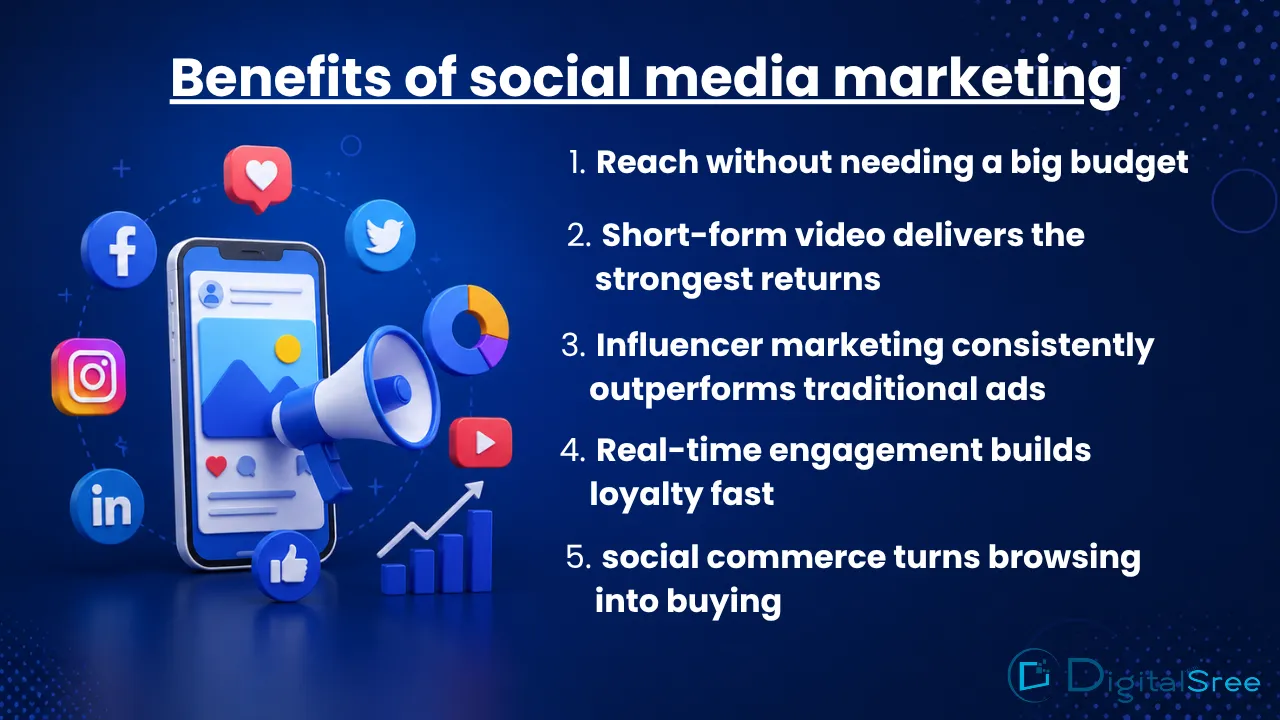
1. Reach without needing a big budget
Reach is the obvious one, a single good post can travel well past your own followers through shares and algorithm pickup, something no traditional ad matches at the same price. Audience targeting adds the precision layer on top: platforms already know interests, location, age, and behavior, so your message lands with people who are actually likely to buy.
2. Short-form video delivers the strongest returns
Short-form video deserves its own mention. It currently delivers the highest return of any content format — 41%, according to Sprout Social’s 2026 data. And I’ve watched a rough 20-second product demo beat a polished, expensive ad, both on reach and on cost, more times than the agency world likes to admit.
3. Influencer marketing consistently outperforms traditional ads
Influencer partnerships surprised me early on. Sprout Social reports 94% of organizations say influencer marketing beats traditional digital advertising, sometimes by 2 to 3 times the return. For freelancers and small agencies, that’s a genuinely useful tool, not just a trend.
4. Real-time engagement builds loyalty fast
Real-time customer engagement moves the needle most. Answering a question or fixing a complaint in the moment beats resolving it through a slow email chain three days later. I’ve watched this habit turn a furious customer into someone who defends the brand unprompted.
5. social commerce turns browsing into buying
Social commerce is worth its own line — platforms now account for a growing share of all online sales, and about 81% of shoppers say social media has pushed them into a purchase they didn’t plan on making. If you sell physical products online, this is probably the clearest advantage on this list.Genuinely, ask any small brand owner who’s watched a reel outsell their entire weekend sale.
The importance of social media marketing right now
The importance of social media marketing today comes down to this: where people look for things has changed. TikTok, Instagram, and YouTube now drive over 60% of product discovery, while Google’s share has dropped to roughly 34.5% (Sprout Social, 2026). People aren’t scrolling absentmindedly anymore — they’re researching, comparing, and deciding, often without opening a search engine at all.
- Small brands can now compete with big budgets
That shift matters most for smaller businesses. A local brand with a smart social presence can go head-to-head with much bigger, better-funded competitors now, because visibility isn’t purely a function of budget anymore. I’ve watched small clients grow just as fast as brands with ten times their marketing spend — one home bakery in Kochi outgrew a much larger competitor’s Instagram following within about eight months, mostly on the back of consistent reels and zero paid spend. No fancy strategy deck involved. Just showing up daily.
- Trust and E-E-A-T are becoming the real currency
There’s a quieter piece to this too, and it’s trust. Google and social platforms increasingly reward what’s called E-E-A-T — Experience, Expertise, Authoritativeness, Trustworthiness. Over 80% of consumers say they want brands to be upfront about how their data is collected and used, and most people can spot bought followers from a mile away. Honestly, most people could always spot it, the platforms just started rewarding that instinct instead of ignoring it. The brands I’ve seen win long-term show their actual process: real case studies, named clients where possible, numbers that hold up under scrutiny. This is where the importance of social media marketing shows up most clearly — trust compounds slower than reach, but it lasts longer.
How social media marketing actually works, day to day
The loop is simple on paper: make content, put it where your audience already is, watch how they respond, adjust. Instagram Insights, Meta Business Suite, LinkedIn Analytics — every major platform hands you data on what’s resonating and what’s falling flat. I check this weekly. Sometimes daily, if a campaign’s live. It’s a small habit, but it catches problems before quarter-end rather than after. Caught an underperforming ad set on a Tuesday once that would otherwise have burned through half the month’s budget by Friday — small win, but it paid for my coffee habit that month. Unrelated, but I really should cut back on that.
Organic and paid social aren’t really separate tracks, even though teams often treat them that way. Organic builds the relationship over time. Paid then scales whatever’s already proven to work — real behavior, not a hunch about what might. Most of the clients who skip this order end up paying twice: once for the ads, and again when they finally hire someone to fix the targeting.
Building a social media marketing strategy that survives past month one
A social media marketing strategy that holds up in 2026 isn’t about being everywhere. It’s about being in the right two or three places with the right message. That’s basically the whole recommendation I give nearly every new client, solo entrepreneur or established brand. But it’s also the difference between a strategy that fizzles out by March and one that keeps compounding for years.
- Choose platforms deliberately, not everywhere at once
Pick one or two platforms where your audience is already spending time; don’t spread yourself across five networks just because you technically can. Set goals you can actually measure — clicks, leads, DMs — not vague ones like “more engagement.” This is the first real test of your social media marketing strategy: can you stay consistent with less, before you try to do more?
- Build consistency before you add paid spend
Keep a simple content calendar so you’re not scrambling every Sunday night for something to post. Engage before you sell — reply like a person, not a brand account, before pushing product. Check your analytics monthly and let that data guide next month’s content. Bring in paid ads gradually, once you already know what’s working organically — skipping that step almost always costs more than it saves. It’s a small rule, but it separates a real social media marketing strategy from a posting schedule dressed up as one.
Done this way, a strategy tends to outlast whatever trend is currently flooding everyone’s feed, because it’s built around your actual audience’s behavior instead of someone else’s playbook. That, more than anything else on this page, is what this whole approach actually comes down to — not the stats, the behavior underneath them.
A few campaigns worth studying
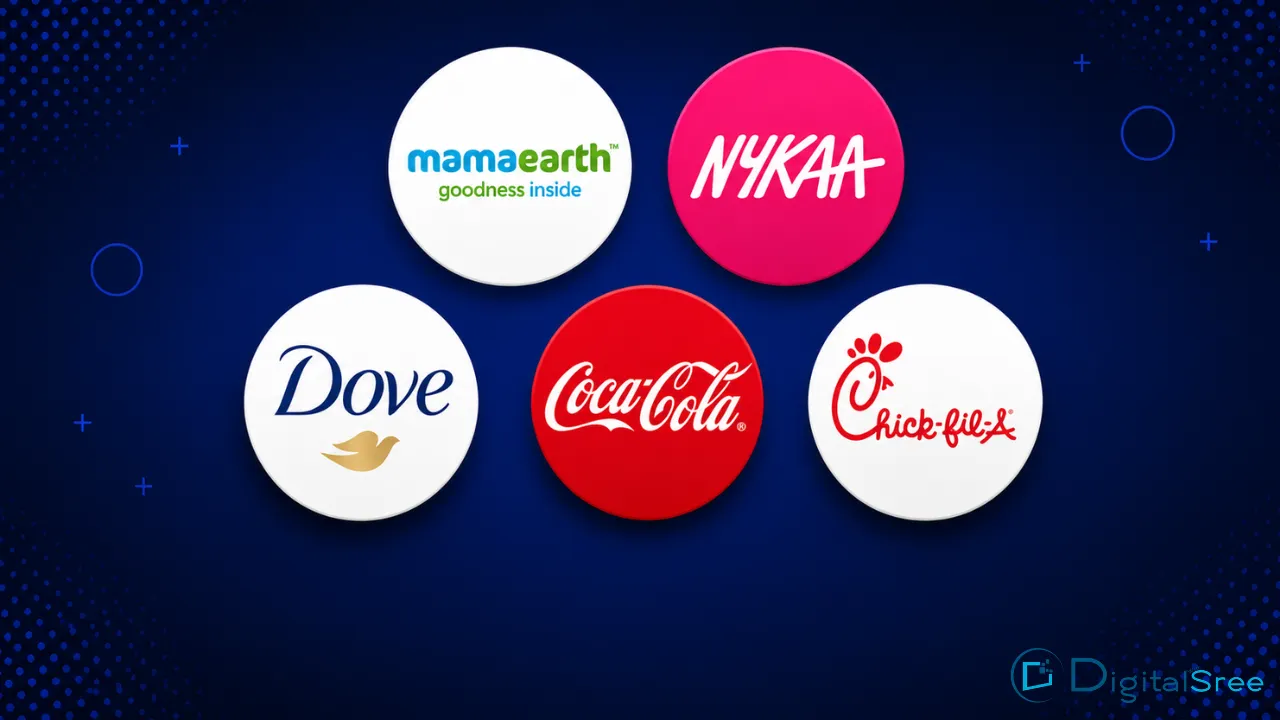
These case studies show the benefits of social media marketing translated into brand-level outcomes, not just campaign metrics.
- Global brands: Dove, Coca-Cola, and Chick-fil-A
Dove’s “Real Beauty” campaign challenged conventional beauty standards through honest, human video — and built years of brand favorability instead of a short-lived spike. Coca-Cola’s “Share a Coke” turned personalized bottle labels into a wave of user-generated content that no traditional ad buy could have manufactured on its own. Chick-fil-A’s discontinued-sauce situation is smaller but telling. The brand noticed genuine disappointment through social listening, brought the product back, and turned a minor misstep into a loyalty moment almost by accident. Sometimes the best campaign isn’t a campaign at all, just someone paying attention.
- Indian brands: Mamaearth and Nykaa
Closer to home, Indian brands like Mamaearth and Nykaa built much of their early growth on consistent content and influencer partnerships rather than big traditional ad budgets — the same pattern the current data shows working at scale for smaller, growing businesses everywhere. I’ve referenced Nykaa’s early influencer strategy in workshops more times than I can count, mostly because it’s such a clean example of patience paying off over a flashy launch.
Conclusion
The advantages of social media marketing go well beyond posting content and hoping something sticks. From social search quietly overtaking traditional discovery to short-form video’s outsized returns, the data lines up with what experienced marketers have been noticing on the ground.
Understanding the importance of social media marketing is step one. Building it into a consistent social media marketing strategy — grounded in real data and genuine engagement, not guesswork — is what turns the benefits of social media marketing into results you can point to.
The businesses I’ve watched grow the most sustainably were never chasing every trend. They just kept applying these advantages of social media marketing consistently, month after month. I can’t promise exact numbers for your business — every industry moves differently — but the pattern holds often enough that I’d bet on it. If you’re ready to turn that into growth, that’s the kind of honest, data-driven work I help clients with every day at Digital with Sree.
FAQ
1. What are the main advantages of social media marketing for small businesses specifically?
Low-cost visibility, real-time engagement with customers, precise ad targeting, and a real shot at competing with bigger, better-funded rivals on a fraction of their budget. That last one matters more than people give it credit for.
2. Why does the importance of social media marketing keep growing every year?
Because buying decisions increasingly start on social media, not in a search bar. Social now drives over 60% of product discovery, and that number isn’t shrinking anytime soon.
3. Which content format gives the best return right now?
Short-form video — 41% ROI per Sprout Social’s 2026 numbers. Authentic customer stories and testimonials come in close behind, and honestly those two overlap more than people think.
4. Where should a beginner even start?
Pick one or two platforms, set goals you can actually track, post consistently for three months minimum before judging anything. That’s the foundation of every social media marketing strategy that survives past month one — skip it and you’re just guessing with extra steps.
5. How do you measure the actual benefits of social media marketing?
Set specific goals — leads, clicks, conversions. Track them through platform analytics plus Google Analytics and UTM parameters. Activity should connect back to real business outcomes, not vanity numbers that look nice in a screenshot.