
Data Acquisition Systems Explained: A Complete Guide to Industrial DAQ Solutions
In the modern industrial landscape, data is one of the most precious assets an organization can gather and store. From monitoring production equipment and managing energy supplies to controlling product quality and workplace safety, all activities are directly dependent on the information about them. This is why data acquisition systems (DAS) are so important for any business that wants to thrive in the modern economy. Such tools allow one to collect information related to physical quantities from machinery, processes or sources in electronic form, transform it into a convenient digital format and utilize the data for specific purposes.
The growing importance of DAS is directly linked to the ongoing industrial evolution and automation of many processes using IIoT and Industry 4.0. A large body of work and research is currently dedicated to developing data acquisition systems, which makes them an essential tool in the modern industrial facility, manufacturing plant, power station, petrochemical enterprise, transport network or research laboratory. In order to ensure uninterrupted operations and maximize efficiency, modern businesses need robust hardware and software that are constantly collecting and analyzing data to spot trends, inefficiencies or equipment wear. By investing into the development of such systems, companies are able to optimize production, increase productivity, prolong the life of machinery and make their operations more profitable and sustainable.
While this paragraph is short, it still manages to convey the importance of data acquisition systems for a modern enterprise. By being a pivotal element of industrial automation and a core component of many modern facilities, DAS allow one to monitor all aspects of the process and spot areas of improvement. Not only that, but with the right industrial PCs, sensors and other equipment, organizations can maximize their performance and make their operations as efficient and productive as possible. Thus, any company that wants to get ahead in the modern economy needs to have a thorough understanding of the data acquisition system and its potential benefits.
What Are Data Acquisition Systems?
Data acquisition systems, also called DAQ systems, are hardware and software that read information from the real world and convert it into digital data for further processing and analysis. Such systems are necessary because most physical variables like temperature, pressure, voltage, current, humidity, vibration, flow, speed, and force cannot be directly understood and processed by computers. A data acquisition system is, therefore, a critical link between physical variables and computer software used to monitor and control equipment.
Every second, thousands of data points are created from one production line. It would be impossible to follow each sensor on an assembly line that has dozens or hundreds of sensors that collect information about the manufactured products or the machines’ condition. The data acquisition system reads these signals and allows the operator to observe what happens in the process. However, the importance of a data acquisition system goes beyond just reading values.
The collected data allows companies to evaluate the process, observe trends, and optimize production, thus making the process more reliable and efficient. Therefore it can be stated that a data acquisition system is essential for maintaining production equipment. For example, it can help in predicting failures and developing procedures to keep the machines running by ensuring there are no irregularities.
Understanding the Data Acquisition Process
Although various forms of modern data acquisition systems involve complicated hardware and software, the process through which they operate is comparatively straightforward.
First, sensors located at strategic points along the industrial site record and analyze specific physical quantities. Generally, there is a variety of parameters that may be measured with different types of sensors, depending on their intended applications. For instance, a thermometer is appropriate for measuring temperatures within a furnace while an accelerometer can track the level of vibrations caused by rotating machinery. Next, sensors usually provide analog data in form of continuous electrical signals. Therefore, prior to being processed by the computer, these signals may require conditioning to meet specific requirements for digitizing and analyzing the data. For this purpose, signal conditioning hardware is utilized to amplify, filter, regulate electrical signals, isolate the circuit, and perform other operations.
Conditioned analog signals are then converted into digital data by Analog-to-Digital Converters (ADC). The conversion process is critical and determines the accuracy of further operations. Therefore, hardware components involved should have appropriate resolution and frequency response, and most often, industrial facilities utilize high-end machines that allow for successful ADC with high sampling rates and excellent precision.
Industrial computers, controllers, or processors then process data acquired by sensors. Typically, such systems include specialized computer programs that process the information, detect anomalies, store records, and raise alarms, when necessary. In particular, modern programs can include artificial intelligence and machine learning technology that can analyze patterns and predict likely deviations from normal values.
Lastly, the processed information can be viewed on video displays, graphed, stored on hard drives or other devices as well as transferred to supervisory systems such as SCADA or PLCs for further analysis. For instance, operators can monitor equipment from remote locations, view the data, analyze historical statistics, or print reports for compliance purposes.
Core Components of Data Acquisition Systems
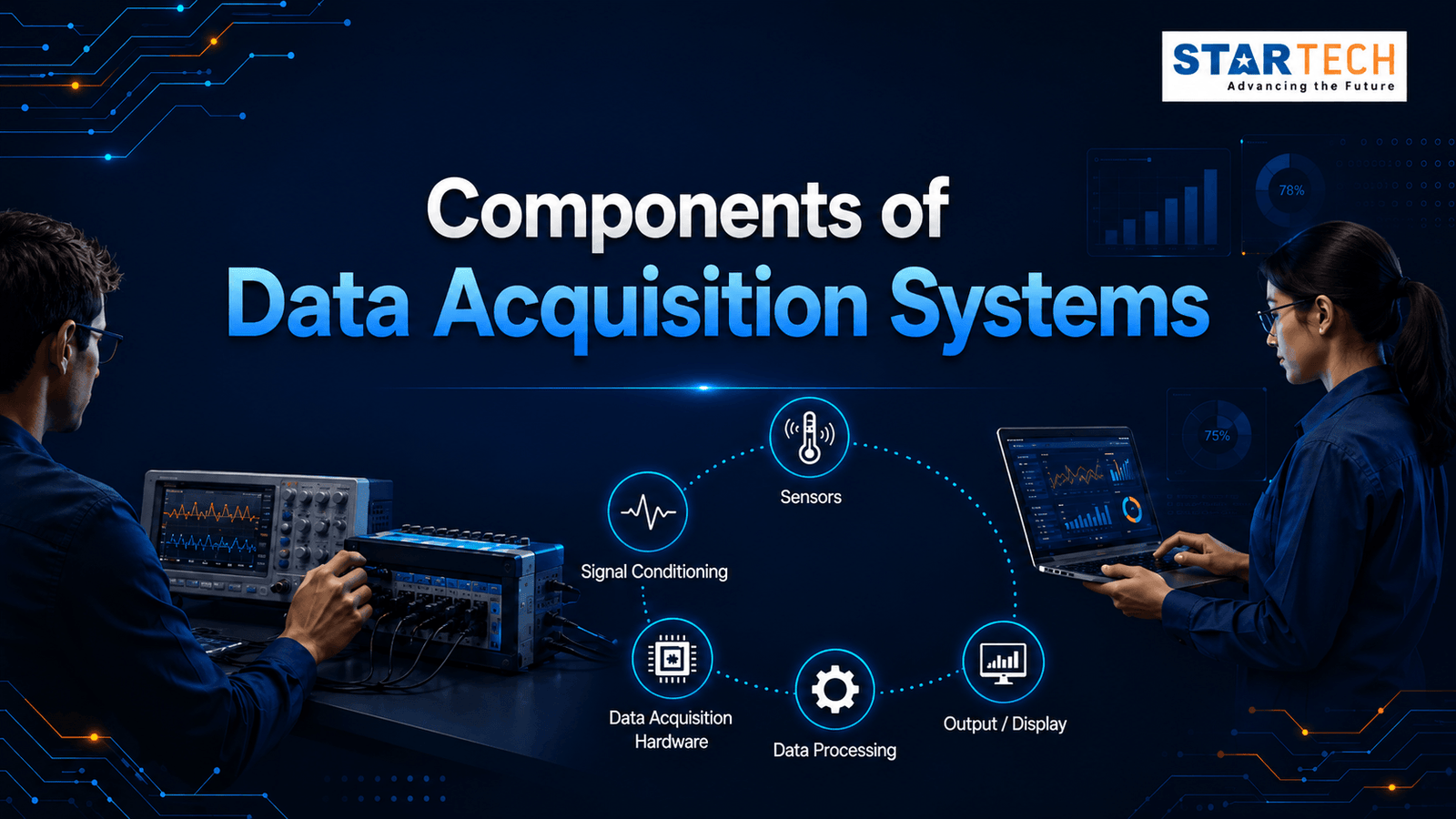
Any data acquisition system is a set of devices, all of which perform particular functions to ensure that the process of acquiring information is efficient and accurate. A data acquisition system comprises several components, each of which plays an essential role in the process.
First, there is the sensor or transducer. This device is responsible for capturing information, which means it is the part of the data acquisition system that is located closest to the measured object or medium. There are various sorts of sensors, whose task is to measure different physical quantities, such as flow, pressure, speed, acceleration, and temperature.
The next component is the signal conditioner, whose main job is to prepare sensor data for conversion into a digital format. Signal conditioning is necessary because, in industrial facilities, electromagnetic interference often occurs, which affects the accuracy of measurement. Large AC generators, drives, welders, and other sources of current intensify the occurrence of such disturbances, which means that signal conditioning is critical to obtain accurate measurements.
When analog data become digital, the analog-to-digital converter comes into play. This device, according to industrial data acquisition sources, transforms sensor data into numbers that a computer can read. The higher the resolution of an ADC is, the more accurate the resulting digital signal will be, which allows acquiring data about the minutest details with ease. Another critical parameter is the sampling rate, which determines how quickly values will be captured. A high sampling rate is particularly important for vibration measurements, as well as for motion control and industrial processes.
After data become digital, they need to be processed, which is the responsibility of a computer or an embedded controller. Industrial automation facilities, as well as critical power and transportation infrastructures, generate substantial amounts of data that must be collected, processed, and acted upon in real time. Thus, it is not surprising that such industrial environments employ fanless embedded computers that offer enhanced performance, do not have noisy fans, and deliver consistent stability.
Finally, the software is the component of a data acquisition system that allows engineers to collect, store, display, and analyze data. Contemporary industrial software enables engineers to monitor and optimize the performance of their systems while providing the ability to generate reports. Moreover, the right data acquisition software can be used to build dashboards, control industrial processes, and scale to thousands of nodes across different networks.
Types of Data Acquisition Systems
Data acquisition systems come in different configurations to satisfy a wide range of applications, installation conditions, scalability needs, and performance levels. The primary forms include DAQ based on personal computers, standalone or embedded DAQ systems, modular systems, and wireless data acquisition systems. Organizations use these systems depending on their requirements and industry needs.
1. PC-Based Data Acquisition Systems
DAQ systems based on personal computers form the largest category of data acquisition systems. They use DAQ hardware connected to a desktop computer, industrial PC, or laptop via USB, PCIe, or Ethernet. In essence, they are more powerful, offer better visualization and analysis, and are highly scalable compared to other systems. Therefore, they are mostly used when individuals need to leverage the processing and presentation capabilities of desktop computers when analyzing data.
2. Embedded or Stand-Alone Data Acquisition Systems
These systems are also known as stand-alone data acquisition systems. Unlike the PC-based systems, they do not require the use of a PC because they have an embedded computer within them which processes the data. Their presence enables people to conduct independent data acquisition, processing, and visualization tasks in remote and industrial areas. In other words, embedded systems provide a complete solution to data acquisition problems at the edge of the network. For this reason, they are mostly used in manufacturing, power, utilities, and transportation industries where there is a need for reliable systems that do not depend on other components to operate.
3. Modular Data Acquisition Systems
Modular systems offer the best value proposition in modular form. They allow organizations to add more channels to their existing systems to support more tests, more sensors, or new applications. This technique allows companies to start small and then scale with their business needs. It is, therefore, a cost-effective approach that allows companies to avoid buying new systems they can use for a short time before moving to more advanced ones. In other words, they offer a scalable solution that satisfies current and future data acquisition needs.
4. Wireless Data Acquisition Systems
Wireless DAQ systems allow individuals to monitor and control physical objects without the need for cables. In other words, they provide an option of connecting sensors and actuators using wireless communication networks to acquire and send data. These systems are mostly used in remote areas where it would be too expensive to lay underground cables or place overhead electric wires. Some of the applications include oil fields, wind farms, remote weather stations, and in large-scale industrial facilities.
The trend in data acquisition systems is shifting towards smart industries, the use of industrial internet of things (IIoT), and embedded systems. In this case, the traditional data acquisition systems are being combined with Industrial IIoT systems to enable the continuous flow of data from sensors and computers in the factory to cloud analytics software.
Industrial Applications of Data Acquisition Systems
Data acquisition systems can be applied in almost all spheres of industry since acquiring data is crucial for the proper functioning of processes and their optimization. This technology component is vital in any field as it allows for making decisions with greater accuracy while reducing the possibility of errors.
First, in the field of manufacturing, data acquisition systems allow for monitoring production equipage to ensure that it runs smoothly and safely. Thus, a wide range of parameters such as temperature, vibrations, motor currents, pressure, and speed are analyzed. In case of deviations, operators can be alerted to take the necessary measures to eliminate them so that the production process is not stopped.
In addition, in the energy and electric power sector, data acquisition systems are primarily used to monitor the condition of networks and power plants, generators, and transformers. These systems allow for measuring the main characteristics of electricity, voltages, currents, frequencies, and power qualities. By constantly monitoring these data, operators can ensure the stable and safe functioning of all electrical equipment.
DAQ systems are also used to monitor oil and gas production facilities. These systems track the movement of pipelines, drilling rigs, and other equipment, and analyze the parameters of pressure, temperatures, speed, and vibrations.
Moreover, in the transport sector, data acquisition systems allow for monitoring infrastructure, rolling stock, aircraft, and other transport vehicles to assess their technical condition. This technology is especially important for railways since by analyzing the received data, engineers can make decisions to optimize movements and ensure safety.
In the pharmaceutical and food industries, compliance with regulatory documentation is of great importance. Therefore, by monitoring the required parameters with DAQ systems, companies ensure product quality, control production conditions, and collect the necessary information for documentation.
It is vital in these industries since the introduction of errors in the preparation of documents significantly reduces the accuracy of data on production processes and their results.
Finally, data acquisition systems are used in research laboratories to monitor and collect data from various types of equipment. This is vital for obtaining accurate results of experiments, conducting research, and testing products.
Arduino Data Acquisition for Learning and Prototyping
Although industrial data acquisition systems are created to meet the strict requirements of a business setting, many individuals, including students, enthusiasts, and engineers, start learning the fundamentals working with DAQ by using Arduino development boards. Such tools are perfect for those who wish to gain an understanding of how sensors operate and how the data they collect is processed in the digital realm.
An Arduino data acquisition project usually entails a setup where sensors are connected to a given microcontroller, which then processes the data coming from the input devices. More specifically, the data from sensors is sent to the analog-to-digital converter, which transforms it into digital information that can be used to perform calculations run by relatively simple programs.
The results can be displayed on a computer, saved on an SD card, sent to the cloud, or presented in an analytical dashboard.
Arduino projects are popular among students, educators, and professionals alike because they allow one to get familiar with the characteristics of various sensors, master the intricacies of signal conditioning and analyze the collected data. Essentially, one can work with temperature, humidity, light, pressure, and motion sensors, among others, to get hands-on experience with sensor calibration, analog-to-digital conversion, downsampling and other processes.
At the same time, it is important to note that Arduino and other similar consumer-oriented platforms are ill-suited for actual industrial applications. For starters, they cannot offer the level of customization, reliability, and precision that is required in the majority of business settings.
Moreover, systems running on such platforms cannot be used in critical infrastructures, which require uninterrupted 24/7 operations, high performance, and maximum stability under extreme ambient conditions. In such environments, data acquisition systems running on industrial hardware are usually preferable, and they are often paired with embedded computers to achieve the desired outcomes.
Furthermore, such systems can operate in diverse physical environments, which is paramount in industrial engineering. Finally, critical data acquisition infrastructures usually involve industrial switches and controllers that offer advanced features like signal conditioning, Modbus, Ethernet, or EtherCAT support, fiber optics, CAN Bus, PROFINET, and other communications options.
Benefits of Implementing Data Acquisition Systems
Organizations that use modern data acquisition systems to monitor and control their activities benefit from increased efficiency in their operations. Instead of making decisions based solely on sporadic checks, business owners can take actions considering real-time information about the current state of their equipment.
Firstly, data acquisition systems improve the operational visibility of businesses. With the help of such systems, engineers can assess the working conditions of machines. As a result, they can quickly detect deviations and take necessary steps to eliminate them. For example, if equipment begins to behave abnormally, it will allow engineers to stop malfunctions. In turn, this will reduce the costs associated with lost productivity due to unplanned equipment failures.
Moreover, the data acquisition system helps in planning a predictive maintenance schedule and eliminating the need for unnecessary procedures. Using information from similar equipment, engineers can track the behavior of the machines’ various components. As a result, they can schedule preventive maintenance more efficiently while avoiding unscheduled procedures. In turn, this reduces costs and ensures that equipment does not malfunction unnecessarily and stop production.
Additionally, modern data acquisition systems contribute to improvements in the quality of products. By collecting and analyzing information about the production process at different stages, businesses can ensure that the manufactured products meet established requirements. This allows for detecting and eliminating defects at the initial stages of production. At the same time, by examining the causes of possible deviations, engineers can prevent future quality problems.
Furthermore, the data acquisition system helps keep track of all activities without the need for manual accounting. It is especially important for organizations that must comply with various regulatory and industry-specific requirements. In particular, such systems store information about the state of equipment and the entire production process, which helps eliminate the need for manual bookkeeping. In addition, this reduces the time and effort required to compile reports on the past performance of the enterprise.
The ability to collect and analyze information about electricity consumption helps in identifying energy savings. For example, data acquisition systems can track which parts of the equipment consume the most energy. At the same time, such information minimizes the costs associated with electricity. In addition, by ensuring proper distribution of electricity, organizations can count on the reliable functioning of their equipment. Moreover, modern data acquisition systems help organizations to become more sustainable and reduce their carbon footprint.
Most importantly, collecting and analyzing operational information helps in making the right business decisions. With knowledge of how exactly the machines work in real-time, managers can quickly find ways to improve operations. As a result, by using the information acquired from the data acquisition system, they will be able to identify the most significant inefficiencies and eliminate them. In turn, the data obtained will reduce the costs associated with the production process, as well as help in implementing the digital transformation strategy.
How to Choose the Right Data Acquisition System
When choosing a data acquisition system, it is necessary to take into account a few factors, including current and future business needs. After all, in any industry, there are specific features inherent only to that particular field. Therefore, it is crucial to choose the best data acquisition system according to the required technical specifications in order to obtain high-quality results.
Firstly, when selecting a data acquisition system, one should pay attention to the sampling rate at which the system works. Different tasks require a different sampling rate. For example, for measuring temperatures in a room, a few measurements per minute will be enough.
However, if it is necessary to measure the vibration of rotating equipment, several thousand measurements per second will be needed to get an accurate result. Secondly, the number of channels is also a crucial aspect when choosing data acquisition hardware. The number of channels can vary from one to several hundred, so it is important to choose a system with enough input and output channels so that the company can connect and control all the necessary equipment.
Moreover, if the company is developing further, a good solution would be to choose a system that can scale.
Another factor that should not be ignored when choosing a data acquisition system is the working environment. Most often, industrial computers work in a harsh environment, where they are subjected to dust, vibration, moisture, and other factors.
Therefore, it is important to know how well the system will perform in a specific working environment. In this aspect, it is better to choose industrial fanless computers, since they have proven their reliability and have become an excellent solution for any industrial site. They are characterized by high performance, high reliability, and a long lifespan.
When choosing a data acquisition system, it is also important to consider the connection technologies. It is necessary to determine whether it is necessary to integrate the system with other devices such as programmable logic controllers, SCADA systems, MES systems, or other instruments and software.
The ability to integrate increases productivity and reduces downtime, thus saving money. It is also important to note the advantages of the necessary software that will help in creating a strategy for working with DAQ systems. The best option would be a system that has intuitive software that allows configuring and recording data, visualizing, analyzing, reporting, and integrating with other software.
Finally, when selecting a data acquisition system, it is important to consider the technical support and maintenance of the purchased equipment. In this aspect, it is crucial to orientate on the most reliable hardware in the industry in order to ensure many years of trouble-free operation.
The most cost-effective solution is scalable hardware, which allows not only working with the current level of the business but also taking it to new levels.
Future Trends in Data Acquisition Systems
The future prospects of data acquisition systems are inextricably linked to the ongoing trends of industrial 4.0, artificial intelligence, and the Industrial Internet of Things (IIoT). In terms of Industry 4.0 and IIoT, the emphasis on creating a fully integrated system results in moving from mere data acquisition and collection to actualizing the value of information to make faster and more accurate decisions.
One such direction is represented by the concept of edge computing, where the data is processed at the source, i.e., on devices at the point of origin, rather than waiting for it to be sent to a server or centralized cloud-based system. By enabling industrial computers to process and analyze sensor data close to the source instantly, the latency involved in the communication between the monitored equipment and the operators is significantly reduced.
Edge computing is further complemented by the use of artificial intelligence, machine learning, and analytics, which, combined together, enable industrial monitoring and data acquisition systems to perform a variety of tasks. For instance, modern DAQ systems can process historical and real-time data to detect patterns that require human intervention. This is particularly useful for the operation and maintenance of industrial machinery, as predictive analytics can recognize patterns suggestive of an impending failure before it occurs, thus informing operators about the specific course of action.
The trend of industrial 4.0 and IIoT also sees the increasing use of wireless communications in industrial settings as a way to benefit from the latest innovations in that area while eliminating the need to lay cables at the worksite. Moreover, the use of wireless solutions facilitates the ability of engineers and managers to access plant data from anywhere, thereby creating opportunities for greater business efficiency.
In terms of cloud computing, modern DAQ systems can leverage the power of cloud-based data storage, analytics, and management solutions. In particular, enterprises can utilize the ability of clouds to store and share data across multiple machines while providing remote access to operators in different parts of the world. For instance, an enterprise that utilizes multiple production facilities can monitor their equipment performance using standardized dashboards and compare this data across sites.
With the increased use of connected systems and the overall digitalization of industrial operations, cybersecurity is becoming a serious concern. This trend is particularly relevant to data acquisition systems, where the emphasis is placed on ensuring that the data is secured and that only verified and authorized personnel can access it. Thus, modern data acquisition systems feature an array of features that improve cybersecurity, including enhanced data encryption, secure communications, authentication, and network security features.
The future prospects of data acquisition systems also foresee a continuous improvement of compact and fanless embedded computers as devices that can support the most computationally intensive tasks, including high-speed data acquisition and processing, AI, and edge computing. By eliminating the need for active cooling, such embedded computers provide the necessary stability while ensuring that industrial automation systems can operate in a variety of environments.
Conclusion
As automation and control technologies continue to evolve, the importance of accurate, reliable, and real-time data has become more critical than ever. Data acquisition systems form the foundation of any successful monitoring, control, analysis, or prediction strategy – empowering companies to optimize production, improve product quality, and reduce maintenance costs down to a fraction of what it would otherwise be.
Industrial data acquisition systems are at the heart of modern operations, from manufacturing and power generation to transportation and R&D, driving innovation and enabling enterprises to make the most out of their operations, products, and services in a digital world.
When selecting or upgrading your data acquisition system, it is paramount to ensure that its capabilities are scalable, durable, software-compatible, and reliable.
By implementing the right industrial hardware and fanless embedded computers, your business can unlock new levels of performance and prepare for the future of Industry 4.0, edge computing, and smart automation.
If your business is in the market for industrial-grade data acquisition systems or rugged fanless embedded computers that will help design a system that supports your business needs now and in the future, StarTech GCC can assist you in selecting the right equipment to build a reliable and scalable industrial monitoring system. We offer a comprehensive portfolio of industrial automation hardware and cutting-edge edge computing solutions as well as provide expert advice on building a robust and future-proof infrastructure.
FAQ
1. What is a data acquisition system?
A data acquisition system comprises hardware and software that allows acquiring information from sensors, converting it from analog to digital form, and processing it for monitoring, analyzing, reporting, and controlling purposes. It helps multiple industries keep track of relevant physical quantities and make adequate decisions based on the collected data.
2. What is the purpose of data acquisition?
The main objective of data acquisition is to capture accurate information from physical processes and convert it to digital form for monitoring and analysis purposes. This is beneficial to organizations because it helps in increasing productivity, ensuring employee safety, facilitating efficient maintenance, and improving the quality of goods or services produced.
3. What industries use data acquisition systems?
Data acquisition systems are employed in a broad range of applications and industries. From manufacturing and energy to oil and gas, automotive, aerospace, and transportation, DAQ systems are essential. Other industries, including pharmaceuticals, food and beverage, environmental and chemical, research and development, and utilities, also benefit from the implementation of data acquisition technologies. In short, any industry that requires measurements and continuous monitoring can take advantage of DAQ systems.
4. Can Arduino be used for data acquisition?
Yes. Using Arduino boards is common in educational settings, for research, and for prototyping purposes. They allow a person to get a general understanding of how to integrate sensors and collect basic data but for industrial applications, data acquisition systems are more suitable as they have much better specifications in terms of performance and precision and work reliably on a large scale, often using specialized hardware and communication tools.
5. What is the difference between DAQ and SCADA?
Data acquisition entails capturing and digitizing sensors’ signals. SCADA is a supervisory system that utilizes the data acquired by DAQ to monitor, display, alarm, and control the whole process of an industrial facility.