
RTU vs PLC: 7 Critical Differences Every Engineer Must Know
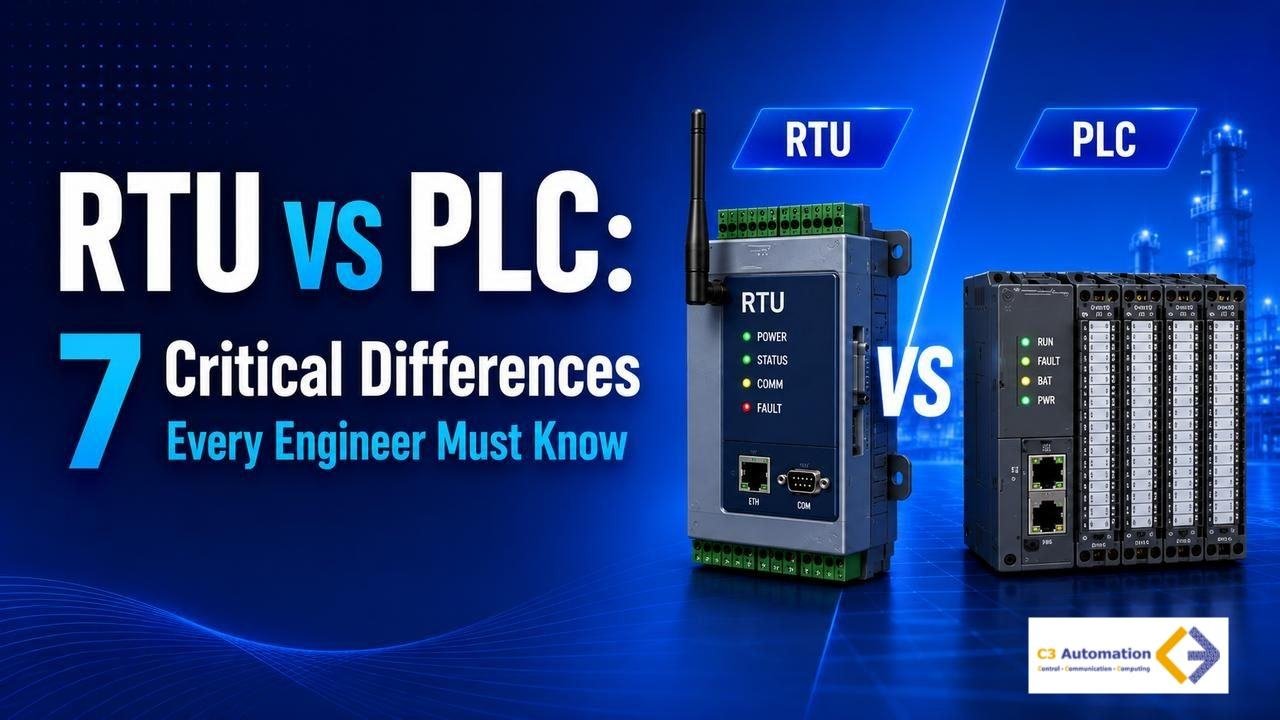
Ask ten engineers about RTU vs PLC, and you’ll get some version of the same answer: a PLC runs fast control logic inside a plant; an RTU keeps an eye on things out in the field. That’s the short version. The longer version matters more once you’re actually specifying hardware for a project. Here’s the thing — that line isn’t as clean as it used to be.
IIoT and Industry 4.0 have pushed both device types toward remote connectivity and edge processing, so what used to be a simple category choice now has real consequences for uptime, maintenance budgets, and how your system behaves the moment a connection drops. This guide covers the real difference between RTU and PLC — hardware, communication, cost, and where each one earns its keep. You’ll see common RTU protocols along the way, plus a look at typical PLC application areas. Less textbook, more “here’s what actually happens on a job site.”
What Is a PLC?
Think of a PLC, short for Programmable Logic Controller, as an industrial computer whose only job is running control logic fast and without fail and starting a motor. Sequencing a conveyor. Managing safety interlocks, coordinating a ten-step batch process without missing a beat. That’s a normal day for one.
PLCs grew out of relay panels — literal walls of wired relays that factories used before anyone thought to put a processor in the loop. You can still see that DNA in how PLCs work today: a CPU, a power supply, and modular I/O racks wired to sensors and actuators on the floor. Most are programmed in Ladder Logic, which looks enough like an old relay diagram that electricians pick it up fast, even without a coding background.
Where do you find PLCs? Mostly inside controlled facilities, though ruggedised and extended-temperature versions do exist for rougher spots. What really sets a PLC application apart is speed. A PLC scans its program and updates outputs in milliseconds — and on a packaging line or with robotic coordination, that kind of speed isn’t a nice-to-have. Miss the timing, and you’ve got a defect, or worse, a line down.
What Is an RTU?
An RTU, short for Remote Terminal Unit, does the opposite job. Instead of controlling something locally, it watches a remote site and phones home — collecting data and sending it back to a central SCADA system. A PLC’s whole purpose is running logic on-site. An RTU’s job is gathering data and getting it back reliably, no matter how far away it is.
RTUs end up in places nobody wants to drive out to check on: along a pipeline right-of-way, at a pump station in the middle of nowhere, in an unmanned substation, at a water treatment site miles from the nearest road. So they’re built for it — ruggedised against heat, vibration, and dust, and often running on solar or battery power since grid power isn’t guaranteed.
You don’t really program an RTU the way you program a PLC. You configure it — set the data points, the scaling, the alarm thresholds, how often it should check in. Most talk to the central system using RTU protocols like DNP3 or Modbus. And here’s the feature that matters most: store-and-forward. Lose the connection, and the RTU just keeps logging data locally with a timestamp.
Once the link comes back, it dumps the backlog through. If your only connection is cellular, radio, or satellite, that’s not a minor convenience — it’s the whole reason the device works at all.
So that’s the core difference between RTU and PLC in practice: one runs logic fast, on-site; the other collects and relays data reliably, from wherever it happens to be. Everything below builds on that.
The 7 Key Differences at a Glance
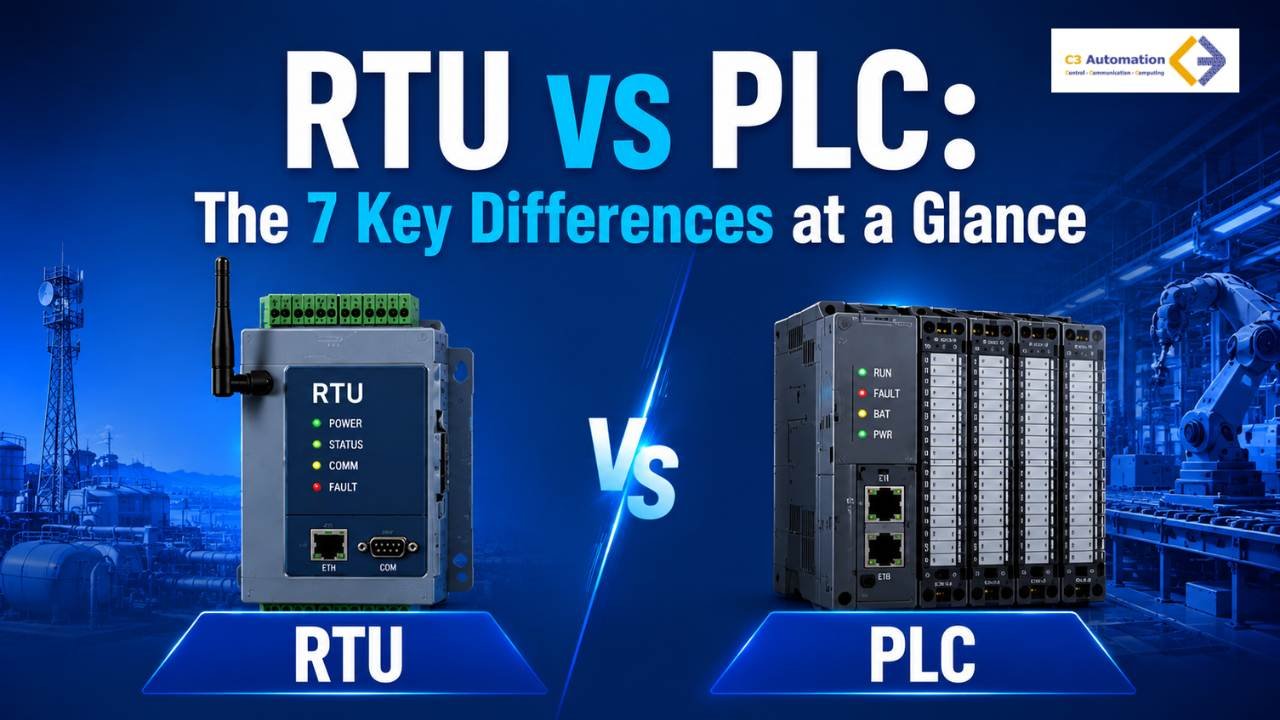
You’ve got the basics. Here’s the full breakdown of what actually separates a PLC application from an RTU application:
1. Operating environment
PLCs typically live in controlled, enclosed facilities. Ruggedised versions exist, but that’s still the exception. RTUs are built from the ground up for harsh, remote, or unmanned sites.
2. I/O and processing style
PLCs lean toward high-speed digital I/O for machine control. RTUs lean toward analogue I/O, since field telemetry (flow, pressure, temperature) is rarely a simple on/off signal.
3. Programming standards
4. Communication protocols
PLCs run Profinet or EtherNet/IP. RTUs run DNP3, Modbus, or IEC 60870-5-101/104. The choice comes down to whether the priority is speed on a local network or reliable data delivery over long distances.
5. Connection resilience
RTUs are built around store-and-forward for spotty links. PLCs generally assume a steadier connection, though this really depends on the platform, and many newer models buffer data locally as well.
6. Power requirements
PLCs need stable industrial power, full stop. RTUs are often designed to run on low-power, solar, or battery power.
7. Cost and maintenance profile
PLCs usually cost less upfront but can rack up maintenance costs in harsh settings, unless you spring for a ruggedised model. RTUs cost more to buy but tend to save money over a distributed deployment’s lifetime.
Technical Deep-Dive: Hardware & Architecture
Start with the environment, and the rest of the RTU vs PLC hardware story pretty much writes itself.RTUs are made for harsh conditions — heat, vibration, dust, remote sites with zero climate control. PLCs, historically, live in enclosed cabinets inside a plant, climate-controlled and predictable. That’s changing a bit; ruggedised and extended-temperature PLCs are showing up more often for tougher or semi-remote jobs. But it’s still not the default. That environmental split trickles down into everything else:
- I/O and processing: PLCs are tuned for fast digital I/O — good for machine control where milliseconds matter. RTUs are tuned for broad analogue I/O, since they’re reading continuously changing values like flow, pressure, and temperature off field sensors.
- Programming standards: Most PLCs follow IEC 61131-3 — Ladder Logic, Function Block Diagrams, Structured Text; take your pick. RTUs largely skip programming altogether. You set data points, scaling, and reporting intervals through a template instead of writing logic from scratch.
- Communication standards: RTUs often run DNP3, especially in utilities and oil and gas, where getting the data right matters more than getting it fast. PLCs more commonly run Profinet or EtherNet/IP, built for quick, low-latency communication inside a facility network.
Why does any of this matter? Because putting the wrong device in the wrong environment doesn’t usually fail gracefully. It fails early, or it quietly feeds you bad data until someone notices
RTU vs PLC Decision Matrix
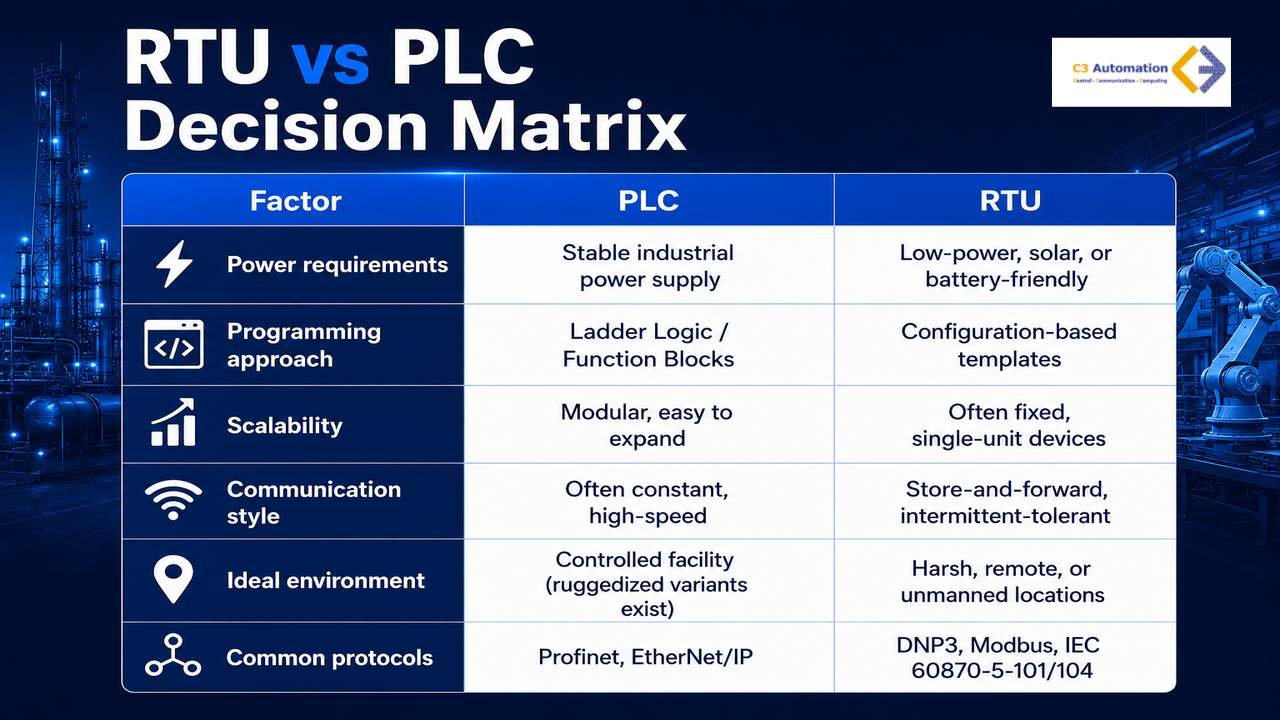
None of this is really about which device is “better.” It’s about which one fits the site you’re actually working with. If your project needs fast, local control in a stable environment, a PLC checks every box. If it’s remote, unpredictable, or hard to reach, an RTU is built for exactly that. Most projects land clearly on one side once you line the factors up like this
PLC Application and RTU Application: Where Each One Fits
Sometimes the fastest way to settle an RTU vs PLC debate is just to look at where each one actually gets used.
Common PLC application areas include:
- Manufacturing and assembly line control
- Packaging and material handling automation
- Machine sequencing and safety interlock systems
- Batch processing in controlled facility environments
Notice the pattern — every PLC application here needs fast, predictable logic running somewhere stable and powered.
Common RTU application areas include:
- Oil and gas pipeline monitoring across remote terrain
- Water and wastewater treatment telemetry
- Remote metering for utility infrastructure
- Environmental and weather station monitoring in unmanned locations
Big infrastructure projects rarely pick just one. It’s pretty normal to see PLCs running local, fast control — say, a pump station — while RTUs handle distributed monitoring across tunnels or remote lines where you can’t count on a steady connection. That mixed setup used to be unusual. Now it’s closer to standard practice on large projects.
Maintenance, Cost, and Total Ownership
Sticker price alone doesn’t tell you much here.
PLC
PLCs are usually the cheaper buy upfront, and that holds across most PLC application areas. But that gap doesn’t hold once you leave a controlled environment — take a standard PLC somewhere harsh or remote, and installation and maintenance costs climb fast, unless you’ve paid extra for a ruggedised unit. Here’s why: a normal PLC needs a climate-controlled cabinet, some protection from vibration and dust, and a technician who can actually reach it when something goes wrong. Skip any one of those, and you’re signing up for more breakdowns, shorter component life, and site visits that end up costing more than what you saved on the hardware in the first place.
RTU
RTUs cost more to buy, and that’s mostly down to ruggedisation. You’re paying for extended-temperature components, sealed enclosures, hardware that can run on solar or battery power without needing constant attention. But give it time, and that upfront cost tends to even out. Most RTUs are built for remote firmware updates and diagnostics, so nobody has to drive out to the site every time something needs tweaking — and on a network with dozens or hundreds of remote points, that saves real money.
Even one skipped trip to a pipeline station hours from the nearest town can cover a good chunk of that extra hardware cost by itself. So which one’s actually cheaper? Wrong question, honestly. What matters is where the money goes over the system’s lifetime — hardware now, or labour and downtime later. In a facility-based project, PLCs usually come out ahead on total cost. Spread-out, hard-to-reach deployment: RTUs usually win once you factor in five or ten years of maintenance runs.
RTU vs PLC: Which One Should You Choose?
If you take one thing away from this whole guide, make it this:
- Choose a PLC → fast, predictable control inside a facility. This is the classic PLC application: Manufacturing lines, packaging, machine sequencing. This is the right call whenever the process lives somewhere powered and enclosed, and the timing has to be tight — milliseconds, not minutes. If you’re stopping a motor at the exact right moment or sequencing a dozen steps in a batch process, nothing else keeps up the way a PLC does.
- Choose an RTU → remote monitoring or telemetry somewhere harsh, unmanned, or hard to reach. Pipelines, water utilities, remote metering. This is the right call whenever the site is somewhere you can’t easily get to, power isn’t guaranteed, and the connection back to base is going to drop sooner or later. An RTU is built to keep working through all of that without losing data.
- Choose both → large, distributed systems that need local control and wide-area monitoring running at the same time. This is the right call for anything that spans multiple sites — a plant with several remote pump stations, a utility network with dozens of monitoring points feeding one control centre. PLCs handle the fast, local work at each site; RTUs (or PLCs configured for RTU-style duty) tie it all together across distance.
That covers most real projects, honestly. Everything above explains the why — architecture, protocols, applications, cost — but this is the answer people actually search for.
Conclusion
There isn’t a clean winner in the RTU vs PLC comparison, and there probably shouldn’t be. It comes down to where the device has to work and, more and more, what that specific platform can actually do. A PLC is still the right call for fast, predictable control inside a stable, powered facility-the classic PLC application. An RTU is still the stronger pick for remote or harsh sites where you can’t guarantee a reliable connection. And on a lot of real projects — especially large or spread-out ones — the honest answer isn’t PLC or RTU. It’s both, each one doing the job it’s actually built for.
As PLCs and RTUs keep bleeding into each other’s territory through IIoT and edge computing, the real skill isn’t picking a favourite. It’s matching the device to the environment instead of defaulting to whatever you already know. That’s the difference between RTU and PLC decisions that hold up and ones that fall apart the first time a connection drops.
FAQ
1. What is the main difference between RTU and PLC?
Mostly, it comes down to purpose and where the thing lives. A PLC runs fast control logic, usually tucked inside a controlled facility. An RTU sits out in the field somewhere and reports back — that’s its whole job.
2. Can a PLC replace an RTU, or vice versa?
Sometimes, yeah. Newer hybrid controllers blur the difference between RTU and PLC a lot more than people expect. But drop it in a harsh spot with a shaky connection, and an RTU’s store-and-forward setup still wins over a standard PLC every time.
3. What communication protocols do RTUs use?
Honestly, three come up again and again: DNP3, Modbus (you’ll see both the RTU and TCP versions), and IEC 60870-5-101/104. Which one you end up with usually isn’t really your choice — it’s dictated by your industry, how much bandwidth you’re working with, and whether there’s an old SCADA system in the mix that everything else has to play nice with.
4. What industries use PLCs vs RTUs most?
If it’s manufacturing, packaging, or an assembly line, that’s classic PLC application territory. If it’s oil and gas, water utilities, or anything spread across remote infrastructure, RTUs are doing the heavy lifting there.
5. Is a hybrid PLC-RTU system possible?
Definitely — and it’s a lot more common than people assume. Plenty of large projects run PLCs for the local control side and RTUs for remote monitoring, all as part of one bigger system.