
Building Automation and Control Systems in the GCC: 10 Benefits for Modern Facilities
Facility managers across the UAE, Saudi Arabia, and Oman are under increasing pressure to reduce operating costs while ensuring they meet stricter requirements for energy efficiency. Building automation and control systems are now the norm. They link HVAC automation and lighting, security, and energy management to form an integrated platform. The market worldwide for automation and control systems for buildings is expected to grow from $107 billion in 2025 to more than $119 billion by 2026.
Automated facilities have reduced hundreds of millions in energy expenses, as well as tons of carbon emissions. For facilities team members across GCC, the need for these smart building solutions is never stronger. Cooling loads are the main source of energy costs in this region, while sustainability demands are increasing. Below are the 10 most important benefits that will drive adoption in 2026. We will also look at the fundamental elements of these systems, as well as what to look for when choosing an integrator for your system.
What Is Building Automation and Control System (BACS)?
Building automation and control systems are a collection of sensors, controllers, and software that oversee and control the building’s electrical and mechanical systems. This covers HVAC automation, lighting, fire alarms, life safety, and security. Instead of managing these systems separately, consolidates control. Facilities teams can monitor the performance of their operations, automate routine tasks, and handle issues through one interface. Modern smart building solutions make use of AI to determine patterns of occupancy and detect faults in equipment before they cause disruption, and continuously refine energy use.
The Four Layers of a Building Automation and Control System
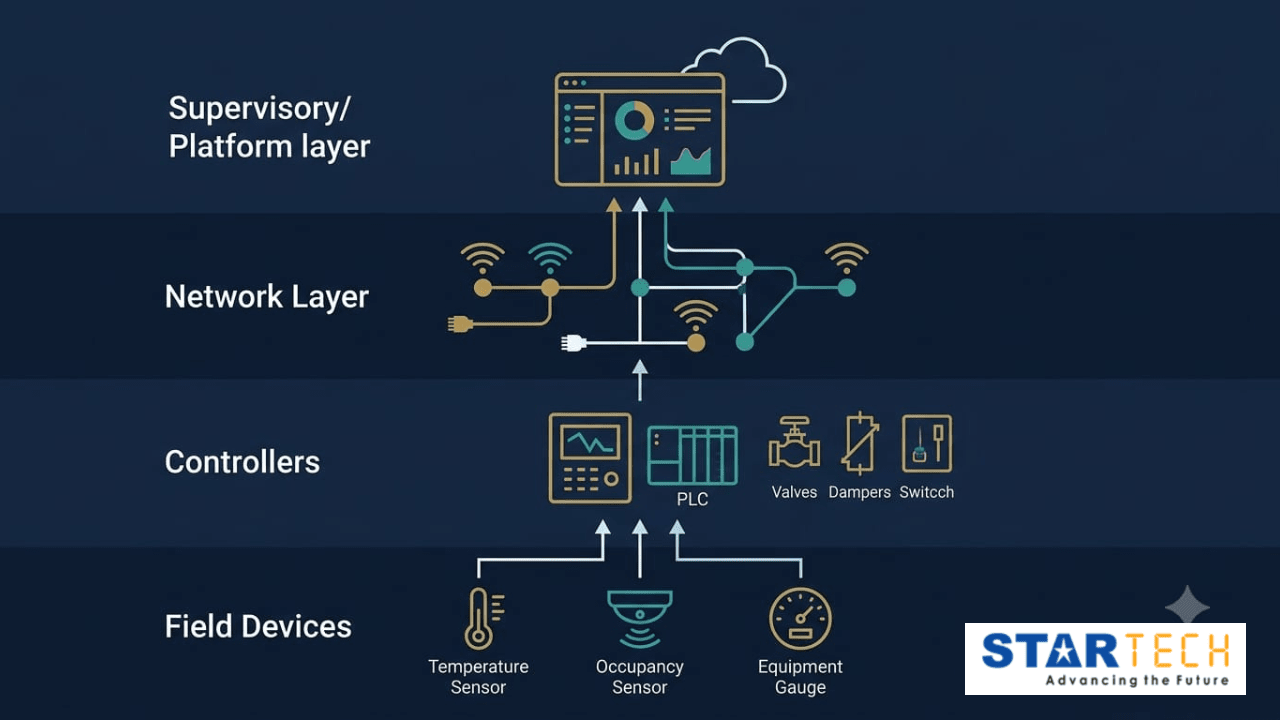
An average building automation and control system is made up of four layers.
1. Field Devices
Sensors and actuators can collect real-time data about temperatures, occupancy levels, and the condition of the equipment.
2. Controllers
Handle this data locally and then execute HVAC control logic and adjust valves, dampers, and switches without relying on central servers.
3. Network layer
Connects field and controller equipment to the platform. It blends the wired protocols used for critical zones and wireless sensors for retrofitting.
4. supervisory software
Connects everything to dashboards, alarms, and other tools that facilities teams utilise every day. Understanding these layers is essential when it comes to evaluating proposals, as each of them affects how the smart building system performs throughout its life.
Key Building Automation Protocols for Modern BMS
The protocol that connects controllers, field devices, and supervisory software is what determines how the system is integrated with equipment from various manufacturers.Here are the main ones you’ll come across in smart building solutions today:
1. BACnet
The most common language for HVAC automation and building systems. It’s open and non-proprietary, meaning almost any manufacturer’s equipment can “speak” it, which is why most modern
2. Modbus
An older, simpler language still widely used on the industrial and mechanical side of things, like pumps and motors. It’s basic, but reliable, and it’s been around long enough that almost everything supports it.
3. KNX
The go-to language for lighting and room controls in smart building solutions, especially in homes and smaller commercial spaces. Think dimmers, blinds, and room sensors talking to each other smoothly.
Key Components of a Modern Building Automation and Control System
1. Significant Energy Cost Reduction
The cost of energy is typically the majority of the lifecycle costs for a building, and HVAC automation is the biggest item on a GCC facility’s energy bill. A Building management system reduces waste by altering the temperature, ventilation, and lighting in accordance with the actual occupancy and demand, rather than relying on fixed timetables.
Even small optimisations such as smarter scheduling, better setpoint control, and demand-based air conditioning can help significantly lower the monthly cost of utilities without the loss of quality of life.
2. Centralized Monitoring and Control for Facility Teams
Instead of managing lighting, access control, and fire systems through separate interfaces, a BMS consolidates all functions into a single, streamlined control panel, enhancing operational efficiency. Facilities teams can monitor the status of their facility, alter settings, and react to alarms via one screen.
This provides decision-makers with confidence in managing large areas like commercial towers, hospitals, and factories where manual control is unfeasible. This, when combined with other smart solutions for buildings, such as central lighting control and security dashboards, reduces the workload of personnel, helping them feel supported and less overwhelmed in their roles
3. Predictive Maintenance and Reduced Downtime
Instead of just putting off equipment failure, the latest Building Automation System uses condition-based monitoring and predictive analytics. It detects the emergence of issues that could be causing problems in HVAC automation equipment earlier -A compressor drawing more current than usual, a chiller that is threatening to fail — prior to them causing unexpected outages. It shifts the focus of maintenance away from reactive and towards proactive. Thus extending the lifespan of equipment and reducing repairs for facilities teams.
4. Improved Occupant Comfort with Smart Building Solutions
These smart building solutions keep constant temperature, humidity, and air quality throughout the day. They adjust according to occupancy and environmental conditions. This is particularly important in hotels, mixed-use developments, and health facilities. The comfort of the occupants and the quality of the indoor air directly affect satisfaction and, in the clinical setting, the outcomes of patients. These innovative building solutions are more often expected rather than being treated as an upgrade.
5. Enhanced Security and Access Control
Integration of access control, CCTV, and intrusion detection into HVAC automation, as well as the larger controls and automation for buildings, demonstrates how your expertise enhances security and makes coordinated actions possible. For instance, it can secure a space and notify security personnel when an intrusion attempt is identified, highlighting their vital role in maintaining safety.
Centralised security data supports compliance reporting and investigations by facility teams, with strict data privacy and security measures in place. Smart building solutions also include visitor management and license plate recognition at entry points, enhancing security without compromising privacy.
6. Support for Sustainability and Green Building Certification
Buildings contribute significantly to carbon emissions, but understanding this allows the audience to see their role in implementing effective decarbonization strategies. Cooling is often the most significant energy consumer in GCC buildings, and highlighting HVAC automation’s role can inspire the audience to see their impact on reducing the carbon footprint.
These systems facilitate achieving certifications such as LEED or Estidama by providing real-time data on energy consumption and demand, directly supporting compliance and certification efforts.
7. Scalable Smart Building Solutions Across Portfolios
It doesn’t matter if it’s a single office tower or an industrial portfolio; the Modern Building Automation System is built to be scalable. Cloud-based smart building solutions allow the facility team to manage several properties using one platform. They can also establish common HVAC automation strategies across different sites.
This flexibility makes these solutions for building particularly useful to developers who manage portfolios with mixed commercial, residential, and industrial properties.
8. Simplified Compliance and Reporting
The increasing importance of fire safety and energy efficiency in the GCC highlights the vital role facility managers and building engineers play in ensuring safe, sustainable environments.Automated building automation and control systems create reports on the audit trail and data on performance required for compliance reporting automatically. This cuts down on the manual work that facilities teams used to do to compile reports manually.
9. Reduced Total Cost of Ownership over Time:
The upfront investment in a Building Management System or Building Automation System is significant. But the combined savings from reduced HVAC automation energy use, fewer emergency repairs, extended equipment life, and lower staffing overhead typically deliver a strong return over the system’s lifespan.
Plug-and-play smart building solutions have also brought down integration and commissioning costs. This makes a BMS more accessible to mid-sized facilities that previously found building automation and control systems and upgrades cost-prohibitive
10. Future-Ready Infrastructure for AI and IoT Integration
The buildings that are automated today can be expected to take advantage of the future’s technologies with little disruption, providing benefits such as increased energy efficiency, improved occupant comfort, and enhanced operational insights.
AI-enabled analytics, IoT sensor networks, digital twin modeling, and IoT sensor networks each rely on an interconnected HVAC automation system that a contemporary BMS provides, ensuring compatibility and ease of integration with future technologies. Facilities that invest in building automation and control systems today can feel assured that they are gaining immediate advantages, such as cost savings, while positioning themselves for future smart building innovations that will further enhance efficiency.
How to Choose the Right Building Automation Partner in the GCC
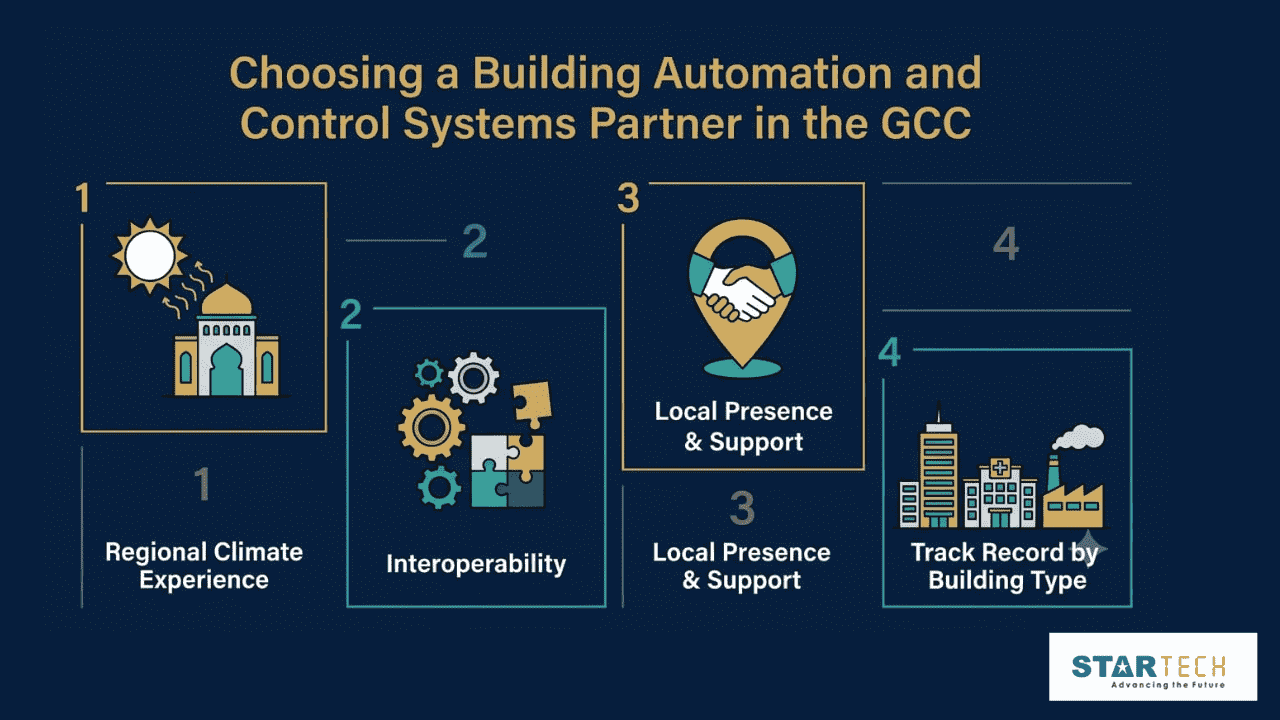
Some integrators struggle with Gulf installations because the extreme temperatures in the Gulf push HVAC automation beyond typical limits, highlighting the need for regional experience. Discover how regional climate experience and interoperability with equipment from several manufacturers can build your confidence in reliable HVAC automation, supported by a local presence that ensures ongoing support and commissioning. A track record of performance across specific building types is key, as towers, hospitals, and industrial sites each have unique specifications, helping you set realistic expectations.
Where Building Automation and Control Systems Are Headed Next
The building automation and control systems market is undergoing rapid change due to rising energy costs, tighter regulations, and an ageing infrastructure, emphasising the importance of your expertise in navigating these shifts. Newer platforms are shifting away from rule-based control towards autonomous operation, opening new opportunities for innovation and growth in building performance.
As connected controllers and sensors expand the attack surface, cybersecurity becomes increasingly vital, with secured communications and zero-trust architectures now recognised as industry standards. A building automation and control system in place today will be able to absorb AI-driven analysis and IoT sensors as they become more commonplace, instead of requiring the replacement of a platform that costs a lot in just a few years.
Conclusion
Building automation and control systems, as well as other intelligent building solutions, have gone from being something to be desired to a fundamental requirement for facilities across the GCC. They assist teams in reducing expenses, achieving sustainability goals, and keeping up with increasing expectations from occupants. In addition, from HVAC automation and predictive maintenance to security integration and compliance reporting, the advantages of a well-designed Building Management System are evident throughout the lifetime of the technology.
Facility owners considering the possibility of building a new structure or an upgrade should consider the building’s automation system and controls as an investment in the long-run infrastructure that pays for itself numerous times over if it is designed and installed correctly in accordance with regional climate conditions and the regulatory conditions.
FAQ
1. What is the difference between a Building Management System and a Building Automation System?
The terms are often used interchangeably; recognising their differences can enhance your understanding. BMS typically refers to the software managing the building’s systems. In contrast, Building Automation System is a broader term that includes controllers, sensors, and software, helping you grasp the full scope of building control systems.
2. How much can HVAC automation reduce energy costs?
Savings differ based on the type of building and the efficiency of existing systems. Facilities typically see significant reductions in HVAC automation and lighting energy usage after the implementation of smart building solutions, which have reduced payback times as the cost of energy rises.
3. What industries benefit most from building automation and control systems?
Commercial offices, hospitality, healthcare, and industrial facilities see the largest gains, since these sectors combine high energy consumption with strict comfort, safety, or compliance requirements.
4. How long does it take to implement a Building Management System or Building Automation System?
The timeframes depend on the size of the building and size and range from several weeks for single-building retrofits to several months for larger projects with multiple sites.
5. What ongoing maintenance does a Building Management System require after installation?
Regular calibration of the sensors and software, and a review of control sequences to ensure that the system is always in sync with how the building is utilised. Facilities teams that do not take this process often see their savings decrease over time.