
7 Powerful Industrial Automation Benefits Transforming Modern Industries
Industrial automation has evolved beyond its initial promise and become a foundational element of modern operations. With increasing manufacturing output and process complexity, industries including oil & gas, utilities, water treatment and manufacturing are rapidly adopting industrial automation at an accelerating rate.
Understanding what industrial automation entails today, its implementation process, and what should be considered prior to investing is critical for engineers, operations managers and procurement leads when making long-term infrastructure decisions.
What Is Industrial Automation and Why Is It Essential for Modern Industry?
Before evaluating specific technologies, it’s essential to gain an understanding of what industrial automation entails and why it has become such a strategic necessity across capital-intensive industries.
1. Let’s understand Industrial Automation Systems
Industrial automation refers to the use of control systems like PLCs, SCADA systems, RTUs and HMIs to oversee industrial processes with minimal human interference. Its scope ranges from single machine control all the way through enterprise-wide process management across distributed field sites.
2. The Evolution of Industrial Automation in Manufacturing
Automation in manufacturing began with relay-based control panels and has since evolved to include programmable logic controllers (PLCs) from the 1970s onward. Now, automation in manufacturing encompasses networked control architectures with real-time data acquisition systems and cloud monitoring platforms, all feeding into larger digital transformation strategies.
3. Key Objectives of Industrial Automation
Core objectives of process excellence include improving process consistency, lowering operational costs, increasing throughput and enhancing safety while simultaneously increasing data visibility and creating resilient systems that scale with operational growth.
7 Powerful Benefits of Industrial Automation for Industrial Operations
Industrial automation offers more advantages than cost savings alone. Here are seven benefits that have been consistently realized across manufacturing, utilities and process industries when automation has been properly implemented.
1. Improved Efficiency and Output Capacity
Automated production lines run continuously without fatigue-related slowdowns. This is one of the key benefits of industrial automation for high-volume operations such as bottling plants. By replacing manual inspection with automated conveyors and vision systems, throughput increases by 30-50% while maintaining output quality standards.
2. Enhanced Product Quality With Consistent Production
Manual processes introduce variation, while automated control systems execute the same logic every cycle, guaranteeing dimensions accuracy, mixing ratios and temperature controls within tight tolerances – this is particularly critical in pharmaceutical manufacturing and food processing industries.
3.Enhanced Workplace Safety
Industrial automation protects workers from dangerous work environments – high-temperature furnaces, toxic chemical handling or high-pressure pipelines – with PLCs and safety relays acting as interlocks that prevent equipment operation under unsafe conditions, significantly decreasing workplace incidents across process industries.
4. Reduced Operational Costs
Though initial investments may seem significant, their long-term returns in terms of reduced labour costs, waste, rework and unplanned downtime are substantial. Furthermore, energy management automation helps minimise utility consumption by optimising equipment running schedules.
5. Better Data Visibility and Decision-Making
Modern automation systems generate continuous process data that, when integrated with SCADA platforms, is visualized in real time allowing operations teams to identify inefficiencies and respond more accurately and quickly when responding to deviations rather than using manual logs as records.
6. Reduced Downtime Through Predictive Monitoring
Condition monitoring sensors that’re part of automation platforms keep an eye on things like vibration and temperature and current draw and pressure trends. They do this to help with maintenance. Condition monitoring sensors look for patterns that’re not normal. If they find something that’s not right they send an alert. This alert happens before something breaks. So we can fix the problem before it is too late. This means we do maintenance when we want to not when something is broken. Condition monitoring sensors help reduce shutdowns that we do not plan for. We use condition monitoring sensors to stay on top of maintenance. Condition monitoring sensors are very helpful for maintenance.
7. Greater Scalability and Flexibility
Modular PLC systems and distributed I/O configurations allow facilities to increase capacity without overhauling their entire control systems. Adjusting logic via software enables the modification of automated lines to meet evolving process requirements without the need for extra wiring expenses.
How PLC Programming Enables Reliable Industrial Automation
PLC programming forms the backbone of many industrial control applications, providing engineers and project teams with essential insight when specifying or upgrading automated systems. Understanding how it works and its application allows engineers and project teams to make better-informed decisions when specifying or upgrading systems.
1. Understanding PLC Programming
PLC programming involves writing control logic that regulates how a programmable logic controller (PLC) reacts to input signals from sensors and field devices. IEC 61131-3 defines several languages to facilitate Programmable Logic Controller programming depending on application complexity: Ladder Diagram, Structured Text and Function Block Diagram are among them.
2. How PLC-Based Control Systems Work
PLCs perform continuous input scanning, logic execution and output control using real-time scan cycles measured in milliseconds. They handle process sequencing, safety interlocks, motor control valve actuation as well as communicating with SCADA systems and HMI panels using protocols like Modbus TCP or PROFINET.
3. Most common applictions of PLC Programming Across Industries
PLCs play an integral role in water treatment by controlling pump sequencing and dosing control, in oil and gas they regulate compressor start-up sequences and emergency shutdown systems, in manufacturing PLC programming drives conveyor logic and batch process control. Discover more about process control systems used across these industries.
Why SCADA System Integration Is Critical for Industrial Automation
SCADA systems are one of the core elements in any industrial automation architecture, offering visibility and centralised control that are critical for operations teams to efficiently oversee complex, geographically dispersed processes.
1. What is SCADA System Architecture
SCADA consist of field devices like RTUs, PLCs and sensors connected through communication networks to a central server running supervisory software that processes incoming data and presents it on operator workstations with graphic displays, trend charts and alarm panels.
2. Real-Time Data Monitoring and Data Acquisition
SCADA continually poll field devices, collecting process values from field devices and sending them back to centralised databases for processing. Operators benefit from having up-to-date visibility into pressures, flows, temperatures and equipment states across geographically distributed sites via one control room interface.
3. Benefits of SCADA System Integration in Industrial Facilities
Effective SCADA system integration offers centralised alarm management, historical trend logging, remote control capability and regulatory reporting. Facilities that integrate SCADA into their PLC infrastructure reduce operator workload while quickly responding to any abnormal process conditions that arise.
Human Machine Interface (HMI): Improving Visibility and Operational Control
HMI platforms serve as the central interface between operators and automated systems, and an efficient team. A well-designed Human Machine Interface will significantly expedite issue identification, response times, and ensure safe process operation.
1. What Is Human Machine Interface (HMI)?
Human Machine Interfaces are visual panels – either hardware- or software-based – designed to allow operators to monitor process conditions and interact with control systems in real time. HMI displays provide real time data from PLCs and SCADA servers in an accessible format that makes sense to control room operators.
2. Key Features of Modern HMI Platforms
Modern Human Machine Interface platforms feature touchscreen interfaces, alarm management with timestamped event logs, trend displays, and secure remote access. Furthermore, they support standard communication protocols enabling integration with PLCs, RTUs and SCADA servers across mixed vendor automation environments.
3. How HMI Improves Industrial Automation Efficiency
Human Machine Interface panels significantly speed up operator response time by quickly notifying operators of critical alarms and process deviations, diagnostic displays help maintenance teams pinpoint faults quickly, and standardised operating procedures standardise operations, decreasing human errors during transitions between processes.
Industry 4.0 and the Future of Industrial Automation
Industry 4.0 represents the next step in industrial facility operations. It builds on existing automation infrastructure by adding connectivity, intelligence, and data-driven decision making at every level of operation.
1. How Industry 4.0 Expands Traditional Automation
Industry 4.0 transforms conventional automation by adding digital connectivity, data intelligence and cyber-physical integration. While traditional control systems were focused on machine-level logic, Industry 4.0 connects this level with enterprise systems for full visibility from field device to boardroom.
2. Smart Manufacturing& Connected Operations
Smart manufacturing uses real-time data from automated systems to dynamically optimize production, while connected operations enable remote monitoring of equipment health, automatic reporting, and coordinated control across multiple sites – capabilities which have become increasingly crucial for managing distributed infrastructure in GCC industrial facilities.
3. Emerging Technologies Shaping Industrial Automation
IoT gateways, edge computing, digital twins and AI-driven analytics are revolutionizing how automation systems function. These technologies enable IoT device monitoring at scale. For teams considering adopting industry 4.0 principles or smart manufacturing frameworks, The International Society of Automation offers helpful overviews.
Real-World Industrial Automation Applications Across Industries
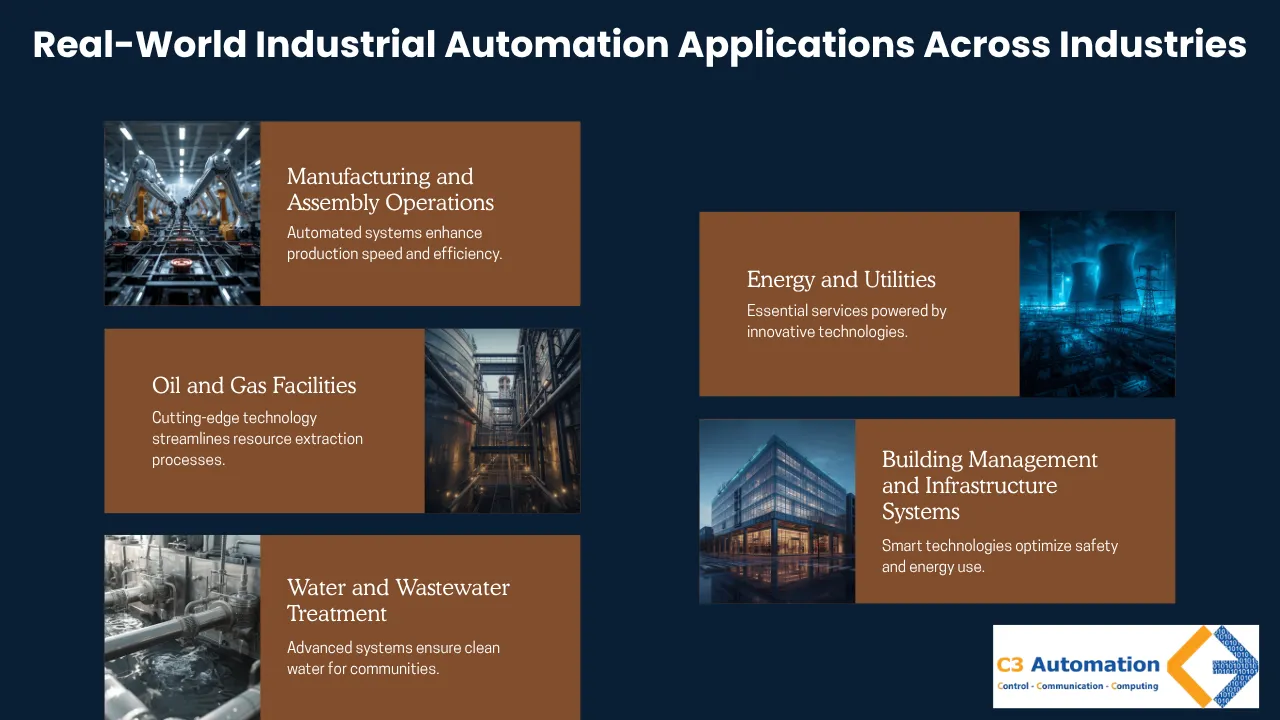
Automation technology transcends industries. The same core principles – PLC control, SCADA integration and HMI visibility — apply across a wide variety of operational environments with their own requirements and challenges.
1. Manufacturing and Assembly Operations
Automotive and electronics manufacturers utilize automation for robotic welding, assembly sequencing, vision-based quality inspection and end-of-line testing. Automated lines reduce cycle times while increasing traceability and providing rapid switching between product variants.
2. Oil and Gas Facilities
Upstream and midstream operations rely on automation for wellhead control, pipeline monitoring, compressor management and emergency shutdown systems. RTUs and SCADA networks enable remote supervision of unmanned assets over large geographic areas.
3. Water and Wastewater Treatment
Water utilities rely on PLC-controlled pumping stations, automated dosing systems and SCADA networks to efficiently coordinate their treatment processes across multiple sites while still meeting compliance regulations – helping ensure consistent water quality compliance while decreasing staffing needs at remote locations.
4. Energy and Utilities
Power generation and distribution facilities utilize automation for load management, substation control and grid monitoring. SCADA systems offer real-time visibility into grid operations for rapid fault isolation and reduced outage duration – read about SCADA applications in power systems to gain an in-depth view into utility use cases.
5. Building Management and Infrastructure Systems
Building automation encompasses HVAC, lighting, access control and energy management in commercial and industrial facilities. Applying industrial automation principles to buildings reduces energy consumption while centralising management from one user interface.
Common Industrial Automation Implementation Challenges and Best Practices
No automation project can go forward without its share of obstacles, but by anticipating and planning for potential implementation challenges upfront, the chances of a successful deployment and long-term system reliability increase considerably.
1. Legacy System Integration
Many facilities employ older PLCs, proprietary protocols, and outdated networks not intended to accommodate modern connectivity needs. Protocol converters – like Modbus RTU to Modbus TCP gateways – enable legacy field devices to communicate with modern SCADA platforms without extensive infrastructure replacement costs.
2. Cybersecurity in Industrial Automation
As systems become more interconnected, OT cybersecurity becomes an unavoidable requirement. Traditional IT security tools may compromise industrial control systems. Therefore, purpose-built OT firewalls, intrusion detection and network segmentation must be employed to secure SCADA and PLC environments. Explore industrial network security considerations in connected automation environments.
3. Workforce Training and Change Management
Automation deployments often fail due to inadequate operator preparation. This risk can often be overlooked when organisations adopt industrial automation for the first time; training programs tied to HMI and SCADA familiarisation are essential for staff readiness.
4. Planning for Scalability
Automation architectures should be designed for future expansion from the outset. By selecting modular PLC platforms, scalable SCADA licences, and open communication standards early on, automation architectures will avoid costly redesigns when production capacity increases or new process lines are added.
How to Evaluate an Industrial Automation Solution for Long-Term Success
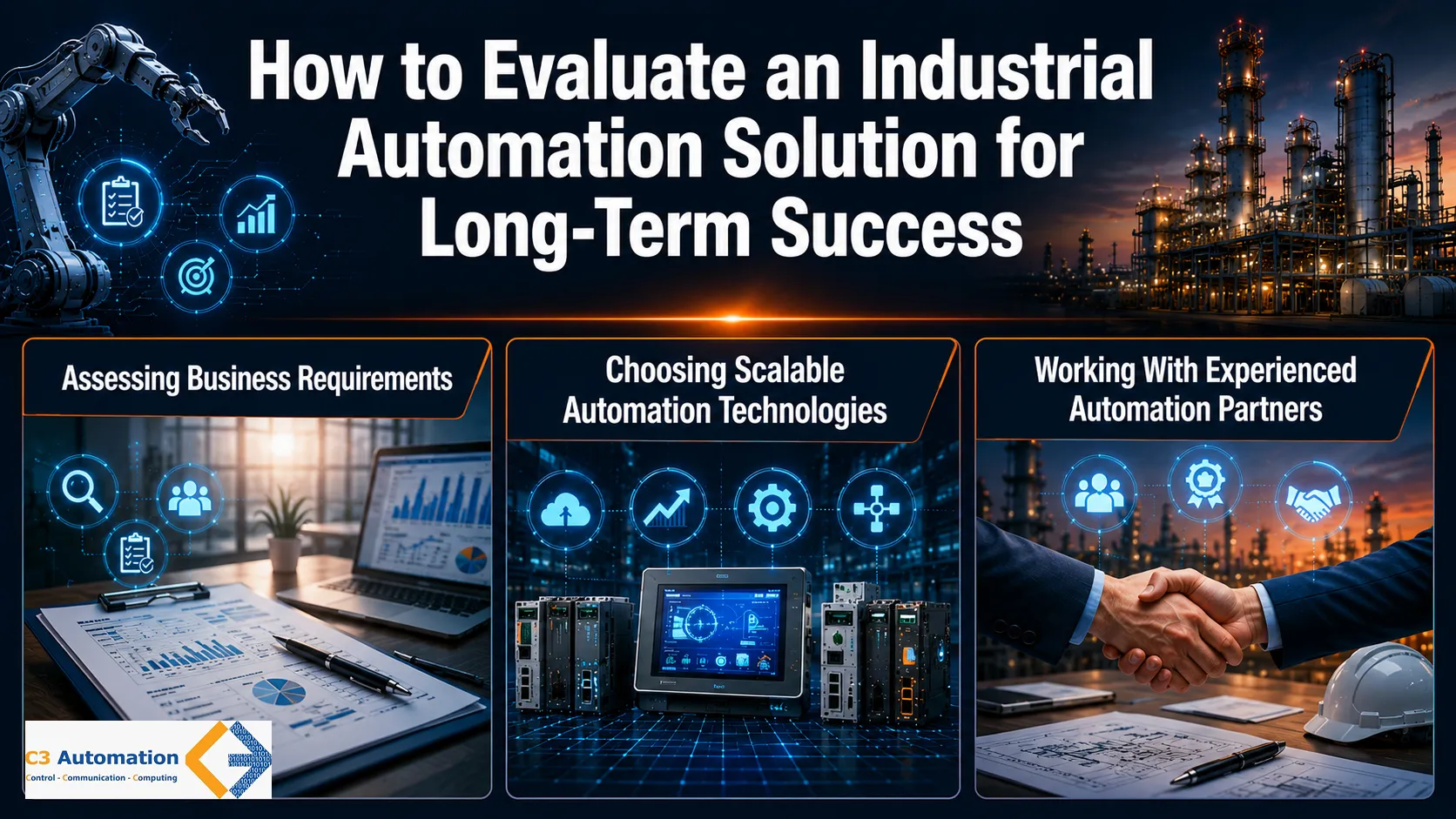
Selecting an industrial automation solution requires more than simply comparing product specifications. A structured evaluation covering business needs, technology capabilities and partner capabilities helps reduce implementation risks while assuring that its value extends over its full lifecycle.
1. Assessing Business Requirements
Before choosing any technology, organizations should identify current process bottlenecks and establish clear objectives at every stage of a facility to avoid scope creep and over-engineering.
2. Choosing Scalable Automation Technologies
Select platforms that support open protocols, have established vendor ecosystems, and offer long-term product availability. Locking into proprietary systems limits future flexibility; as such, lifecycle support and local technical availability evaluation – particularly important factors in GCC – should also be carefully considered.
3. Collaborating With Experienced Automation Partners
Implementation quality has an equal influence on results as equipment selection. When selecting an integrator with experience across your target industry, commissioning risk is reduced significantly and engineering standards are met throughout. Take a look at C3 Automation’s industrial automation services to gain a better understanding of what an experienced integrator should offer.
Conclusion
Industrial automation has progressed far beyond simple machine control. Now it encompasses every layer of an operation from PLC logic on the plant floor to SCADA dashboards in the control room – creating facilities which are safer, more efficient and better equipped to compete in demanding markets.
This guide’s seven benefits of automation aren’t abstract: they represent real results across oil and gas, manufacturing, utilities and water treatment when planned and implemented correctly. Technologies such as PLC programming, SCADA system integration, HMI platforms and Industry 4.0 frameworks all work as part of an integrated system rather than as individual parts.
For GCC industries facing pressure to reduce costs, improve uptime, and meet rising regulatory standards, the question is no longer whether to automate — it is how to do it right.
FAQ
1. What are the main components of industrial automation?
Main components include Programmable Logic Controllers (PLCs), Remote Terminal Units (RTUs), SCADA systems, Human Machine Interfaces (HMIs), sensors and field instruments as well as communication networks and industrial software for data management and visualisation.
2. How does PLC programming support industrial automation?
PLC programming defines the logic that governs how automated systems respond to process inputs. It allows precise, repeatable machine control while also providing safety interlocks and managing process sequencing – as well as data exchange with SCADA and HMI systems.
3. Why is a SCADA system important?
SCADA systems provide centralised visibility and control across geographically distributed industrial assets, offering real-time monitoring, alarm management, historical data logging and remote operation – making it invaluable to utilities, oil & gas operations as well as large manufacturing operations.
4. What is the purpose of Human Machine Interface (HMI)?
An HMI (Human Machine Interface) serves as the interface through which operators interact with automated control systems. It displays live process data, alerts operators to abnormal conditions and allows control inputs – providing greater situational awareness and faster responses during process events.
5. How does Industry 4.0 influence industrial automation?
Industry 4.0 goes beyond machine control into data-driven operations by incorporating IoT connectivity, cloud analytics, digital twins and AI. By harnessing these tools together, it enables predictive maintenance, remote asset management and real-time optimisation capabilities that traditional automation cannot reach.