
Building Management System: 8 Powerful Insights That Transform Facility Control
Each modern facility is based on hundreds of invisibly made decisions throughout the day – such as when to cool a lobby, when to turn off a light in the corridor, and when to lock doors after hours. A Building Management System is the sole platform that takes these decisions in a way that is intelligent, automated, and consistent.
For facility owners throughout the UAE and across the GCC region, where the energy and cooling demands are among the highest in the world, an expertly designed Building Management System isn’t an expensive accessory – it’s the foundation of effective and safe operations.
In this article, we will explain exactly what a Building Management System is and how the HVAC system can be integrated into it, the essential elements that make it function, and the best way to assess the quality of a Building Management System partner before you decide to commit money to one.
This isn’t a repeat of generic definitions – it’s a reflection of how Startech’s automation engineers develop, integrate, commission, and design BMS platforms for commercial and industrial buildings in Sharjah, Riyadh, Muscat, in addition to Abu Dhabi.
The Essential Building Management System Explained
A Building Management System (BMS), often referred to as a Building Automation System (BAS), is a central control system that manages and monitors the building’s mechanical and electrical services from a single dashboard. It comprises heating, ventilation, and cooling (the HVAC Control System), lighting, access control, fire detection, and power distribution.
Instead of a technician manually adjusting thermostats floor to floor, sensors transmit live data to the Building management system, and it performs micro-adjustments in real-time, such as making a damper tighter, dimming a zone, or flagging a malfunctioning pump – often before humans realize any issues.
This results in a building that is closer to its ideal level of comfort and energy all the time, not only when someone is watching it.
5 Core Components Every Powerful BMS Needs
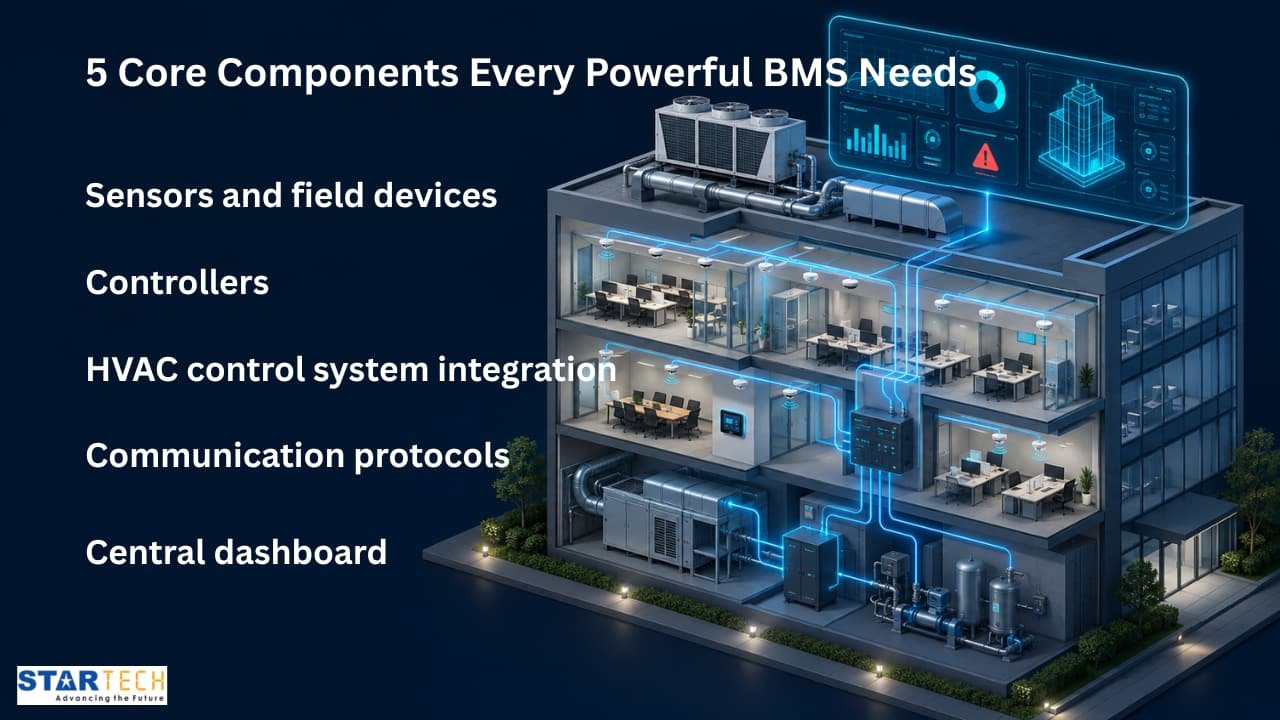
The performance of a BMS can only be as robust as the components it is fed by. In reality, five layers are what determine if the system is performing well or fails to deliver:
1. Sensors and field devices — temperature, humidity, occupancy, and air-quality sensors that .continuously capture real-world conditions, often over IoT-enabled wireless networks.
2. Controllers — the logic layer that interprets sensor data and issues commands to dampers, valves, chillers, and lighting circuits.
3. HVAC control system integration — the mechanical backbone of comfort management, tightly coordinated with the Building management system so heating and cooling respond to actual occupancy and weather load rather than fixed schedules.
4. Communication protocols — BACnet, Modbus, or LonWorks networks that let devices from different manufacturers talk to one platform without conflict.
5. Central dashboard — where facility managers view alerts, trends, and energy reports, and where predictive maintenance flags are raised before equipment fails outright.
If any of these layers is weak – such as sensors that don’t report occupancy properly or a controller system that isn’t able to communicate across protocols– the whole BMS isn’t performing as well, no matter how well-designed the software appears on paper.
The Critical Role of an HVAC Control System in Every BMS
HVAC typically accounts for the single largest share of a commercial building’s energy bill, which is why the HVAC control system sits at the center of almost every BMS deployment. A properly tuned HVAC control system inside a Building management system does three things a standalone thermostat never can:
- Load matches in real time. Cooling output adjusts to actual heat load (occupancy, solar gain, equipment heat) rather than running at a fixed setpoint all day.
- Coordinates zones. Instead of every zone competing independently, the BMS balances chiller output across the whole building, reducing short-cycling and mechanical wear.
- Feeds predictive maintenance. Vibration, pressure, and temperature trends on compressors and air handling units are tracked over time, so a failing bearing or refrigerant leak gets flagged weeks before it causes downtime.
Widely used technical standards for HVAC design and control sequencing already exist in the industry, and most credible BMS integrators align control logic to these established frameworks rather than improvising sequences from scratch.
7 Proven Benefits of Installing a BMS in Your Facility
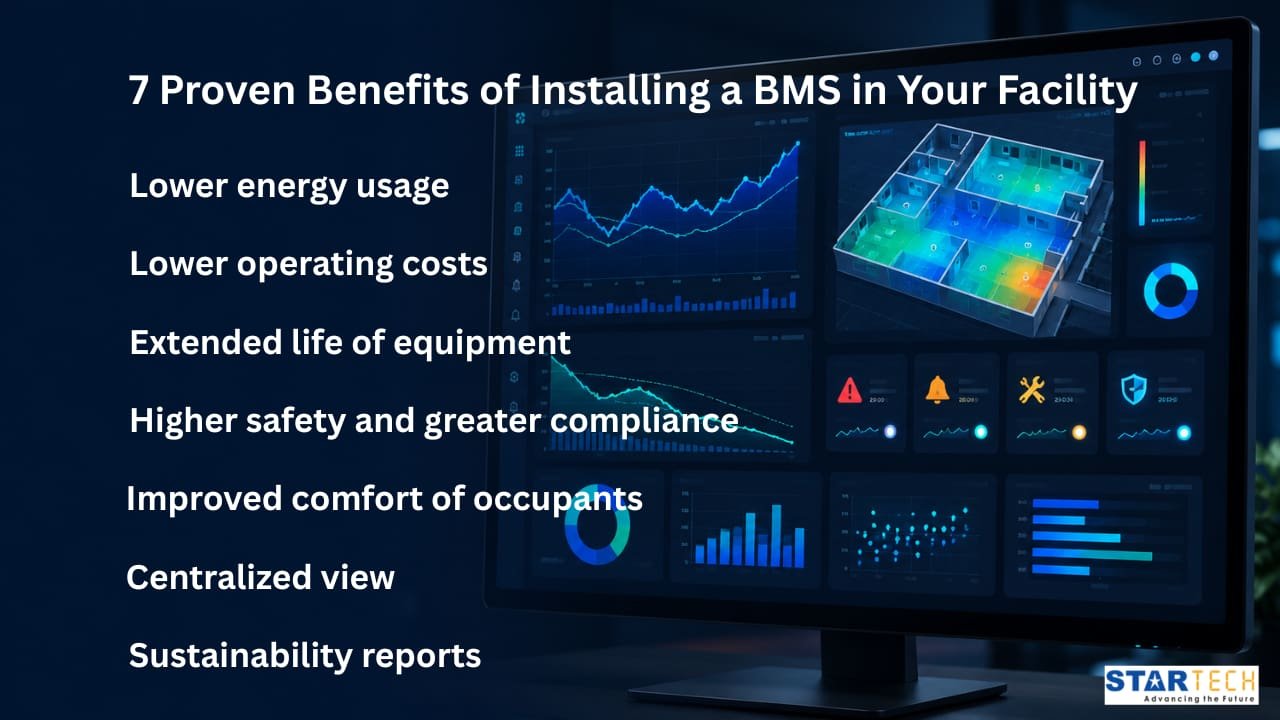
Facility owners who are considering investing in BMS should consider the following: BMS typically reap rewards across seven different areas:
1. Lower energy usage
Instead of running HVAC and lighting according to predetermined schedules, regardless of the actual demand, the Building management system adapts its output in accordance with the actual demand, occupancy, and the time of dayand reducing waste in zones which are not used at all or are empty for long periods of time.
2. Lower operating costs
Fewer manual interventions, fewer callouts for emergency repairs, and a reduction in peak-demand fees all result direct from the system, which detects problems earlier and automatically balances load instead of relying on personnel to spot problems later on.
3. Extended life of equipment
Predictive maintenance monitors the vibration, pressure, and temperatures on chillers, compressors, and air handling equipment, alerting to wear-in weeks before it escalates into a costly breakdown, making sure the investment in mechanical equipment that the building has already made.
4. Higher safety and greater compliance
Integrated fire detection as well as life safety, along with monitoring and control of access, react faster when they’re connected through a single platform. Each incident is automatically recorded to be reviewed for audits or incident review of incidents.
5. Improved comfort of occupants
Temperature and air quality remain consistent across all areas – not just around the thermostat since the BMS is balancing building conditions instead of reacting to one sensor.
6. Centralized view
Facility staff get one dashboard which displays energy, lighting, HVAC, security, and lighting status rather than switching among separate systems that were not intended to communicate with each other.
7. Sustainability reports
4 Essential Types of Building Management Software You Should Know
It is not the case that all BMS platform is made to do the same task. Before choosing one is important to know the strengths of each type and what areas it fails in:
1. Building Automation System (BAS)
This is the hardware-and-software core that directly operates HVAC, lighting, and electrical subsystems using field sensors and controllers. A BAS is what people envision when they hear the word “BMS” – it’s the layer that physically adjusts dampers and valves, as well as lighting circuits in real-time, and is the basis that each software type listed here will eventually plug into.
2. Computerized Maintenance Management System (CMMS)
Rather than managing equipment in real-time, the CMMS is focused on maintenance scheduling, spare-parts inventory, and tracking work orders. It’s the system that facility teams depend on to know when filters are required to be replaced, if the part is available, and also who’s responsible for repairs – transforming maintenance from an involuntary process into one that is documented and trackable.
3. Energy Management System (EMS)
An EMS is specifically designed to monitor the consumption pattern, identify waste, and then automatically shut off unused lighting or HVAC systems in areas that are not being used. While BAS handles the physical control, BAS manages the physical control while an EMS provides analytics over top of that, showing the floors, zones, or time intervals that are responsible for the highest expenses so that facility managers can take action based on data rather than speculation.
4. Integrated security and life-safety
Platforms In a growing number of modern BMS deployments that tie security and fire protection, security and surveilance, and access control into the same view, as do energy and HVAC data. This is especially important in times of emergency, as having access to the status of doors, occupancy, and HVAC smoke-control settings from one single screen can dramatically improve the speed of response.
A majority of facilities do not require running all four as distinct systems. The most efficient deployments incorporate BAS, EMS, and security functions under a BMS umbrella.
This means that information that comes from one system, for example, an EMS alerting an overheated zone – will automatically trigger action in another, like the BAS, altering airflow prior to when it turns into a comfort issue.
5 Warning Signs Your Building Urgently Needs a BMS Upgrade
Many facilities operate with inefficient or ineffective controls for a long time simply because no one has ever failed catastrophically. There are warning signs that indicate that a structure needs a complete Building management system or a major upgrade to the current one:
1. The cost of utility bills keeps rising even though there are no changes in usage patterns or occupancy. This usually points to HVAC systems operating according to fixed schedules rather than reacting to demand.
2. Different zones have extreme temperature variations, and some regions are too cold, and some too warm, which is a common indication of uncoordinated zone-by-zone manual controls.
3. Maintenance will always be reacting. If equipment failures are only discovered when they result in problems for the occupants or cause downtime, no monitoring layer can detect early warning indications.
4. Facility staff use distinct access points or logins for lighting, HVAC, and fire safety and security. There’s no one perspective on what’s happening throughout the entire building.
5. There is no usage information to support sustainability reports, as well as energy audits. This makes it a challenge to find waste or to show that the green building requirements are being met.
If any of these are familiar to you, it’s typically more cost-effective to get a good BMS today than to pay the hidden costs associated with fragmented reactive construction operations.
6 Critical Factors to Weigh Before Choosing a BMS Provider
Protocol flexibility: Before signing anything, you should know whether the system is compatible with various communication protocols or binds the user to a specific hardware manufacturer’s ecosystem for every possible expansion. The vendor lock-in isn’t often mentioned in the initial estimate; however, it is discovered 2 years later, when adding a zone will require paying a premium for components that are from a closed vendor.
Scalability: Is it possible to expand from a single site to a portfolio of multiple sites without having to replace the entire system? Facilities that plan to add floors or buildings over time must ensure that the controller network is scalable without taking it down and reinstalling the base platform.
CyberSecurity position : Is the network monitored and segmented, or is it an open entry point for your IT infrastructure? A BMS that is networked can also be an attack point, so make sure to inquire about how the vendor separates building control traffic from the corporate network.
Local climate experts: Does the integrator really adjust HVAC control systems to hot environments such as the GCC, or do they use general, temporal-climate control logic that fails once temperatures rise?
Predictive maintenance feature: Does the platform identify failures before they occur, or record them after they have occurred? The benefit of predictive maintenance is prior warning. So seek out specific examples of when the system will typically alert you to problems.
After-installation support :Does it have a regional team that is able to respond on-site, and not only remote help desks? Sensor calibrations and controller faults usually require immediate attention; therefore, the proximity of the sensor and its response time are more important than the software.
Trends Shaping the Future of Building Management Systems
The building management industry is changing fast. Three trends are worth keeping an eye on:
- Artificial Intelligence-driven Predictive Control.
Building management system platforms are moving from reactive rule-based logic to artificial intelligence models that forecast occupancy and weather load hours in advance, pre-adjusting HVAC before demand even hits.
- More in-depth IoT convergence.
Sensors are getting smaller and less expensive and are able to feed richer real-time data into BMS platforms, and are reducing the blind spots that separate zones.
- Sustainability-driven mandates.
Frameworks referenced by bodies like the U.S. Department of Energy’s Building Technologies research are becoming more reflected in regional green building codes, urging more facilities towards BMS adoption to stay in compliance.
- Retrofit-friendly and wireless sensors.
As wireless sensor networks get older, retrofitting structures with a complete BMS is getting quicker and less disruptive because fewer walls have been opened up to connect new cables.
Conclusion
t’s important to note that a Building Management System is no longer a “nice to have” bolted onto a structure after the fact. It’s the operating layer that decides the efficiency of a facility or loses money and uptime every year.
In this article, it is evident that the same pattern holds for buildings that combine the HVAC system control, energy management, and security into one BMS platform, which experience lower operating expenses, longer lifespan of equipment, and more peace of mind than buildings operating each system separately.
The climate of the GCC is making this more important. The high temperatures push HVAC loads to the limit all year round, and the cost for poorly designed, manual-controlled structures is lower than in most other places. A properly designed BMS doesn’t just focus on comfort or ease of use. It’s an immediate lever for the cost of energy, as well as maintenance budgets and the value of assets over time.
FAQ
1. What does a Building Management System actually control?
BMS regulates and supervises the HVAC control system of a building, including lighting, life-safety and fire alarm equipment, access controls, and power distribution, managing them all from a central platform, instead of managing each of them separately.
2. Is a BMS similar to an HVAC system?
Not at all. An HVAC control system is a system that manages heating, air conditioning, and ventilation specifically. A BMS is a larger platform that incorporates HVAC control, security, lighting, and energy, as well as fire safety management.
3. What is the amount of energy a BMS really saves?
The savings can vary based on the type of building, climate, and how old the controls are. However, the greatest gains are typically from demand-based HVAC schedules and cutting down on energy consumption in non-occupied zones. This is exactly where a correctly calibrated BMS will first focus its efforts.
4. What kinds of buildings can benefit the most from a BMS?
Industrial facilities, commercial offices, hotels, hospitals, and multi-site portfolios get the most rapid returns since they have high HVAC loads with complicated, multi-system operations that are hard to control manually.
5. How long will BMS installation usually require?
Timelines vary based on the size of the building and how many legacy systems require integration. It can range from a few weeks in one small building to a few months to an industrial rollout that includes customized controller programming.