
Components of Search Engine Marketing (SEM): The Best 2026 Guide
SEM is not a unit but a combination of various parts. Let’s break down the components of search engine marketing one by one. Search Engine Marketing, popularly known as SEM, is one of the most powerful strategies businesses use to get discovered on Google and other search engines .
This happens when people are looking for things they want to buy. Understanding the components of search engine marketing is important for anyone who wants to improve their online presence and bring the right visitors to their website. In SEM, It combines Search Engine Optimization (SEO) and Pay-Per-Click advertising (PPC) to attract highly targeted website traffic and improve conversions.
Search Engine Optimization is when you make your website better so it shows up in search results naturally. You do this by making your website content good and relevant so search engines like it. Pay-Per-Click advertising is when you pay to have your website show up at the top of search results.
In today’s world getting on the first page of search results is a must. It is not something you can ignore. Search Engine Marketing helps businesses do that. It uses both organic and paid methods to make sure people see your business online.
This guide will break down what is search engine marketing made of. It will explain the components of search engine marketing and how SEM works. You will learn about the benefits of SEM. We will also look at the tools you need. We will discuss what is trending in SEM in 2026. We will keep it simple and practical.
What is Search Engine Marketing
So, what is Search Engine Marketing exactly? In simple terms, it’s the practice of increasing your visibility on search engines using both free and paid methods. Search Engine Marketing is a way to make a website show up more on search engine results pages. It does this by using both optimization and paid advertising.
So basically Search Engine Marketing is like a mix of two things: getting a website to show up naturally and paying for ads.in simple terms, SEM = SEO + PPC. When you search on Google you see two kinds of results.
One is the natural results that show up because of Search Engine Optimization and the other is paid ads from Google Ads. These two things work together to make a Search Engine Marketing plan.
Businesses like Search Engine Marketing because it brings people to their website away and also over time. It helps them reach people who are looking for what they are selling.
It also makes their brand well known when people are searching for things. It helps turn visitors into customers by bringing in people who are really interested in what they have.
For example if someone searches for ” digital marketing course” they will see a paid ad from Google at the top. Then they will see a blog post that shows up naturally below it. These two things together are an example of Search Engine Marketing, in action.
Search Engine Marketing is important because it uses both natural search results and paid ads to reach people. This means that businesses can use the components of Search Engine Marketing to get their website to show up on search engine results pages in two ways.
| SEM | SEO |
| Immediate visibility | Long-term growth |
| Paid traffic | Organic traffic |
| Fast results | Slow results |
| Budget dependent | Content dependent |
| Stops when budget stops | Keeps working over time |
| Sponsored trust | Higher user trust |
How Does Search Engine Marketing Works
Each step below reflects one of the working components of search engine marketing in action, SEM is a process made of connected steps, some of them are
Step 1: Keyword research
Every SEM starts with understanding what people are actually typing into search engines. Keyword research identifies these search terms, along with the intent behind them
Step 2: Campaign creation
In SEM, campaign setup includes both SEO and PPC . For SEO, you optimize your website content, headings, internal links, and technical elements. For PPC, you create ad campaigns by choosing keywords, writing ad copy, and setting your target audience.
Step 3: Ad auction and ranking process
When a user searches on Google, Google selects ads through an auction process and also decides which ads appear and their position based on factors like your bid amount, ad relevance, and landing page quality.
Step 4: User clicks
Users may click on either organic results or paid ads, depending on which one best matches their needs. This components of search engine marketing helps your business appear in both, increasing visibility and attracting more customers.
Step 5: Landing page experience
After the click, Users land on a page that matches their search. A good landing page loads quickly, explains the offer clearly, and encourages the user to take action.
Step 6: Conversion tracking and optimization
The final step is tracking performance. Marketers measure clicks, conversions, bounce rate. This data helps improve campaigns and increase return on investment.
Major Components of Search Engine Marketing
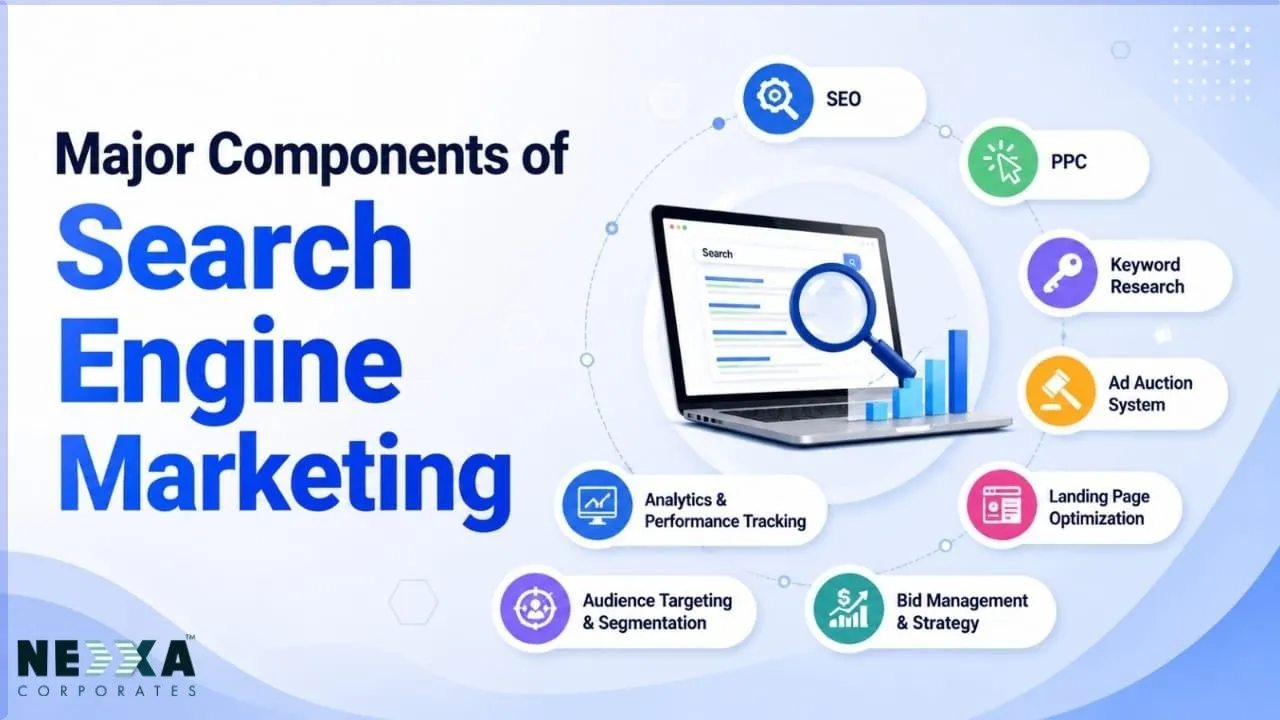
1. SEO (Search Engine Optimization)
SEO focuses on improving organic rankings in search engines without paying for clicks. It includes: On-page SEO , such as content marketing, keywords, meta tags, and heading structure. Off-page SEO: such as backlinks and brand mentions. Technical SEO: such as site speed, mobile-friendliness, crawlability, and indexing.
Example: A blog post that ranks on Google’s first page purely through quality content and backlinks without any paid promotion, SEO is important because it builds long-term traffic and trust.
2. PPC
PPC is a paid advertising model where advertisers pay only when users click their ads. PPC is commonly used in Google Ads and can generate traffic quickly, Budget control and High targeting accuracy
3. Keyword Research
Keyword research is really imporant in components of search engine marketing. It helps us figure out what people are actually searching for on the internet.
This information is useful for creating content that people will want to read and for making ads that will reach the people. When we do keyword research well we can make sure that our content and ads are relevant and that we are not wasting our time.
4. Ad auction system
An ad auction system is how ads get shown on search results. It is based on how much money we are willing to pay for each ad, how good the ad is and if the ad is relevant to what people are searching for. If we understand how the ad auction system works we can make our ads more visible without spending much money.
5. Landing page optimization
Landing page optimization is about making the page that people see after they click on an ad really good. A good landing page should be easy to understand, useful and focused on one thing like getting people to fill out a form or make a purchase.
6. Bid management and strategy
Bid management and strategy are important for pay per click advertising. We need to decide how money we are willing to pay for each click or conversion. If we are smart about how we bid we can balance our budget, get a lot of traffic and get results.
7. Audience targeting and segmentation
Audience targeting and segmentation let us show our ads to the people. We can target people based on where they live, what device they use, what language they speak, what they are interested in and how they behave. If we segment our audience we can show ads that’re really relevant to specific groups of people.
8. Analytics and performance tracking
Analytics and performance tracking help us see how our ads are doing. We use tools to track how many people are visiting our website, how many people are converting how much money we are spending and what people are doing on our website. This information helps us make our ads better, in the future.
These eight elements together make up the full components of search engine marketing that drive real results for a business.
Essential SEM Tools Every Marketer Should Know
These tools are support the different components of search engine marketing, from keyword research to performance tracking.
1. Google Ads
2. Google Keyword Planner
3. Google Analytics 4
4. Google Search Console
5. SEMrush
6. Ahrefs
How SEM Creates a Complete Digital Marketing Funnel
SEO will help build organic visibility that contributes to awareness and trust. PPC, on the other hand, helps provide instant traffic that allows business to access users instantly when they need them. Landing pages help turn website visitors into leads or customers.
Analytics, on the other hand, helps marketing professionals understand what works and what does not. Remarketing and retargeting is another benefits of SEM. It allows businesses to present their advertisements to those who already visited the website and failed to convert.
Benefits of SEM
The benefits of SEM go beyond just visibility,it’s one of the few marketing methods where results are fully measurable. Understanding the components of search engine marketing is really good for businesses. It helps them get noticed fast because paid campaigns can put a business at the top of search results right away.
Components of search engine marketing also helps businesses reach the people so they can focus on the things that matter like what people are searching for, where they are, what device they use and how they behave online. With SEM businesses can see what they get for their money because they can track every click and every time someone does what they want them to do.
SEM is also a way to grow a business because it is easy to make campaigns bigger or smaller depending on how much money a business has and what they want to achieve. Because SEM helps businesses connect with people who are already looking for something it brings in people who are ready to buy right away.
One of the biggest benefits of SEM is that it gives businesses a lot of control over their campaigns. They can use SEM to reach people who are searching for things online. This means businesses can use components of search engine marketing to get people to visit their website or store.
SEM is a way for businesses to get their name there and get people to notice them. The main thing about components of search engine marketing is that it helps businesses get customers and make more sales.
for example, Take a small ecommerce store, for instance. Once they started running SEO and PPC side by side instead of picking just one, their traffic and leads picked up within a matter of months. That’s really the whole point of SEM ,organic and paid working together tend to move faster than either one on its own.
Why SEM is Important for Businesses in 2026
Understanding the components of search engine marketing helps to businesses stay ahead as search keeps changing. SEM is super important in 2026, this is because how people search for things is getting more competitive and is based on data.
Search engines are using AI to help people find what they are looking for,this means businesses have to make sure they show up in both the search results and the paid ads.The competition for ad space on search results pages is getting tougher.
So businesses need to target their ads and make sure their landing pages are great. People are mostly searching on their phones so it’s really important that websites load fast and are easy to use. Components of search engine marketing helps businesses to get a return on investment faster, than other marketing methods.
This is because you can track the results clearly. It helps businesses make decisions and control their budgets. SEM results are measurable which supports decision-making and budget control. One of the benefits of SEM is Businesses can see how well their SEM efforts are doing.
Modern Trends in Search Engine Marketing
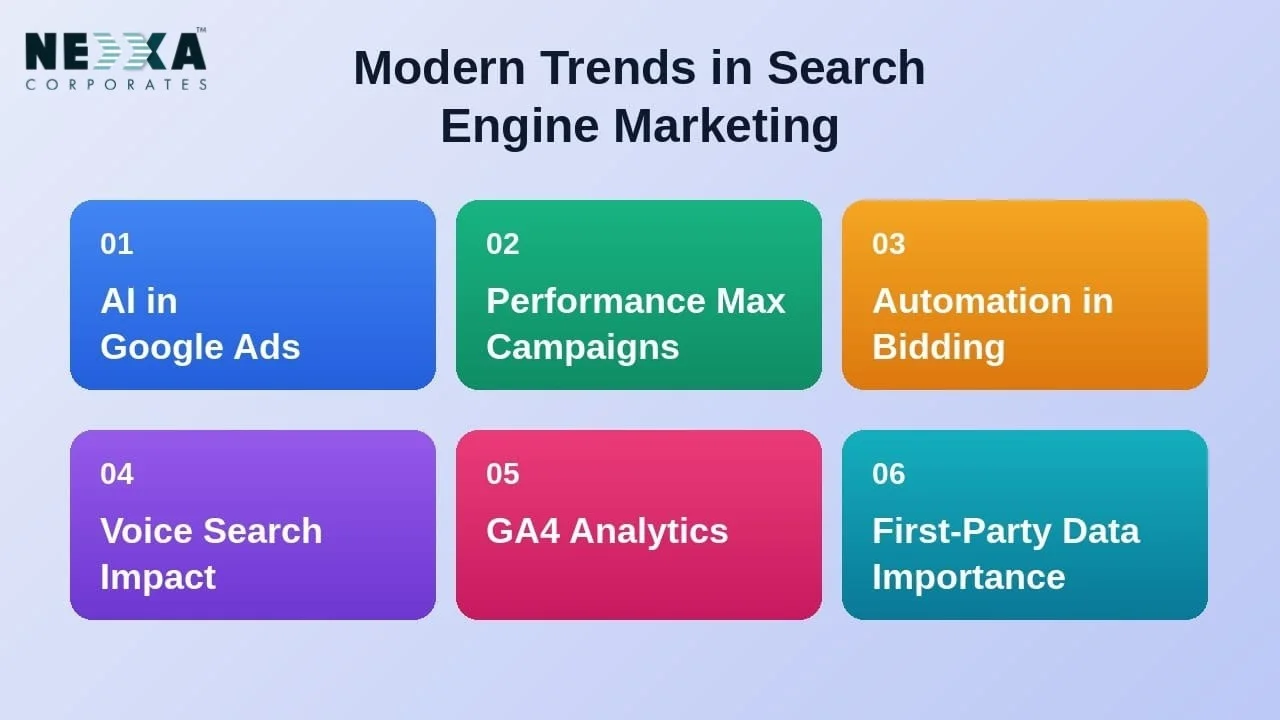
1. AI in Google Ads
Artificial intelligence has become a key part of Google Ads. AI helps advertisers improve audience targeting, automate bidding strategies, create more relevant ads, and optimize campaign performance based on real-time data.
2. Performance Max Campaigns
Performance Max campaigns allow businesses to advertise across multiple Google channels, including Search, Display, YouTube, Gmail, Discover, and Maps, from a single campaign. Google’s AI automatically identifies the best placements to maximize conversions.
3. Automation in Bidding
Smart bidding uses machine learning to adjust bids automatically for every auction. It analyzes factors such as user intent, device, location, and time of day to help achieve goals like increasing conversions or maximizing return on ad spend (ROAS).
4. Voice Search Impact
With the rising popularity of voice assistants, the way people search on the web has been affected. Companies need to focus their SEM campaigns on natural keywords and searches in the form of questions.
5. GA4 Analytics
Google Analytics 4 (GA4) uses an event-based measurement model instead of the traditional session-based approach. This gives marketers to understand more about user behavior, customer journeys, conversion rates through websites and apps.
6. First-Party Data Importance
Now that the laws about privacy have changed and third party cookies have decreased in reliability, the value of first party data has risen. The first party data collected by businesses from their customers can be used to make personalized marketing campaigns, target an audience, make good marketing decisions, and budgeting advertisements.
This demonstrates the way in which search engine marketing continues to change through the use of AI, automation, and data. Businesses that embrace these changes will be able to improve their campaigns and reach marketing goals.
Common Mistakes in SEM
Many SEM campaigns fail because of avoidable mistakes. Wrong keyword targeting, Ignoring landing page quality, No conversion tracking, Poor ad copy, Weak campaign structure, Not testing or optimizing regularly.
A strong SEM strategy requires constant improvement. Even small mistakes can reduce clicks, increase costs, or lower conversions. That’s why a strong SEM strategy isn’t something you set up once , it needs constant attention and improvement to keep working well.
Apart from not falling prey to such basic errors, marketers must pay attention to aligning keywords with search intent in order to ensure that their ads target only those customers who are ready for action. Checking search term reports periodically will help in identifying any waste, whereas A/B testing ad copy will ensure continuous improvement in ad messaging.
The allocation of budget is another key factor, since a reallocation of the budget to those keywords and campaigns that are performing well could greatly improve the return on investment.
Conclusion
you need to know about these components of Search Engine Marketing to make a plan that really works. Search Engine Marketing is really good because it uses the long term power of Search Engine Optimization and the immediate impact of Pay Per Click to create a plan that gets results.
From researching keywords and ad auctions to making sure the landing page is tracking conversions every part is important in helping businesses find the right people at the right time.
As people keep changing how they search for things because of Artificial Intelligence using their phones to browse and being more careful, with their data businesses that use a Search Engine Marketing strategy will do better. They will be able to stay visible and make money in 2026 and after that.
If you are just starting or making your campaign better you need to know about these parts of Search Engine Marketing to make a different plan that actually works.
FAQ
1. What are the major components of search engine marketing?
The main components of Search Engine Marketing are SEO, PPC, keyword research, ad auction system, landing page optimization, and conversion tracking.
2. What is landing page optimization in SEM?
It is the process of improving the webpage where users click an ad. It focuses on fast loading speed, clear design and relevant content to increase conversions.
3. How does SEO differ from SEM?
While SEO focuses on organic ranking, SEM involves the use of SEO as well as paid methods in order to boost search engine visibility. The main benefits of SEM is that it gives quick as well as organic results.
4. what are the latest modern trends in SEM?
Modern SEM trends include AI-powered bidding, Performance Max campaigns, marketing automation in Google Ads and google analytics.
5. How is PPC used in SEO?
Pay Per Click method in which businesses pay for ads when people actually click on them. This means businesses only pay when someone clicks on their ad.Platforms like Google Ads use PPC to help businesses reach potential customers quickly.