
Industrial Automation: Types, Components, Benefits & Applications in the UAE
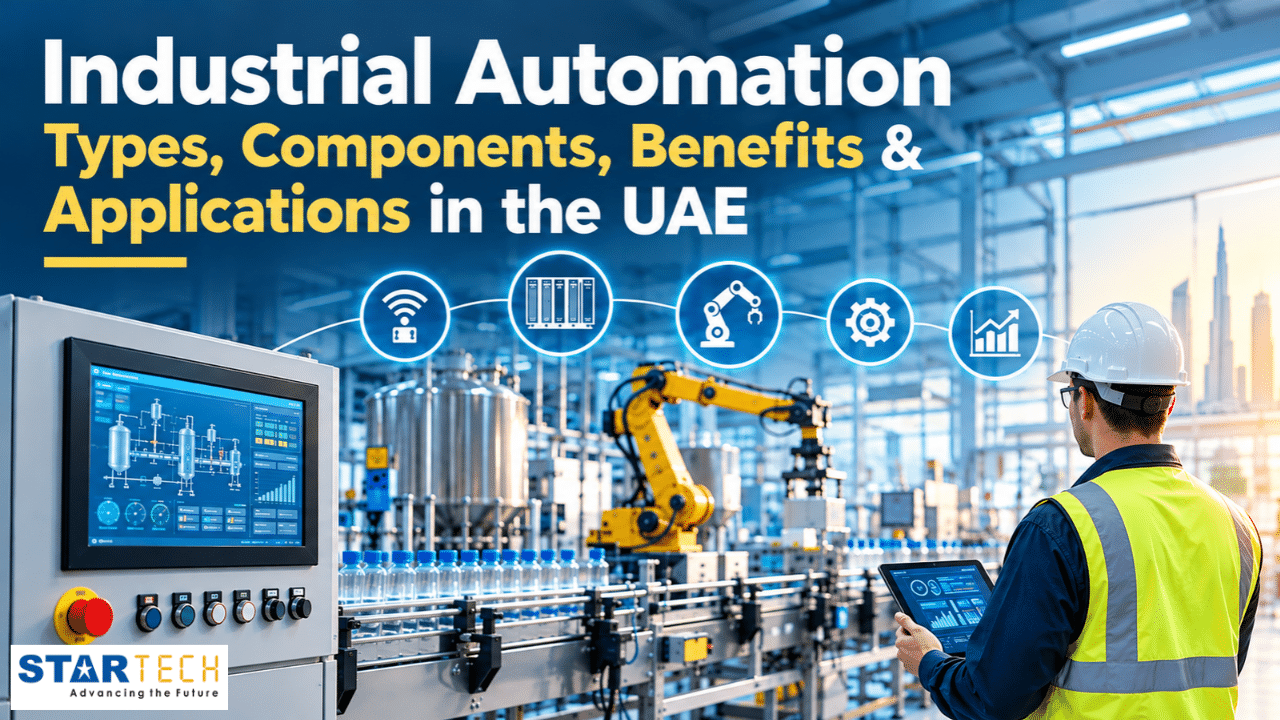
Industrial automation is the use of control systems, sensors and software to run machines and processes with very little manual input. Walk through almost any modern plant in the UAE, from a bottling line in Sharjah to a pump station near Abu Dhabi, and you’ll see it quietly doing its job. This guide is for plant managers, procurement teams and facility managers who want a clear, practical picture. We’ll cover the types, key components, benefits, real applications, how to upgrade old systems and how to choose a provider you can trust. In short, a good system needs tough hardware, a secure network and a partner who is still around after installation.
What Is Industrial Automation?
Let’s start simple. Industrial automation means using technology to control industrial processes, so people spend less time on work that is repetitive, risky or needs great precision. A typical system has three parts. Sensors read what’s happening. A controller decides what to do. The work is done by actuators like valves and motors. The screens enable the operators to see what is going on and to intervene if necessary.
The basic automation meaning is simple: a machine or computer program does a job that a person used to do by hand . Automation can fill bottles, mix a batch or hold a tank at the right temperature.
Why is this approach used in many UAE plants? Automation is efficient, with machines keeping up for hours. Automation also means safety as people are kept away from heat and pressures.
How Industrial Automation Works
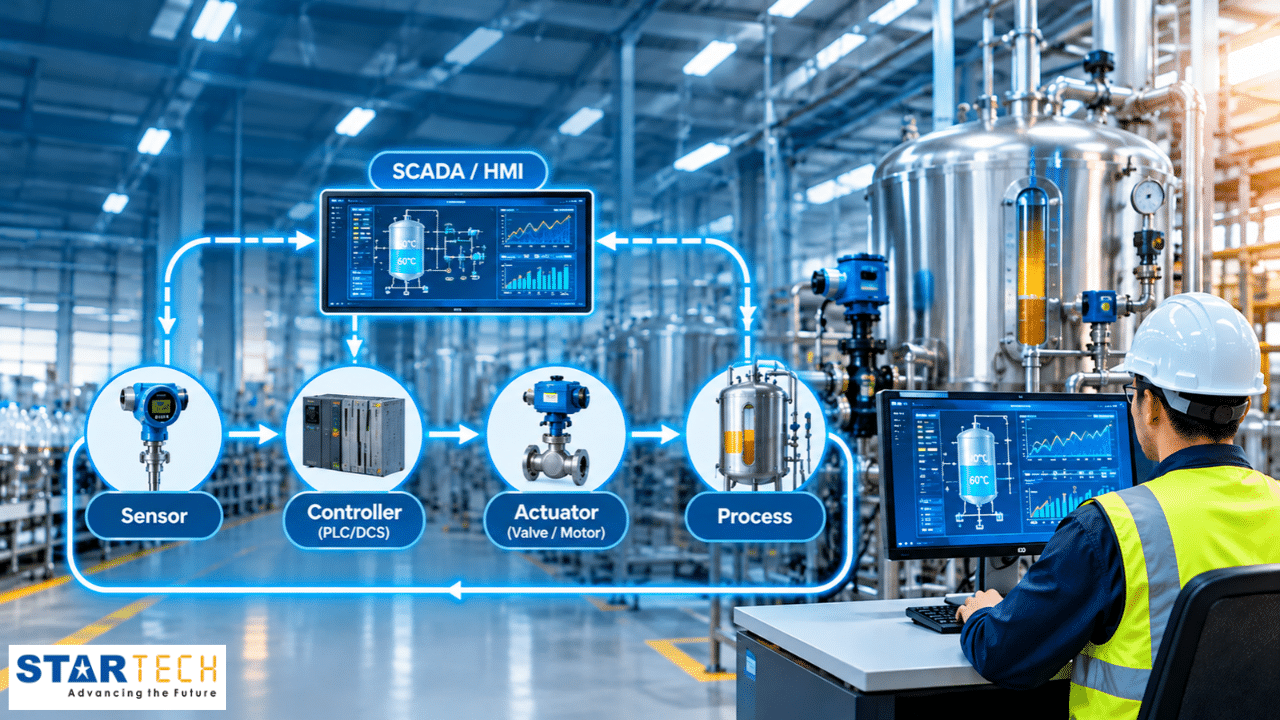
Think of a loop with four steps. Sensors collect data like temperature, pressure, level or flow. Controllers (a PLC or DCS) read it and decide. Actuators (valves, motors, pumps) act. SCADA and HMI screens let operators see it all and change settings.
Here’s an everyday example. A tank has to stay at 60°C. The sensor reads 58°C and tells the PLC. The PLC sees the tank is too cool and opens a steam valve a little. At 60°C, it closes the valve. The operator watches it on an HMI screen, and nobody has to stand next to the tank. Repeat that thousands of times a day and you have industrial automation at work.
Industrial Automation vs Autonomation
You might also hear the word autonomation, or jidoka. It’s from Toyota, and it means automation that can detect a fault and stop itself. The classic case is the auto loom. When a thread breaks, the loom shuts down itself and no bad cloth gets produced.
| Point | Industrial Automation | Autonomation |
|---|---|---|
| Focus | Speed and repeatable output | Quality and catching faults |
| Human role | Sets up, monitors, maintains | Steps in when the machine stops itself |
| Goal | More output, less manual effort | No defects passed to the next steps |
What’s the point? A lot for quality focused plants like pharma and food. Generally, it’s a lot cheaper to catch a fault up front than to find a bad batch later on. Most modern lines employ both ideas: industrial automation for speed, autonomation for quality.
Types of Industrial Automation
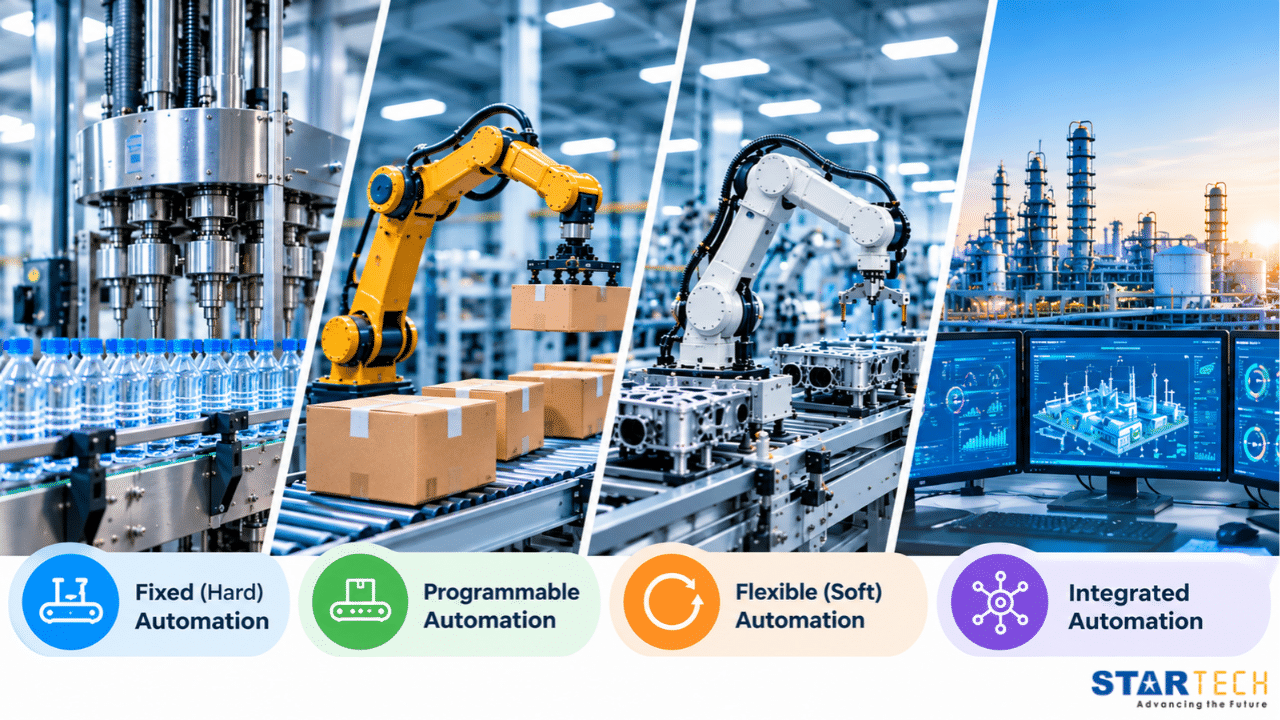
There’s no single best choice. The right type depends on how much you produce and how often your product changes.
Fixed (Hard) Automation
Built for high-volume lines that make one product, like bottling or a dedicated assembly line. It’s fast and cheap per unit, but hard to change once built.
Programmable Automation
Think batch production. The machines are changed to do things for each group of products so it works for factories that make a group of items in cycles. There might be some time needed to get everything, between each group.
Flexible (Soft) Automation
Made to switch between tasks quickly usually with very little time when nothing is being made. If you often change the kinds of products you make, this is an option.
Integrated Automation
A complete system that brings everything together. Machines, quality checks, inventory and management systems all share information so the entire plant works as one system.
| Type | Best for | Changeover | Typical Use |
|---|---|---|---|
| Fixed | One product, high volume | Slow and costly | Bottling, packaging |
| Programmable | Batches | Moderate | Mixing, batch processing |
| Flexible | Frequent product changes | Fast | Mixed-product lines |
| Integrated | Whole plant | Depends on setup | Large, connected facilities |
So which fits you? If you make one product all day, fixed is usually enough. If your range keeps changing, look closely at flexible or integrated industrial automation.
Key Components of an Industrial Automation System
Every system is built from a few groups of industrial automation equipment: controllers, operator screens, field devices, drives and panels, and the networks that tie them together. At Startech we supply many of these through our partner Advantech, including ADAM remote I/O modules, UNO industrial computers, industrial switches and gateways.
One thing people often forget: UAE conditions are hard on equipment. Summer heat, dust and coastal humidity wear out ordinary hardware faster than you’d expect. Before buying, check the operating temperature range, the IP rating (our IP67 guide explains the numbers) and whether the computer is fanless, like our rugged fanless industrial computers.
PLC Full Form: What Is a Programmable Logic Controller?
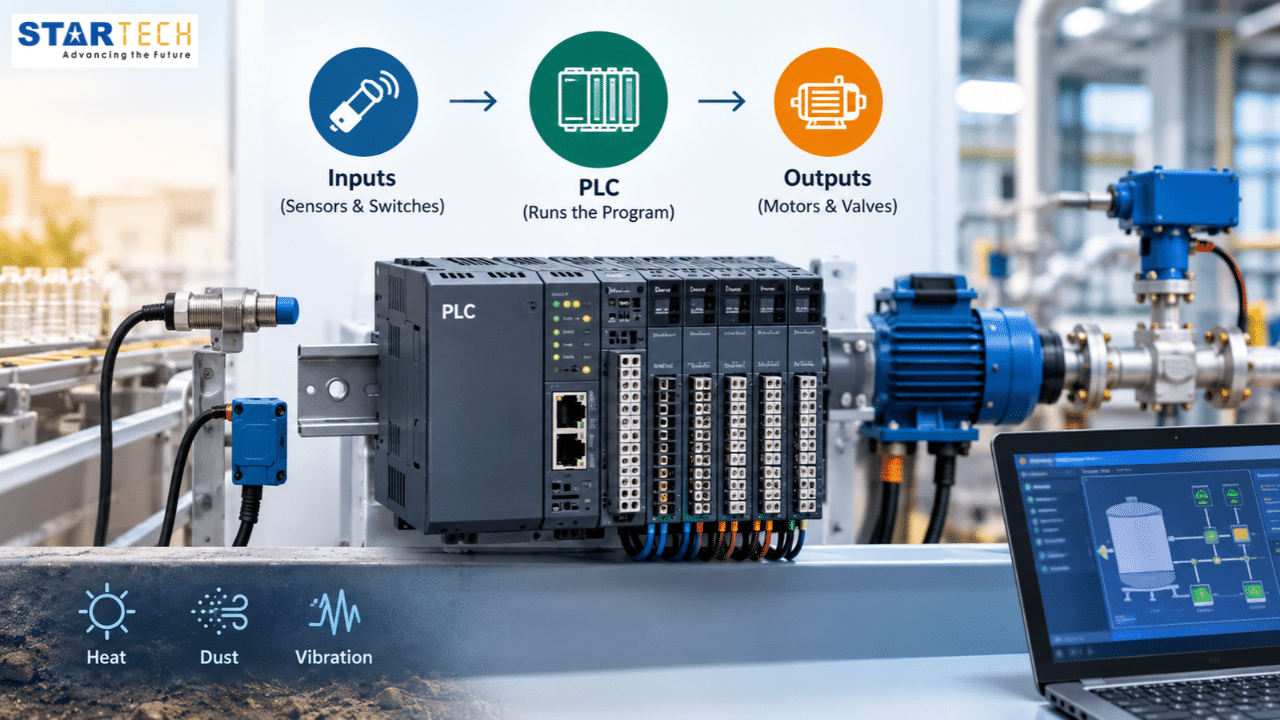
PLC stands for Programmable Logic Controller. It’s a rugged industrial computer that reads inputs (like sensors and switches), runs a program and controls outputs (like motors and valves).
The PLC full form actually explains the job. Programmable means you can change the logic. Logic means it follows clear if-then rules. Controller means it controls equipment. PLCs are built to handle heat, dust and vibration, which is why you find them on packaging lines, pump stations and process plants. More on our PLC control panel page.
SCADA and HMI
SCADA (Supervisory Control and Data Acquisition) is software that monitors and controls equipment across one site or many. An HMI (Human Machine Interface) is the screen at the machine where operators see what’s happening and change settings.
People often ask how PLC, DCS and SCADA differ:
| Type | Best for | Changeover | Typical Use |
|---|---|---|---|
| Main job | Controls one machine or process | Controls a whole continuous process | Monitors and logs many sites |
| Best for | Machines, packaging, pump stations | Refineries, chemical and power plants | Pipelines and water networks |
| Speed | Very fast, real time | Real time, built for stability | Slower, built for supervision |
A simple way to remember it: the PLC acts, SCADA watches. See our pages on SCADA systems and HMI solutions.
Sensors, Actuators and Instrumentation
Sensors catch pressure, temperature, flow, level and vibration. Sensors act as the eyes that see the inside of a plant. Actuators listen to the controller’s signal. Then move, such as opening a valve or turning on a pump. Actuators turn the signal into action. Good instrumentation is the foundation because controllers can only act on data that instrumentation can trust. Instrumentation must be reliable. Browse our wireless I/O and sensors and data acquisition range.
VFDs, Drives and Control Panels
A VFD (variable frequency drive) changes the speed of a motor. On pumps and fans, that can cut energy use. Control panels hold the PLCs, drives, breakers and wiring in one safe enclosure. See our electrical panel page.
System Integration and Networks
System integration connects separate systems, from field devices up to MES and ERP software, so they work as one environment instead of isolated islands. Without it, you get machines that run well alone but can’t share data.
Devices communicate using protocols such as Modbus, Profinet, EtherNet/IP and OPC UA. Gateways help translate between these systems. Our guides on industrial network switches and on communication protocols and gateways go into detail.
Connected machines need protecting too. Split the plant network into zones, limit who can reach each one, and follow standards such as IEC 62443. Our posts on OT network segmentation and OT cyber security show how.
Benefits of Industrial Automation for UAE Plants
- Less downtime: Automated monitoring can spot problems early like a motor that runs hotter than normal so the maintenance team can fix it at a scheduled time instead of in an emergency.
- Safer operation: Machines can work in places such as oil and gas sites or hot process zones and safety systems can shut the process down in seconds if something goes wrong.
- More consistent quality: The same settings run every time, so you get fewer errors, less rework and less waste.
- Higher output: Teams that track Overall Equipment Effectiveness can see how planned time a machine really spends making a good product and fix the losses.
- Flexibility and 24/7 running: Machines run through the night without tiring and a programmed machine switches to a new product much faster than a manual line.
- Lower energy costs: Drives and smart controls use power only when it’s needed, which adds up across pumps, fans and compressors.
Now the honest part. Automation has headaches: the cost, the need for trained staff, linking new systems to old ones and cyber risk after machines are online. None of these is a reason to wait for Automation. A clear plan and a partner who gives training and support make Automation manageable.
Industrial Automation Applications in the UAE
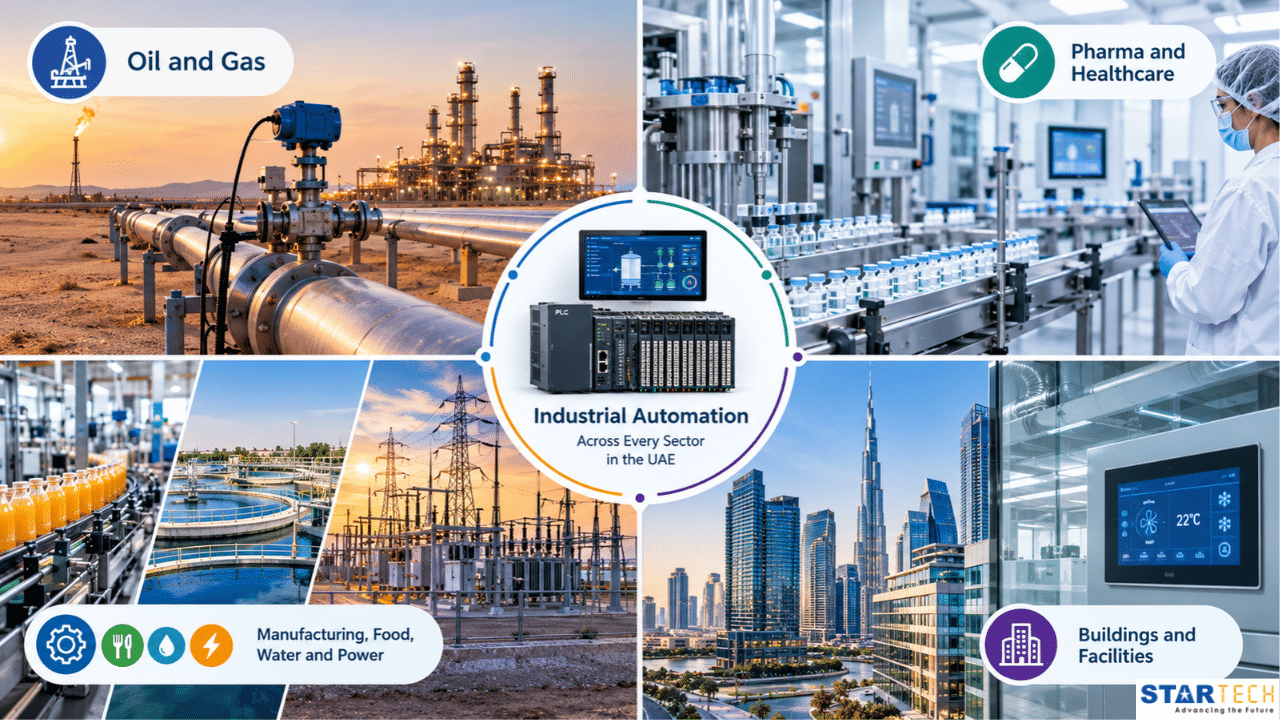
The UAE has a mixed industrial base, from oil and gas to food, water, pharma and huge buildings, so demand for industrial automation is spread across many sectors.
Oil and Gas
Automation monitors wells and pipelines, runs safety systems and controls valves. Remote sites are far from the control room, so they need rugged equipment that survives heat and dust, plus reliable links back to operators. Read our guide to automation in the oil and gas industry.
Pharma and Healthcare
Automation in pharma industry plants is about batch control, traceability and compliance. The system records every step of a batch, often following the ISA-88 recipe model, so teams can show exactly what happened and when. That helps meet strict quality rules and cuts human error.
Manufacturing, Food, Water and Power
Automation runs on production lines controlling mixing, filling, packing and quality checks. Automation keeps a pace. In water and wastewater plants automation drives pumps and manages tanks. Runs treatment steps, around the clock. Automation raises an alarm when a reading goes out of range. In power networks, it supports substations and grid monitoring. See our water and wastewater solutions and our guide to substation automation.
Buildings and Facilities
Building management systems look after HVAC, lighting and energy use across offices, malls and hospitals. Learn more about building automation and control systems.
Retrofitting and Upgrading Legacy Systems
Good news: you may not need a new plant, just a smarter one. It’s probably time to upgrade your industrial automation system if:
- your PLCs are obsolete and the maker no longer supports them,
- you can’t find spare parts,
- faults and unplanned stops are getting more frequent,
- you still read gauges and write numbers down by hand.
Upgrade or replace? Upgrading in stages usually leads to costs and less downtime. A full replacement makes sense when the old system cannot connect to modern devices at all.
The usual steps: first audit what you have. Then plan what to keep and what to replace. Next migrate the program and wiring in stages. Test every input, output and alarm carefully. After that commission the setup train the team and finally hand over the system. Our team can help at each stage. See our industrial automation services.
Industry 4.0, IoT and AI in Industrial Automation
Industrial automation isn’t only about control anymore. It’s about data too. Industry 4.0 is the wider idea of connected, data-driven factories, and automation is the base it sits on.
- Industrial IoT connects machines and sensors, so a manager can check a pump station from the office instead of driving out to site. See our IoT monitoring page.
- Predictive maintenance services a machine when it needs it, not on a fixed calendar. Vibration, heat and current often change before a part fails, and the system can flag it early.
- Digital twins and AI let teams test changes on a virtual copy of a line and spot patterns people miss. Read our post on AI in industrial automation.
These tools build on a solid base. If your sensors, controllers and network are reliable, adding data gets much easier.
Cost of Industrial Automation and How to Plan the ROI
There’s no single price, because every project is different. The main cost drivers are the scope of work, the equipment you choose, integration with your existing systems, training and ongoing support.
To estimate payback, add up the savings you expect: less downtime, lower labour costs on repeat tasks, lower energy use and less waste. Then compare that with the project cost. A phased rollout helps too, because it spreads the investment and lets you prove the benefit on one line before you expand.
How to Choose an Industrial Automation Provider in the UAE
A good supplier is more than just a provider of products. Check their background, look for evidence of past customers, connections with brands and certifications and availability of the after-sale support.
A checklist you can copy:
☐ Have they worked in our industry?
☐ Can they show UAE or GCC references?
☐ Are they an authorised partner of the brands they supply?
☐ Do they offer training and pre-sales advice?
☐ Who handles repairs, and how fast?
☐ Can they support us in more than one emirate or country?
At Startech FZE, we supply and support industrial automation equipment across the GCC, with offices in Sharjah, Abu Dhabi, Riyadh and Muscat. We’re an Advantech certified partner, and our Abu Dhabi office is ICV certified. Our team also offers product training, pre-sales support, and onsite project and RMA services. If you’d like to talk it through, see our industrial automation services.
Conclusion
Industrial automation isn’t about replacing people. It’s about letting machines handle the repetitive, risky and precise work so your team can focus on the decisions that actually need a human. Done well, it helps plants run safer, steadier and at lower cost, and it gives you data to improve every month.
In this guide we’ve covered the four types of automation, the key components from PLCs and SCADA to sensors, drives and networks, and the benefits you can expect. We’ve also looked at real uses across UAE industries, how to upgrade old systems without starting from scratch, and how to choose a provider who will still support you years after installation.
There’s no single right answer. The best setup depends on your process, your scale and the equipment you already have. Many plants start small, with one line or one panel, prove the results and then expand. That’s a perfectly sensible way to begin.
If you’re not sure where to start, a short conversation can save you a lot of time and money. Speak to an engineer, or ask for a site assessment and get a clear picture of what makes sense for your plant.
Talk to our industrial automation team →
FAQ
1. What is the full form of PLC?
PLC stands for Programmable Logic Controller. It’s an industrial computer that controls machines using a stored program.
2. What are the main types of industrial automation?
Four: fixed (hard), programmable, flexible (soft) and integrated. The right one depends on how much you make and how often the product changes.
3. What is the difference between automation and autonomation?
Automation runs a task without manual effort. Autonomation also spots a fault and stops the machine.
4. Which industries in the UAE use industrial automation the most?
Oil and gas, water and wastewater, power, manufacturing, food and beverage, pharma and large buildings. Any site that runs around the clock gains from it.
5. How long does an automation upgrade take?
It depends on size. A single panel can take days, while a whole plant is often done in phases over months. An audit gives you a realistic timeline.