
IoT Applications in the GCC: 10 Real-World Uses Across Industry
Spend an afternoon at a gas processing plant in Sharjah, a water treatment facility in Riyadh or a logistics yard in Muscat and you will notice something that was rare fifteen years ago. Small, quiet devices are talking to each other all day long. Pressure, temperature, vibration, flow, voltage, location. Nobody is walking the site with a clipboard to collect those numbers any more. They arrive on a screen, with an alert attached if something looks wrong.
That is the Internet of Things (IoT) at work. In the GCC, where plants run in extreme heat, assets are scattered across huge distances and governments are pushing hard on digital transformation, IoT applications are no longer “future projects”. They are operating equipment, as normal as a pump or a switchboard.
At Startech FZE we have supplied industrial IT, networking and automation products across the UAE, Saudi Arabia, Oman, Qatar, Kuwait and Bahrain for more than 20 years. As an Advantech partner, and with brands such as Durabook, Getac, Neousys and Winmate in our portfolio, we spend our days helping engineers, integrators and plant owners choose hardware that survives the field and still delivers clean data. This guide pulls together what we see working in the region, the mistakes we see repeated, and a practical way to start.
What Do We Mean by IoT Applications?
An IoT application is any system in which physical equipment such as sensors, meters, controllers, vehicles or cameras collects data, sends it across a network, and leads to a useful action. That action might be an alert to a technician, an automatic valve adjustment, a maintenance ticket or a weekly energy report.
Two terms often get mixed up:
1. IoT is the broad idea of connected devices, from a smart thermostat to a fleet tracker.
2. IIoT (Industrial IoT) is the same idea applied to factories, utilities, plants and infrastructure, where the stakes are higher. Downtime costs money, a failure can be a safety event, and devices must run for years in harsh conditions.
How an Industrial IoT System Is Built
It helps to picture four layers. Every successful project we have seen got all four right, and most failed projects were weak in one of them.
Layer 1: Sensing and data acquisition
This is where the physical world becomes data. Sensors measure temperature, pressure, flow, level, vibration, gas concentration or energy. Wireless I/O and sensors are useful where cabling is expensive, while data acquisition (DAQ) modules and remote I/O collect signals from existing equipment and instruments.
Layer 2: Connectivity
Data has to get from the field to wherever it is processed. That means industrial Ethernet switches, industrial routers, serial device servers, media converters and protocol converters. Industrial sites rarely speak one language. Modbus, OPC UA, MQTT, BACnet and proprietary protocols often coexist, and gateways and RTUs translate between them. Our page on communication protocols and gateways explains the options in more detail.
Layer 3: Edge and cloud processing
Not every decision should wait for a round trip to the cloud. Edge computers filter, analyse and act on data locally, then send only what matters upstream. Depending on the site, that could be a rugged fanless industrial computer, an embedded automation computer or an edge AI GPU system for video and machine-vision workloads. Aggregated data then flows to a private or hybrid cloud, which we cover under Industrial Cloud Solution (IIoT).
Layer 4: Visualisation and action
People need to see what is happening and sometimes intervene. This layer includes panel PCs, touch panel PCs, operator panels, industrial monitors and SCADA or web-based dashboards such as WebAccess software and Edge SRP.
Keep these four layers in mind. When someone asks us why their IoT pilot is not delivering, the answer is almost always a missing or underpowered layer: sensors that drift, a network that drops, an edge case that overheats or a dashboard nobody trusts.
Ten IoT Applications Working Across the GCC
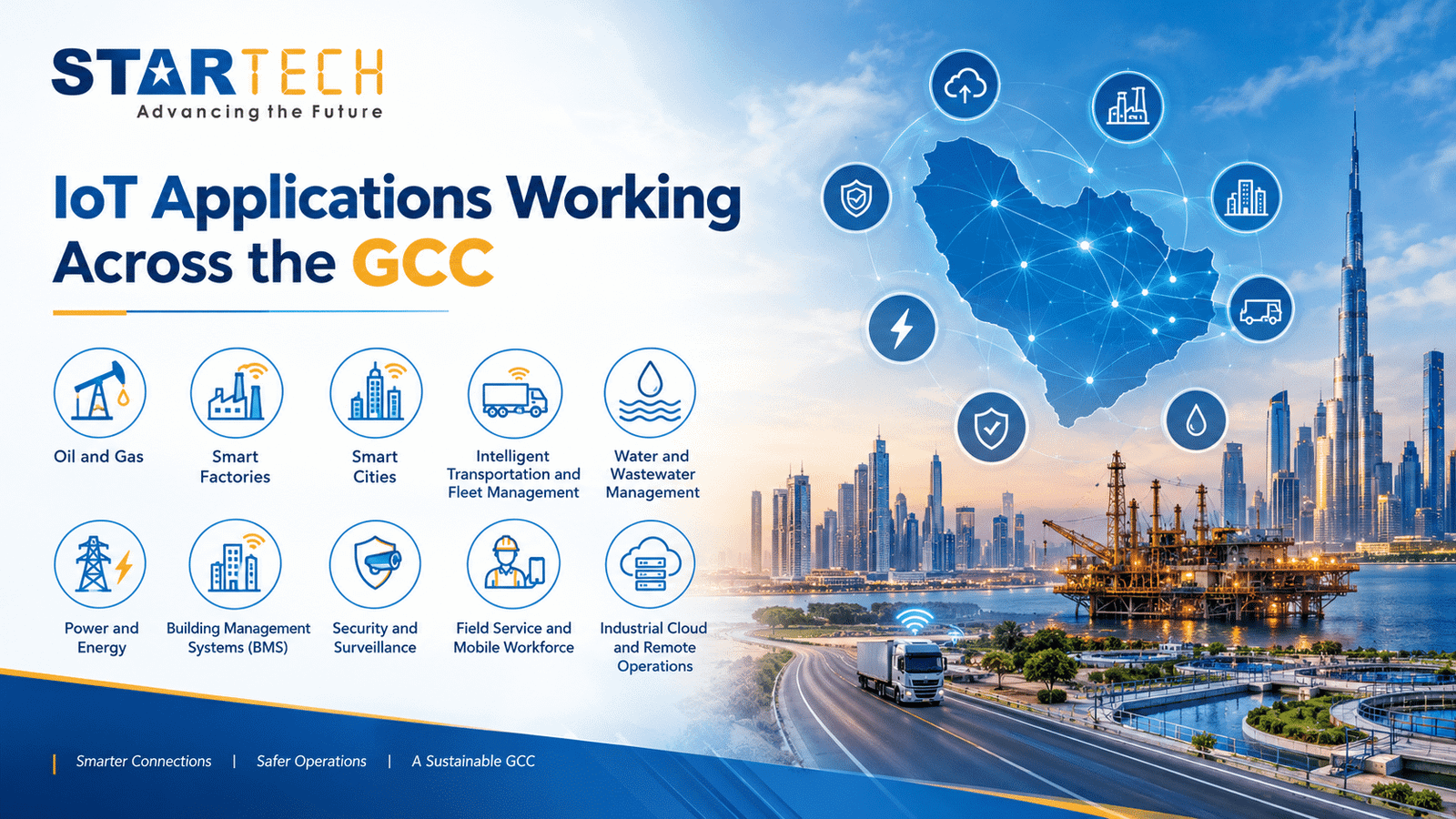
1. Oil and gas: remote monitoring of hazardous, distant assets
Pipelines, wellheads, compressor stations and storage tanks are often hours from the nearest control room, and some sit in hazardous areas where sending people is costly and risky. IoT lets operators watch pressure, flow, tank levels, leak indicators and equipment health from a central location.
In practice, a typical architecture uses ruggedised RTUs or gateways at the field site, cellular, radio or satellite backhaul, and an edge computer that filters data before it travels. The value shows up in fewer unnecessary site visits, faster detection of abnormal conditions and better records for compliance and audits.
2. Smart factories: connected machines and predictive maintenance
A smart factory is simply a plant where machines share their status with each other and with people. The practical wins are straightforward:
- Predictive maintenance. Vibration, temperature and current trends reveal a failing bearing or motor weeks before it stops a line.
- OEE tracking. Overall equipment effectiveness measured from real machine data, not end-of-shift estimates.
- Quality traceability. Linking process parameters to each batch so a defect can be traced to its cause.
- Energy monitoring. Spotting which machine, line or shift is wasting power.
Most factories do not start from a blank sheet. They have older PLCs and machines speaking different protocols, which is why protocol converters and DAQ modules are usually the first purchase, long before any analytics platform.
3. Smart cities: connected infrastructure at scale
Dubai and Abu Dhabi are among the most closely watched smart cities in the world, and Saudi Arabia’s large-scale development projects are building digital infrastructure from the outset. Typical Smart City & IoT include:
- Adaptive traffic signals and congestion monitoring
- Smart parking and public transport information
- Connected street lighting that dims or brightens based on conditions
- Environmental monitoring for air quality, noise and temperature
- Waste collection routing based on bin fill levels
- Public safety systems with networked cameras and sensors
These systems depend on reliable outdoor networking, power over Ethernet at the edge and equipment that tolerates dust, heat and humidity.
4. Intelligent transportation and fleet management
Transport is a natural IoT use case because vehicles are already mobile data sources. Fleet operators track location, fuel use, driver behaviour and engine diagnostics. Public transport operators provide live arrival information, and logistics companies monitor cargo conditions such as temperature for sensitive goods.
In-vehicle hardware has to survive vibration, heat soaking in parked vehicles and unstable power. That is why in-vehicle rugged fanless computers and rugged tablets are standard here, rather than office-grade devices.
5. Water and wastewater management
Water is precious in the Gulf, which makes loss prevention a serious concern. IoT sensors monitor flow, pressure, level and quality across distribution networks. Utilities use the data to find leaks, balance supply and schedule maintenance. Inside treatment plants, connected instruments help automate dosing and track process conditions.
Many water sites are remote and unmanned, so the backbone is dependable remote communication: RTUs, cellular routers and, for battery-powered sensors over large areas, LPWAN technology.
6. Power and energy: substations, distribution and renewables
Utilities and energy providers use IoT to monitor substations, track loads, detect faults and integrate solar and other renewable sources into the grid. As more distributed generation comes online across the region, real-time visibility is becoming essential rather than optional.
Substation environments have their own demands: electromagnetic interference, strict reliability expectations and long equipment lifecycles. Panel meters, substation-grade managed switches and monitored switches form part of this picture.
7. Building management systems (BMS)
In a hot climate, cooling is one of the largest operating costs of any building. An IoT-enabled building management system connects HVAC, lighting, access control, fire systems and energy meters into one view. Facility teams can spot a failing chiller, an overcooled floor or an after-hours lighting waste pattern before tenants complain or the bill arrives.
BMS projects benefit from open protocols and clear integration between subsystems.
8. Security and surveillance
Modern surveillance is an IoT system too: networked cameras, access control, intrusion sensors and a central platform. The practical challenges are bandwidth, power and storage. That is why PoE switches and injectors are widely used for powering and connecting cameras, and why on-site video analytics on edge AI computers is growing, since analysing video locally cuts the amount of data that has to travel.
9. Field service and mobile workforce
IoT is not only about fixed sensors. Technicians in the field carry rugged laptops and tablets that connect to asset data, maintenance history and work orders. A technician who can see live readings from a machine while standing next to it fixes problems faster and gets it right the first time.
Devices used outdoors, in plants or on defence and infrastructure sites need to handle drops, dust, glare and heat.
10. Industrial cloud and remote operations
Once data is flowing, the question becomes where to put it. Many operators keep time-critical decisions at the edge and push aggregated data to a private or hybrid cloud for analytics, reporting and cross-site comparison. This also enables remote operations: engineers can monitor several sites from one control centre, and experts can support plants without travelling.
Why the GCC Environment Changes the Rules
vice written for temperate climates does not always travel well. Here is what we see differently in the Gulf.
Heat is the first enemy. Enclosures on outdoor sites can run far hotter than the ambient air temperature, especially in direct sun. A device rated for office conditions may work in the lab and fail in its first summer. Always check the operating temperature range of every component in the cabinet, not just the main controller. Fanless designs also help, because fans are a common failure point in dusty environments.
Dust and sand get everywhere. Sealed, fanless enclosures and proper ingress protection matter. Ask what the ingress rating is, and what the real maintenance schedule looks like.
Distances are large. Pipelines, water networks and highways stretch over long routes with limited infrastructure, so connectivity planning (cellular, radio, fibre, LPWAN, satellite) is a design decision, not an afterthought.
Projects are ambitious and timelines are tight. National digital transformation programmes mean deployments are often large and fast. That makes local stock, local support and quick RMA turnaround more valuable than a slightly cheaper unit shipped from overseas.
Regulation and local content matter. Government and large enterprise projects may look at in-country value and certified local presence. Our Abu Dhabi office is ICV certified, and we maintain offices in Sharjah, Riyadh and Muscat to support customers across the region.
Security: The Part People Postpone
Every connected device widens the attack surface. In an office, a compromised device is an IT problem. In a plant or utility, it can become a safety and continuity problem. A few principles we recommend to every customer:
Segment the network. Keep operational technology (OT) separate from corporate IT, with controlled gateways between them.
Change default credentials. It sounds obvious, and it is still one of the most common weaknesses.
Limit remote access. Use secure, authenticated, logged connections rather than open ports.
Patch with a plan. Industrial devices cannot always be updated on a whim, so set a managed update process.
Follow recognised standards. The ISA/IEC 62443 series is the widely referenced framework for industrial automation and control system security, and NIST publishes helpful guidance on IoT cybersecurity.
Monitor the network. Managed and monitored switches give visibility into what is connected and how it is behaving.
Choosing the Right Hardware
Software gets the headlines, but hardware decides whether a system is still running three years later. When we help customers specify equipment, these are the questions we start with:
- What is the real operating environment? Temperature range, dust, moisture, vibration, shock, chemical exposure, hazardous area classification.
- What interfaces and protocols are needed? Serial, Ethernet, fieldbus, wireless. Do you need to talk to existing PLCs and meters?
- How much processing must happen on site? Simple data forwarding needs very little. Video analytics and AI inference need far more.
- What power is available? Mains, 24 V DC, vehicle power, solar. Wide input ranges and protection against surges help a lot.
- How long must it last? Industrial products come with long-term availability programmes. Consumer hardware often does not.
- What support is available locally? Pre-sales, training, onsite help and RMA handling all matter on day one and day one thousand.
How to Start an IoT Project: A Practical Roadmap
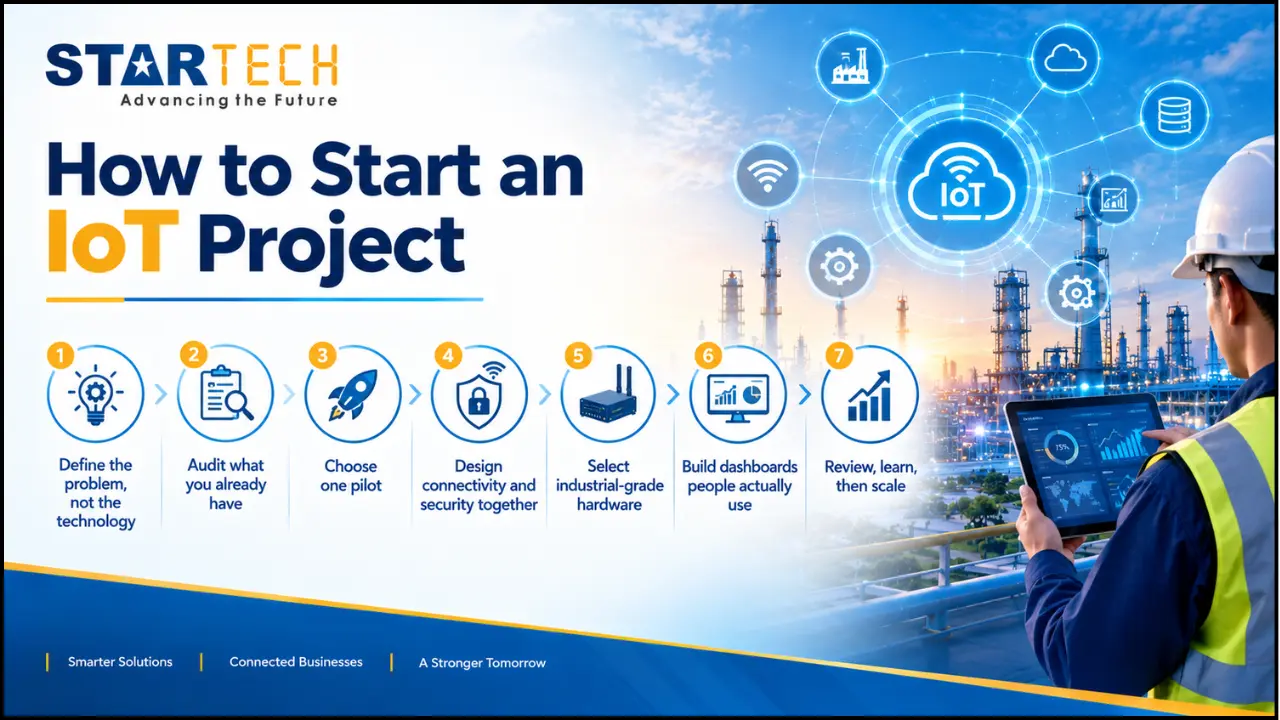
Step 1: Define the problem, not the technology
“We want IoT” is not a goal. “We want to cut unplanned pump downtime by a third” is. Write down the business problem and how you will measure success before you buy anything.
Step 2: Audit what you already have
List your existing controllers, meters, machines, protocols and network infrastructure. You will usually find more usable data than you expected, locked behind older interfaces.
Step 3: Choose one pilot
Pick one line, one site or one asset class. A focused pilot is easier to fund, easier to troubleshoot and easier to explain to management.
Step 4: Design connectivity and security together
Decide how data will travel, where it will be processed and who is allowed to access it. Retrofitting security later is expensive and painful.
Step 5: Select industrial-grade hardware
Match components to the real environment, with margin. Specify spares and agree support arrangements up front.
Step 6: Build dashboards people actually use
Show operators the few numbers they need to make decisions. A screen with 80 gauges is ignored. A screen with five clear indicators and sensible alarms is used.
Step 7: Review, learn, then scale
After a few months, compare results against your original measure. Fix what did not work, then replicate what did.
Why Work With Startech FZE
Startech is a one-stop sales and service centre for industrial IT, networking and industrial automation products in the GCC. With more than 20 years in the industry and distribution across Bahrain, Kuwait, Oman, Qatar, Saudi Arabia and the UAE, we are an Advantech certified partner that also works with Durabook, Getac, Neousys, Winmate and other leading brands.
What that means for your project:
- Pre-sales support: help specifying the right product for your application and environment
- Product and technical training: so your team understands what it is deploying
- Onsite project and RMA services: demos, on-site assistance and handling of defective units
- Regional presence: offices in Sharjah (head office), Abu Dhabi, Riyadh and Muscat
FAQs
1. What are the most common IoT applications in industry?
Remote asset monitoring, predictive maintenance, energy management, smart metering, fleet tracking, building automation and video surveillance are among the most widely deployed.
2. What is the difference between IoT and IIoT?
IIoT is IoT applied to industrial environments such as factories, utilities and energy sites. It demands higher reliability, longer product life, tighter security and tolerance for harsh conditions.
3. Which industries in the GCC benefit most from IoT?
Oil and gas, power and utilities, water management, manufacturing, transportation and facilities management tend to see the strongest returns because they operate large, distributed or energy-intensive assets.
4. Do I need to replace my existing equipment to adopt IoT?
Usually not. Gateways, protocol converters and DAQ modules can connect existing PLCs, meters and machines to a modern platform.
5. What is edge computing and why does it matter for IoT?
Edge computing processes data close to where it is generated, instead of sending everything to the cloud. It reduces latency, saves bandwidth and keeps critical functions running if the connection drops.
6. How secure are IoT systems for critical infrastructure?
They can be secure when designed properly, with network segmentation, device hardening, access control and adherence to standards such as ISA/IEC 62443. Security has to be planned from the start.