
What Is the Internet of Things (IoT)? Meaning, Working, Examples and Uses in the GCC
Every plant, building and fleet brings us to the simple question: what is the equipment doing right now and what is the equipment about to do? The Internet of Things exists to answer that question without anyone walking the floor with a clipboard.
So what is the Internet of Things? In other words the Internet of Things (IoT) is a network of physical objects, such as sensors, machines, vehicles, meters and everyday devices. These objects are connected to the Internet or a private network so they can collect data, share data and act on data with very little human involvement.
This guide explains the Internet of Things meaning in language how the Internet of Things works, the main components and architecture real‑life examples, benefits, risks and how industries across the GCC are putting the Internet of Things to work. Startech FZE has been supplying IT, networking and automation equipment in the region for over 20 years as an Advantech certified partner so much of what follows comes from real project experience.
IoT Meaning and Definition
The Internet of Things tells us that many physical items now include sensors, software and built-in connectivity. These items can send data to devices and systems. The Internet of Things can include any object: a temperature sensor in a cold room, a water‑level transmitter at a pumping station, a smart meter, on a building, a fitness band or a rugged tablet held by a technician.
What makes an item part of the Internet of Things is not the item itself. What matters is the cycle of sense, send, analyze, act. A sensor first senses a condition. Then the device sends the reading. Software then analyzes the data. Finally something happens – an alert, a report or an automatic adjustment.
IoT Full Form and a Short History
The IoT, which stands for the Internet of Things is a term that is usually credited to technology researcher Kevin Ashton. Kevin Ashton first used the phrase in the 1990s while he was working on RFID tracking in supply chains. The idea behind the IoT is older. Machines were already being watched from afar using telemetry and SCADA systems long before the term became popular.
What changed in the decade was the cost and the reach of the IoT. Sensors became cheaper. Wireless networks improved. Cloud platforms matured. Edge computers grew powerful enough to process data where it is created. That mix is why the IoT moved from pilot projects to operations.
How Does IoT Work?
Think of IoT as a chain with five links:
Devices and sensors capture data such as temperature, pressure, vibration, flow, location or energy use.
Connectivity carries that data over Ethernet, Wi-Fi, cellular, LoRaWAN or other links.
Gateways and edge devices collect data from many sensors, translate protocols, filter noise and sometimes make quick local decisions.
Cloud or on-premise platforms store the data and run analytics.
Applications and dashboards show the results to people, or trigger actions automatically.
Here is a simple example. A vibration sensor on a pump sends readings to a gateway. The gateway forwards them to a monitoring platform. When the pattern starts to look like early bearing wear, the system raises a maintenance ticket before the pump fails. Nobody had to walk the floor with a clipboard.
Components of IoT
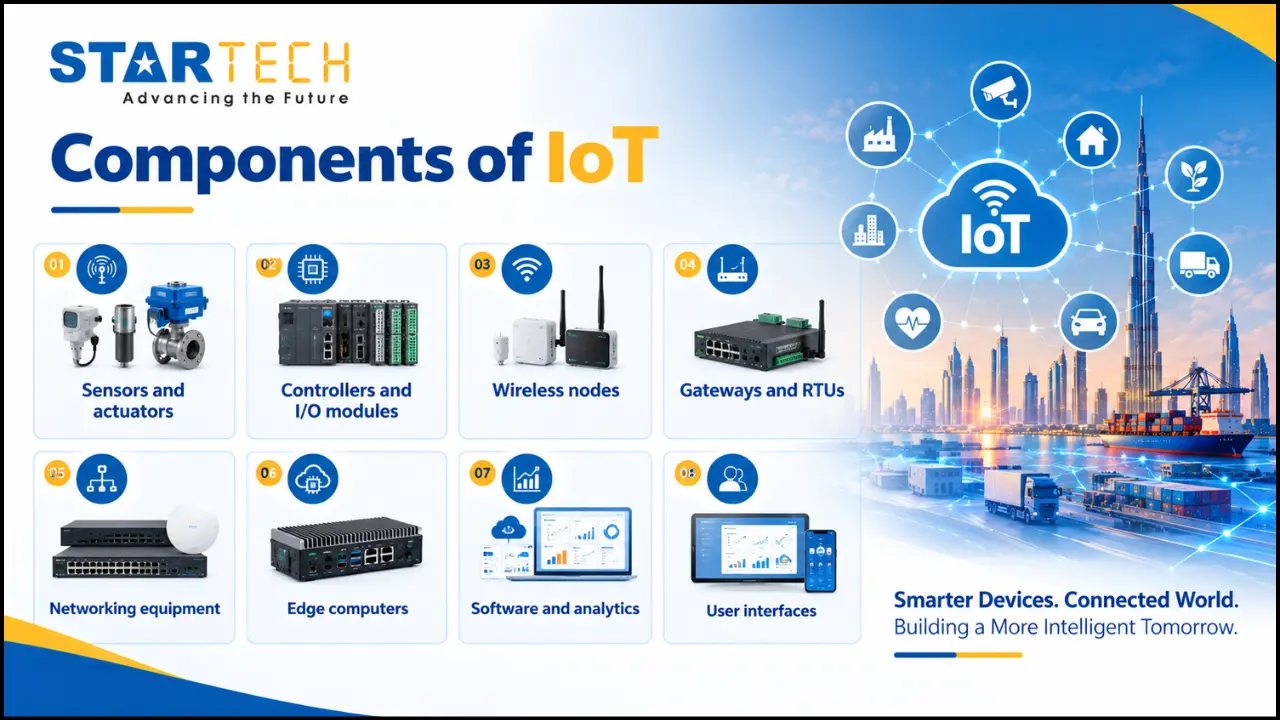
Every IoT system, big or small, is built from the same few building blocks:
- Sensors and actuators: sensors measure, actuators do something (open a valve, switch a relay, start a motor).
- Controllers and I/O modules: devices such as automation controllers and I/O and remote I/O gather signals from the field.
- Wireless nodes: where cabling is hard or costly, wireless I/O and sensors fill the gap.
- Gateways and RTUs: gateways and remote terminal units connect field devices to networks and platforms.
- Networking equipment: industrial routers, managed switches and media converters keep data moving reliably.
- Edge computers: embedded automation computers and rugged industrial PCs process data close to the source.
- Software and analytics: platforms for visualisation, alarms, reporting and machine learning.
- User interfaces: HMIs, panel PCs, dashboards, mobile apps.
IoT Architecture
Most designs follow a layered approach. Different vendors name the layers slightly differently, but the logic is the same.
Perception layer. The physical layer: sensors, meters, cameras and actuators that touch the real world.
Network layer. The communication layer that moves data from devices to gateways and onward to servers.
Edge or processing layer. Gateways and edge computers that clean, filter and analyse data locally. This matters when you need fast response or have limited bandwidth. For heavier workloads, Edge AI GPU computing lets you run image analysis or machine-learning models on site.
Platform and data layer. Cloud or private servers that store, organise and analyse data at scale. The page on the industrial cloud solution (IIoT) covers this layer in more detail.
Application layer. The dashboards, alerts and business tools that people actually use.
IoT Connectivity and Communication Protocols
Devices need a common language. Which one you pick depends on distance, power, bandwidth and the type of equipment.
Connectivity options
- Wired: Ethernet, fibre, serial (RS-232/485)
- Short range wireless: Wi-Fi, Bluetooth, Zigbee
- Cellular: 4G and 5G
- Low-power wide area: LoRaWAN, NB-IoT. See our overview of LPWAN technology.
Common protocols
- MQTT: a lightweight publish/subscribe protocol, popular for sending sensor data to the cloud.
- Modbus: a long-standing industrial protocol used by PLCs, meters and drives.
- OPC UA: a secure, platform-independent standard for industrial data exchange.
- HTTP/REST and CoAP: web-style protocols used by apps and constrained devices.
In real plants you rarely get one clean protocol. Old equipment speaks Modbus RTU, newer devices speak OPC UA, and the cloud wants MQTT. That is why protocol converters and communication gateways are such a big part of practical IoT work.
Types of IoT
People group IoT in different ways. A simple split by use is:
- Consumer IoT: smart speakers, wearables, connected TVs, smart home gadgets.
- Commercial IoT: smart buildings, retail tracking, fleet management, hospitality systems.
- Industrial IoT (IIoT): connected machines and processes in manufacturing, energy, oil and gas, water and utilities.
- Infrastructure IoT: smart cities, intelligent transport, street lighting, public safety.
IoT Applications and Examples in Real Life
Smart homes. Thermostats that learn your schedule, door locks you control from your phone, lights that switch off when a room is empty.
Healthcare. Wearables that track heart rate, connected monitors that alert nurses, and asset tracking so equipment is easy to find.
Manufacturing and smart factories. Machines that report their own condition, production lines that adjust automatically, and quality checks that run continuously. Read more about the smart factory approach.
Oil and gas. Connected sensors that monitor pressure, temperature and gas levels in harsh and remote sites. See how this supports Industry 4.0 in oil and gas.
Power and energy. Interconnected devices that monitor and control equipment across the grid and help balance demand. More on power and energy IoT.
Water and wastewater. Remote monitoring of pumps, tanks and treatment plants to manage supply and control wastewater. Details are on the water and wastewater page.
Smart buildings. A building management system (BMS) uses connected sensors and controllers to manage HVAC, lighting and energy use.
Smart cities and intelligent transportation. Sensors, cameras and connected vehicles that help cities manage traffic, safety and services.
Logistics and supply chain. GPS and RFID tracking, cold-chain temperature monitoring and fleet telematics, often supported by in-vehicle rugged computers.
Agriculture. Soil-moisture sensors, automated irrigation and greenhouse climate control.
Security and surveillance. Networked cameras with analytics that detect incidents in real time.
IoT vs IIoT
This is one of the most searched comparisons, and the difference is mostly about stakes and environment.
| Factor | IoT (Consumer and Commercial) | IIoT (Industrial) |
|---|---|---|
| Typical devices | Smart plugs, wearables, home hubs | PLCs, RTUs, industrial sensors, rugged PCs |
| Environment | Homes, offices, shops | Plants, outdoor sites, hot, dusty or vibrating areas |
| Priority | Convenience and cost | Uptime, safety and reliability |
| Data volume | Moderate | Often very high and continuous |
| Security needs | Important | Critical, since failures can affect safety and production |
| Lifespan | A few years | Often 10 years or more |
In short, IIoT is IoT built for tougher conditions and higher consequences.
IoT vs M2M, AI and Cloud Computing
IoT vs M2M. Machine-to-machine (M2M) usually means a direct, point-to-point link between two devices, often over cellular or serial. IoT is broader: many devices, connected through networks to shared platforms where data is combined and analysed.
IoT vs AI. IoT collects the data. Artificial intelligence makes sense of it. IoT without analytics is a lot of numbers, and AI without data has nothing to learn from. They work best together, for example in predictive maintenance.
IoT vs cloud computing. The cloud is where much IoT data is stored and processed. IoT is the connected devices that produce that data. Many modern systems also use edge computing so that time-critical decisions do not have to wait for a round trip to the cloud.
Benefits of IoT
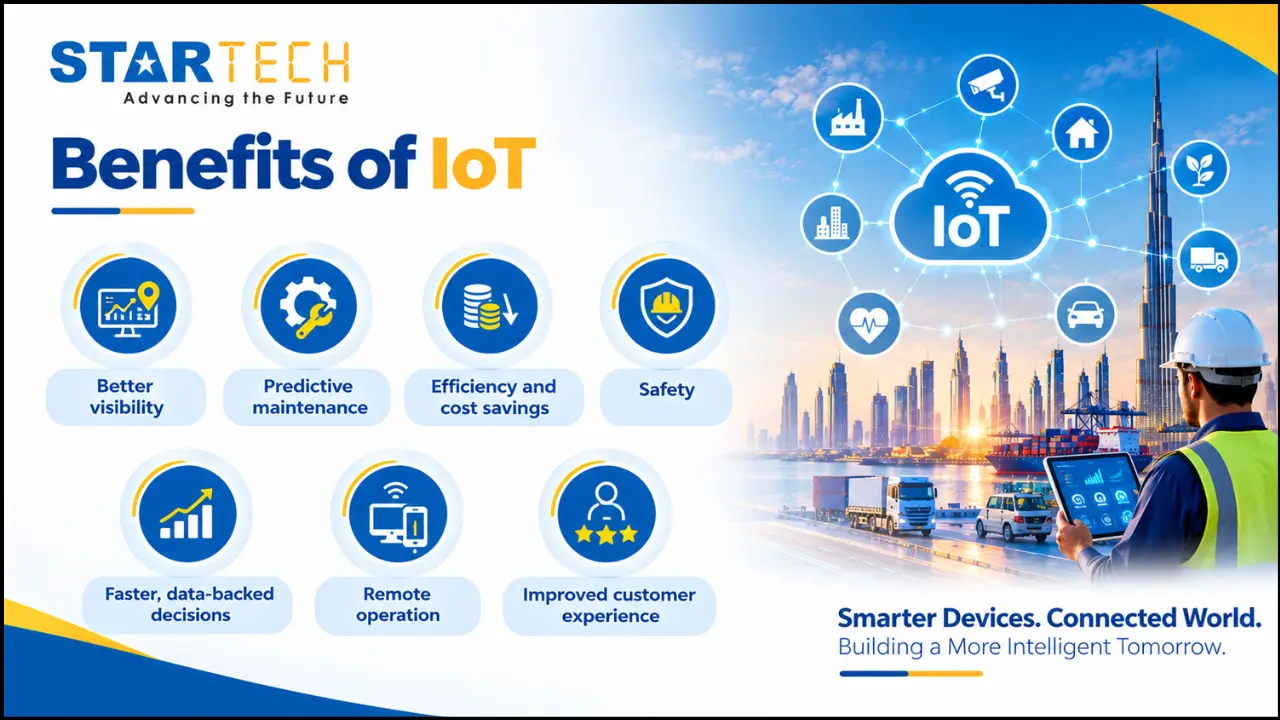
- Better visibility. You see what your equipment, buildings or fleet are doing in real time, not after the fact.
- Predictive maintenance. Fix problems before they cause downtime, which usually costs far more than the repair itself.
- Efficiency and cost savings. Cut wasted energy, water and materials by acting on real data.
- Safety. Monitor hazardous areas and get early warnings without sending people into danger.
- Faster, data-backed decisions. Managers work from live numbers instead of monthly reports.
- Remote operation. Manage sites that are far away or hard to reach.
- Improved customer experience. Track orders, respond quickly and personalise services.
One point deserves honesty: the benefits depend on doing the basics well. A badly planned IoT project gives you more dashboards, not more value.