
The Future of SEO in 2026: How AI, Content Strategy, and Search Behavior Are Changing the Rules
The future of SEO is not a distant future. It’s already transforming how businesses are discovered online. SEO has shifted away from ranking pages solely on keywords and backlinks to look at intent and context as well as trust at a higher level. Artificially generated summaries, conversational searches, and the shift in user behavior indicate that strategies that worked five years ago don’t have the same effect when utilized by themselves.
Making SEO strategies that can last over time and not merely strategies that are designed to last through any algorithm updates requires a solid foundation of know-how, actual expertise, and trustworthiness that is proven.
This guide provides a roadmap of where SEO will take us in the year 2026. We also discuss the increasing importance for AI SEO services, the rising importance that AI SEO capabilities play in AI SEO capabilities, and the reasons why seo and content strategy must be used in tandem rather than as two distinct tasks.
How AI Is Rewriting the Search Landscape
The future of SEO is being shaped by how much search behavior has changed more rapidly over the last two years than during the past decade. Some patterns stand out:
- AI Summary pages are transforming how people click
Industry research on AI-generated search results has repeatedly demonstrated the fact that the moment an AI summary responds to a query directly on the search results page, fewer people visit individual websites, even though the overall visibility (impressions) increases. Certain analysts refer to this gap between growing views and decreasing clicks as “the great decoupling.”
- AI tool use is increasing
A growing share of marketers are now using Artificial intelligence(AI) tools for regularly creating content as well as keyword research and optimization, but the adoption rate among ordinary users is less clear, as many users still opt for traditional search methods for high-risk or more complex queries.
- Search intent is diversifying
Beyond the classic informational, navigational, transactional, and commercial-investigation intents, a newer “AI-native” intent is emerging – users asking layered, conversational questions and expecting a synthesized answer rather than a list of links.
The key insight about the future of SEO, the importance of visibility isn’t just about getting into the traditional top 10 positions. It’s about being the point of reference AI systems draw on when they come up with an answer, as well as the metrics that go into it, differing from the click-through rate that the majority of SEO reports have tracked historically.
AI SEO Service: Why It's Becoming Essential, Not Optional
An AI SEO service is more than just traditional optimization. It analyzes the performance of content through AI Overviews Chat-based assistants, chat-based tools, and search engines that generate results that go beyond traditional blue-link results.
With more and more people turning to AI-generated or conversational responses, business owners need a strategy designed specifically around the way these systems choose the right information, interpret it, and then present it to users data.
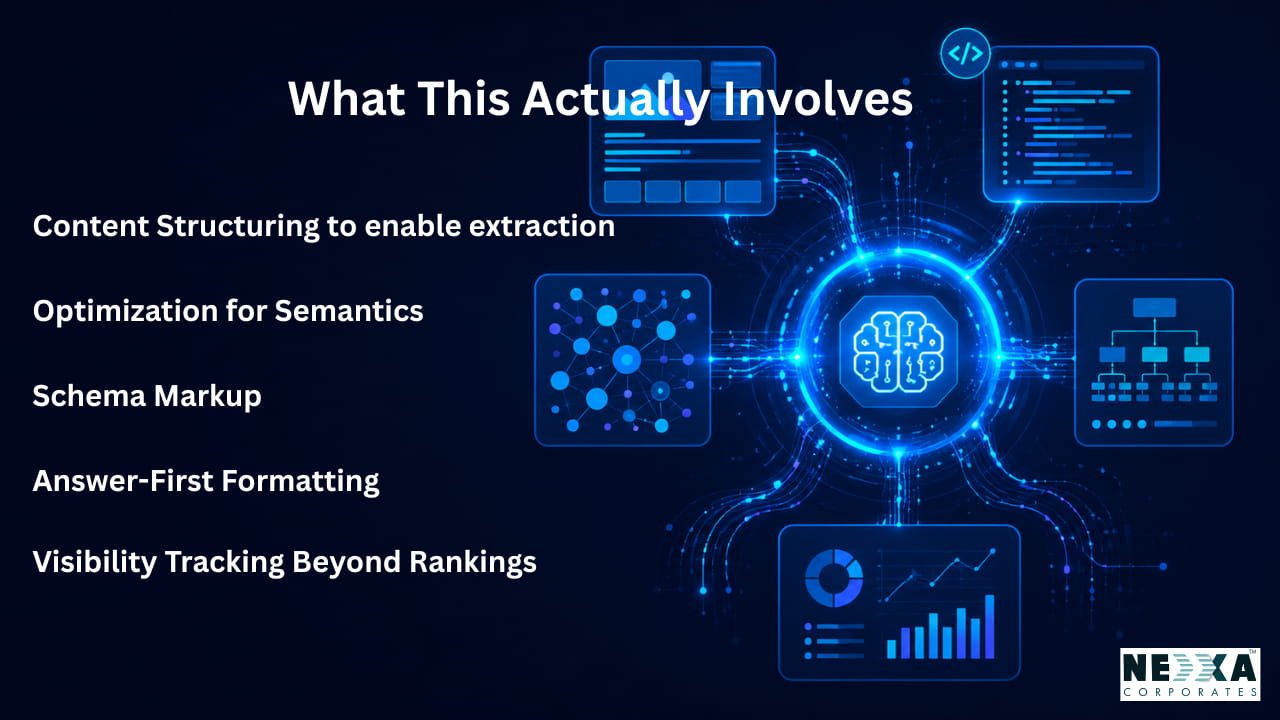
What This Actually Involves
Content Structuring to enable extraction
This is done by using clear headings, simple responses, and parts that AI systems can quickly synthesize. Content that is divided into sensible, scannable sections tends to be integrated into AI overviews and chat responses more effectively than lengthy unstructured text blocks. This can also increase the comprehension of humans, providing an advantage of two kinds: better AI extraction and a more pleasant user experience.
Optimization for Semantics
This is when you write about themes and goals instead of focusing on specific keywords, and anticipating the larger query that a user wants to answer, rather than focusing only on one keyword. Semantic optimization can help content remain relevant across a variety of related queries and variations in phrasing, which are particularly important because conversational search continues to grow.
Answer-First Formatting
This is a way of guiding sections using an easy, concise answer before proceeding to provide more information. This is similar to how AI systems usually collect information, pulling an encapsulated summary first, and then referring to additional details if required. This is also in line with how people consume content, particularly when using mobile or voice-based gadgets, in which a rapid and clear answer is required at the beginning.
Visibility Tracking Beyond Rankings
his requires checking the degree of content appearing in AI-generated summaries and not only tracking position 1-10 within traditional results. This requires a change in reporting – away from the click-through rate and the ranking position as a whole, to determining the frequency of citations, appearances in AI Overviews, and the share of voice across all generative platforms. Businesses that only track traditional rankings may miss warning indications of declining or increasing popularity in these emerging formats.
Generative Engine Optimization and the Rise of LLM SEO
A more recent discipline is in line with the traditional SEO. It’s called Generative Engine Optimization (GEO), also called Answer Engine Optimization (AEO). It is focused on having information selected, cited, and analyzed by AI systems like Google’s AI Overviews, ChatGPT, and other big models of language.
This shift toward AI-driven answers is exactly why understanding the future of SEO now means understanding how LLMs interpret content, not just how search engines rank it.This is closely linked to what’s now known as LLM SEO – a process that optimizes your website so AI models understand and reference your content with precision. In the real world, that refers to:
- Writing in a clear, factual, and well-sourced language that is easy for a model to deduce and then summarize
- The building of authority on a topic through extensive and well-linked content clusters, instead of single posts
- Updated content: Research on AI is consistent in showing that newly published or updated pages are cited more frequently than stagnant, older pages.
- Real authority signals authentic author credentials, original information, and even citations, which make a website better suited to being cited as an authoritative source.
Traditional keyword optimization won’t go out of style, but it’s only one of many layers. The ability to adapt to the future of SEO, not a rigid checklist, is what distinguishes websites that remain visible from those that slide away.
Why SEO and Content Strategy Can No Longer Be Separate Functions
- Topic clusters rather than individual keywords
Create interlinked content around themes, rather than just one keyword per page.
- Map of intent
determining the reasons why people are searching for the term, not just what the term means, and creating the content around that.
- E-E-A-T-driven plan
which involves subject-matter input, citing credible sources, and is based on real personal experience.
- Content refreshes are scheduled
updating pages on a regular basis instead of only releasing new pages and letting the old content deteriorate.
- Coverage in multiple formats
Linking textual content and video with structured information or interactive elements to mimic how people browse.
Brands that integrate SEO into the planning phase of content, instead of putting it on later, have seen much longer-lasting results as the nature of search changes over time.
Brand Visibility Beyond Your Website
A component that’s getting as important as backlinks is how your brand’s name is referenced across the internet, and not only on your domain. AI systems increasingly draw inspiration from forums, community platforms, and third-party discussion forums when they generate responses, and not only from the official pages of your brand.
This signifies:
The community presence is crucial. Genuine, helpful involvement in relevant discussions (Reddit threads and industry forums, as well as Q&A platforms) can affect the likelihood that your brand is highlighted when AI tools are used to summarize a subject.
Third-party citations are often regarded as having more importance than self-published assertions. A brand mentioned positively within an independently reviewed or comparison article is generally regarded as trustworthy by both users and AI systems, much more so than a similar assertion on the brand’s own website.
Share-of-voice tracking is becoming an actual measure. Monitoring how often (and how precisely) your brand appears in AI-generated responses is emerging as an alternative to traditional rank tracking.This growing focus on where and how your brand appears across the web is becoming a defining part of the future of SEO.
Businesses that used to focus solely on their website’s SEO represent an evolution toward the future of SEO, where visibility now extends to conversations about your brand’s name on the web, not only those pages that you directly control.This is another reason seo and content strategy now have to be planned together from day one.
E-E-A-T: From Ranking Factor to Central Requirement
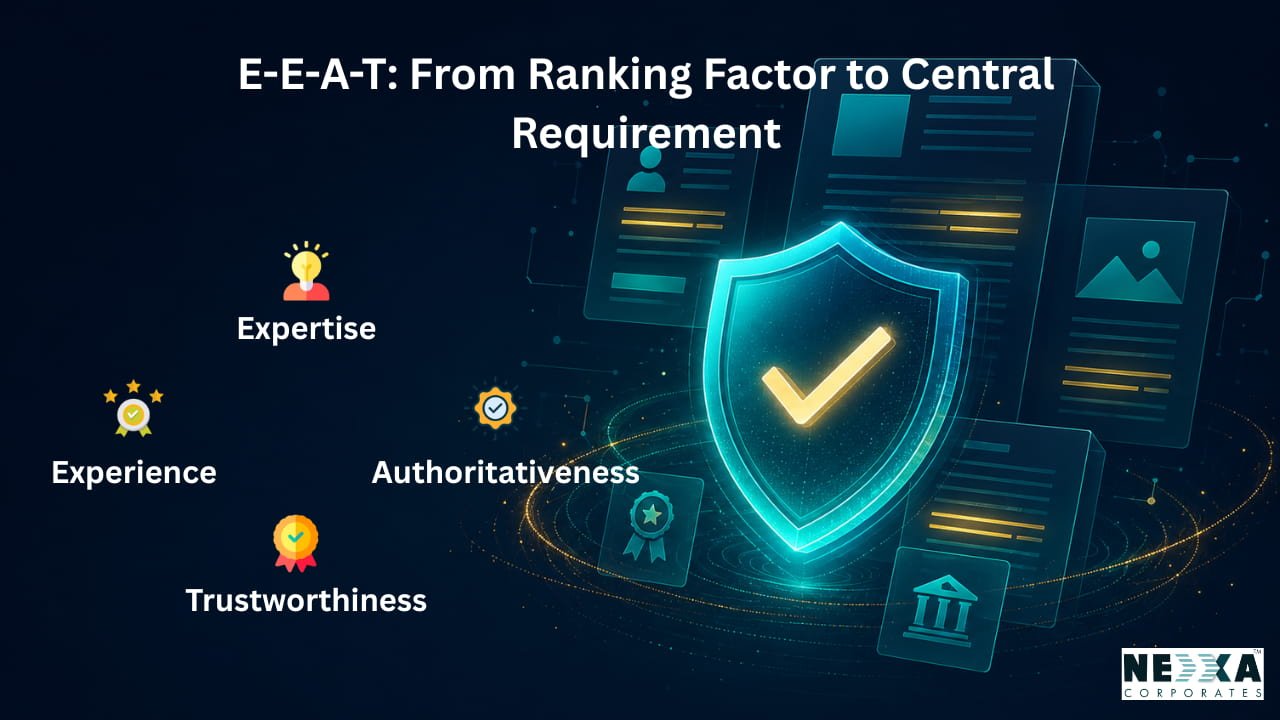
1. Experience
Sharing personal results, such as case studies and actual results of clients, instead of general guidance. This is about going beyond just the description of what a service can do and instead describing the results when it was actually utilized with real numbers as well as real timelines and actual challenges that were worked through.
Content based on lived experiences is much more difficult to replicate on a large scale than general guidance, which is the reason it has more credibility in the eyes of both AI users and systems.
2. Expertise
Utilizing accredited authors and naming subject matter contributors with clear author bios. This requires the use of authentic names, credentials, as well as relevant backgrounds to the content, instead of publishing under an unrelated “admin” byline.
The visible evidence of expertise, like certifications and years of experience or specific industry expertise, can help readers as well as AI systems assess whether the person who wrote the content is actually knowledgeable about the subject rather than simply reciting information that has been found elsewhere.
3. Authoritativeness
In addition, you can earn backlinks and citations through trustworthy and reliable sources. It’s more about the quantity of links and more about the people connecting or referring to the content. A reference in a reputable industry publication or from an acclaimed person is much more important than hundreds of low-quality directories. With time, constant recognition from trusted external sources creates an image that search engines as well as AI models are able to trust.
4. Trustworthiness
Maintaining content that is accurate, well-sourced, and clear, with transparent information about the business and contact information. This includes avoiding vague or unsubstantiated claims, using reliable sources when making claims that are factual and making it simple for readers to identify who’s responsible for the information.
Simple indicators – such as an actual address, working information about contact and clear disclosure of any commercial relationship – can reassure both the user and algorithms that it has come from a reliable, trustworthy source.
What Happens When Brands Don't Adapt
Falling behind on the future of SEO and delaying an AI SEO service — doesn’t always look like a major issue at first – it’s more likely to occur slowly:
Declining AI Visibility
Visibility gradually diminishes from AI-generated results even as the traditional ranking of keywords appears steady, due to AI systems drawing information from more well-structured, other sources instead.
Competitors Gaining Ground
Competitors are now the primary source for AI overviews and chat responses, helping to establish brand recognition and trust that could otherwise be yours.
Growing Analytics Blind Spots
Blind spots of analytics increase as AI referral traffic, share of voice, and citation frequency can’t be tracked by rank-tracking software — which means a business may be losing ground without any warning indicators of the metrics they’re used to track.
Zero-Click Search and the Changing Results Page
Highlighted snippets, AI Overviews, and knowledge panels indicate that a greater percentage of users receive answers without visiting the website. This is a shift in the meaning of what “ranking well” actually means.Zero-click behavior is one of the clearest signs of the future of SEO already arriving.
AI-Generated Summaries
Appear in highlighted snippets of content, without the need to click.
Voice & Conversational Structure
The structure is designed to accommodate voice search and conversational questions.
Findability Goal
The goal is to make important information easy to find, as it’s how information is usually presented, even as a no-click result.
Technical SEO Still Matters - It's the Foundation, Not the Whole Picture
With all the changes, technical SEO isn’t becoming optional. It’s the foundation that allows everything else to function. Technical SEO remains a core part of the future of SEO, not a separate concern. Businesses must continue to put the following priorities first:
- Site Speed-Vital Web Content and overall speed of the site.
- Mobile-First Design -Design that is mobile first, as the majority of internet traffic is now coming from mobile devices.
- Structured Data (Schema Markup)-Helps both AI and traditional systems understand pages accurately.
- Clean Website Structure-Clean website structure with the ability to link internally in a way that both crawlers and users can navigate easily.
This is exactly the technical layer a proper AI SEO service should audit before any content work begins
How Businesses Can Prepare for What's Next
Preparing for the future of SEO starts with these five steps:
- Review existing content for compliance with E-E-A-T standards and find out the areas where authorship or expertise signals are not present.
- Combine SEO and content strategy starting at the beginning of the plan, but not just after an initial draft has been written.
- Build an AI SEO service capability either through internal training or a specially trained partner.
- Track the visibility of AI-generated results as well as brand mentions on the web and beyond, not only traditional rankings for keywords.
- Prioritize original content over content that is generic, in particular, since AI helps make shallow content easier to create at a large scale.
Conclusion
The future of SEO isn’t about adjusting to each algorithm update or trying to catch every new AI feature that search engines launch. It’s about creating a solid foundation based on genuine experience, well-structured content, and technical dependability that will hold up no matter how the search interface evolves.
AI is transforming the way people search for information, but the fundamental principle driving it hasn’t changed — real value for users remains the goal. Companies that approach SEO and content strategy as an integrated field, rather than two distinct tasks handled by two separate teams, will be better prepared.
As generative search — including voice search and AI-driven summaries — takes up a larger part of how people browse, investing in a true AI SEO service now isn’t about keeping pace with the latest trends; it’s about future-proofing your brand’s visibility for whatever the future of SEO looks like next.
FAQ
1. Is SEO being replaced by AI?
No. SEO is changing and not going away. AI has altered the way results are generated and presented; however, businesses require strong optimization in order to be prominent in both traditional and AI-driven searches.
2. What SEO professionals require going forward?
Beyond core technical and keyword knowledge, experts will need to be skilled in the strategy of content, structured data AI/LLM optimization, as well as understanding performance data across different surface types of search.This is why seo and content strategy skills increasingly live in the same role rather than separate teams
3. Should businesses consider investing in the AI SEO service right now?
Yes. AI-driven SEO results are already available in large numbers across all major engines. Companies that are able to adapt before the shift are at an advantage over those who wait for the change to fully take place.
4. What is Generative Engine Optimization (GEO), and is it different from SEO?
GEO, or Answer Engine Optimization (AEO), focuses on getting content cited or summarized by AI systems like AI Overviews and chat assistants. It works alongside SEO, since the same authoritative, well-structured content performs in both classic rankings and AI answers.
5. If zero-click searches reduce website visits, why should businesses still invest in SEO?
Appearing in AI Overviews, featured snippets, and knowledge panels builds brand credibility even without a click. Businesses that get featured early build trust competitors miss out on — even if it doesn’t show up as direct traffic.